. 2016 Feb 24;138(7):2098-101.
doi: 10.1021/jacs.5b12301. Epub 2016 Feb 12.

Iminoboronate-Based Peptide Cyclization That Responds to pH, Oxidation, and Small Molecule Modulators

Affiliations

Iminoboronate-Based Peptide Cyclization That Responds to pH, Oxidation, and Small Molecule Modulators

Anupam Bandyopadhyay et al. J Am Chem Soc. .

Abstract

As a rich source of therapeutic agents, peptide natural products usually adopt a cyclic or multicyclic scaffold that minimizes structural flexibility to favor target binding. Inspired by nature, chemists have been interested in developing synthetic cyclic and multicyclic peptides that serve as biological probes and potential therapeutics. Herein we describe a novel strategy for peptide cyclization in which intramolecular iminoboronate formation allows spontaneous cyclization under physiologic conditions to yield monocyclic and bicyclic peptides. Importantly the iminoboronate-based cyclization can be rapidly reversed in response to multiple stimuli, including pH, oxidation, and small molecules. This highly versatile strategy for peptide cyclization should find applications in many areas of chemical biology.


Figures
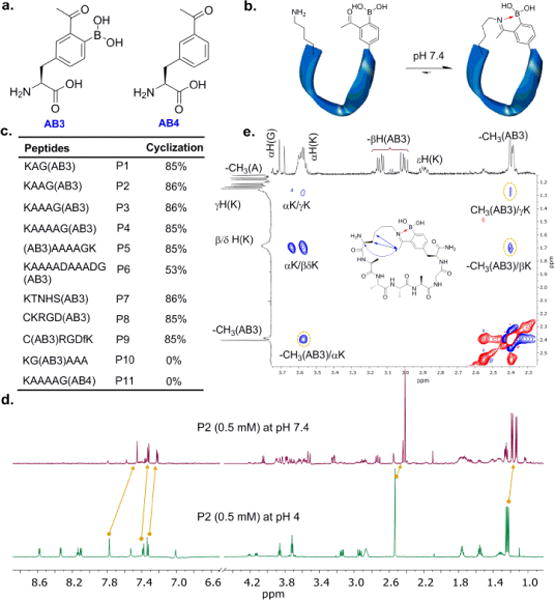
Fig.1
Fig.1
Iminoboronate-mediated peptide cyclization. a) Structure of the unnatural amino acids designed for iminoboronate chemistry; b) illustration of the iminoboronate-based peptide cyclization; c) peptide sequences and their cyclization efficiency at pH 7.4; % cyclization was determined by 1H-NMR with peptides at 0.5 mM, which is significantly lower than the Kd values of intermolecular iminoboronate formation (Figure S2). d) 1H-NMR spectra of P2 illustrating the pH-dependent cyclization; e) ROESY spectrum of P4 showing NOEs between AB3 and Lys.
Fig.2
Fig.2
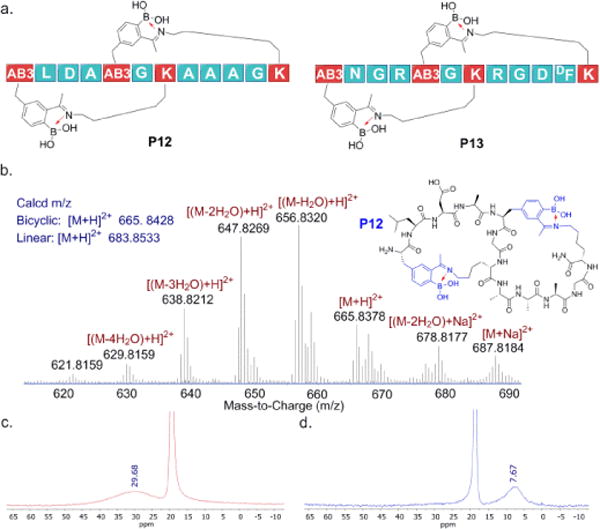
Iminoboronate-mediated peptide bicyclization. a) Peptide sequences designed for bicyclization; b) mass spectrum of P12 at pH 7.4; c) 11B-NMR spectrum of P12 at pH 4.0; d) 11B-NMR spectrum of P12 at pH 7.4. The truncated peaks at 20 ppm are from boric acid used as internal reference. The characterization data of P13 are included in Fig. S17, SI.
Fig. 3
Fig. 3
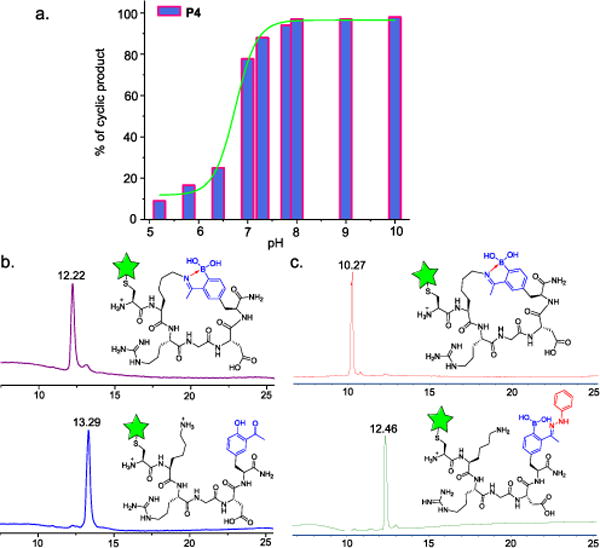
Iminoboronate-cyclized peptides responding to various stimuli. a) pH titration curves showcasing the sharp pH sensitivity of the iminoboronate-mediated peptide cyclization; b) LC chromatograms demonstrating the quick oxidation of AF488-P8 by peroxynitrite; c) LC traces showing linearization of AF488-P8 by phenylhydrazine.
Fig. 4
Fig. 4
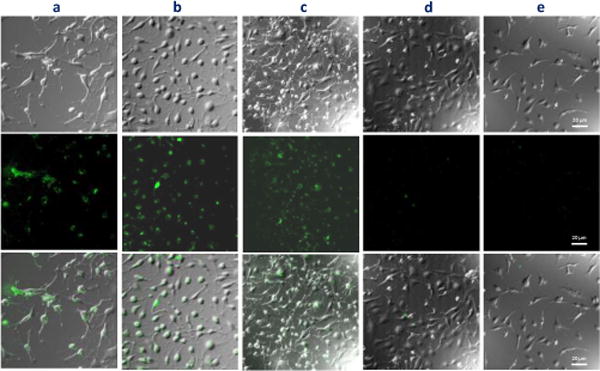
Integrin binding of an iminoboronate-cyclized peptide. The images shown are phase contrast (top), fluorescence (middle) and overlay (bottom) respectively. a) AF488-P14 at pH 7.4; b) AF488-P9 at pH 7.4; c) AF488-P14 at pH 6.0; d) AF488-P9 at pH 6.0; e) AF488-P9L, a phenylhydrazine conjugate of AF488-P9 at pH 7.4. All peptides were used at 10 μM concentration for the cell binding studies. Scale bar: 20 μm.
Fig. 5
Fig. 5
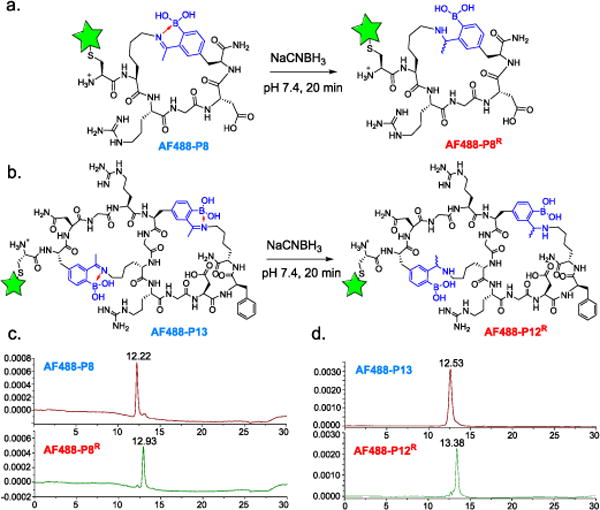
Iminoboronate reduction yielding permanently cyclized peptides. a) Schematic illustration of the iminoboronate reduction to give irreversible peptide cyclization; b) LC chromatograms of AF488-P8 before (top) and after (bottom) reduction; c) LC chromatograms of AF488-P13 before (top) and after reduction (bottom) reduction.

References

    1. Baeriswyl V, Heinis C. ChemMedChem. 2013;8:377. - PubMed
    1. Bock JE, Gavenonis J, Kritzer JA. ACS Chem Biol. 2013;8:488. - PMC - PubMed
    1. Passioura T, Katoh T, Goto Y, Suga H. Annu Rev Biochem. 2014;83:727. - PubMed
    1. Heinis C, Winter G. Curr Opin Chem Biol. 2015;26:89. - PubMed
    1. Goto Y, Ohta A, Sako Y, Yamagishi Y, Murakami H, Suga H. ACS Chem Biol. 2008;3:120. - PubMed

Publication types

MeSH terms