


Physiological Reduction in Left Ventricular Contractile Function in Healthy Postpartum Women: Potential Overlap with Peripartum Cardiomyopathy
- PMID: 26859567
- PMCID: PMC4747599
- DOI: 10.1371/journal.pone.0147074
Physiological Reduction in Left Ventricular Contractile Function in Healthy Postpartum Women: Potential Overlap with Peripartum Cardiomyopathy
Abstract
Aims: Peripartum cardiomyopathy is a potentially life-threatening cause of heart failure, commoner in Afro-Caribbean than Caucasian women. Its diagnosis can be challenging due to physiological changes in cardiac function that also occur in healthy women during the early postpartum period. This study aimed to (i) establish the overlap between normal cardiac physiology in the immediate postpartum period and pathological changes in peripartum cardiomyopathy ii) identify any ethnicity-specific changes in cardiac function and cardiac biomarkers in healthy postpartum women.
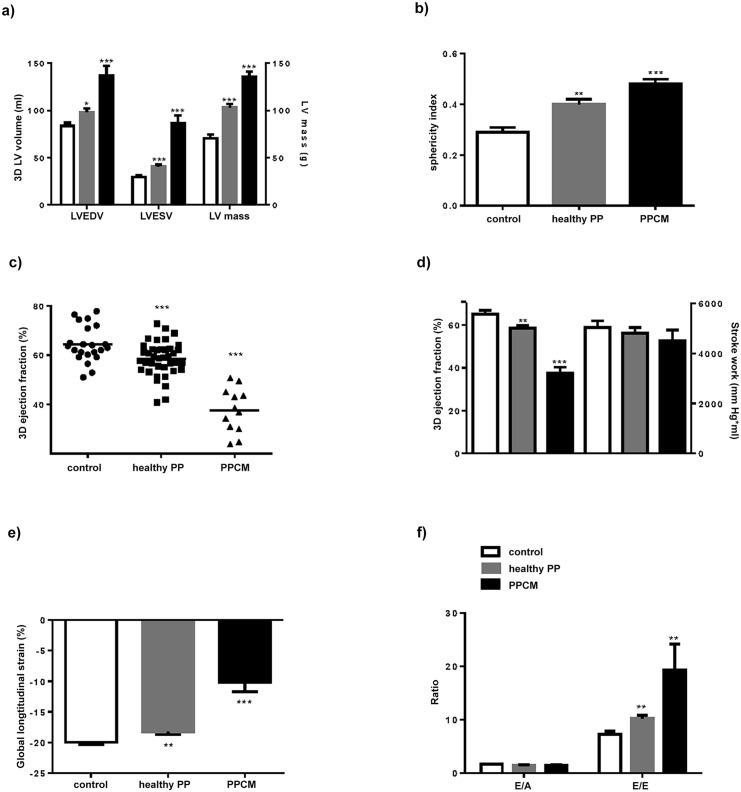
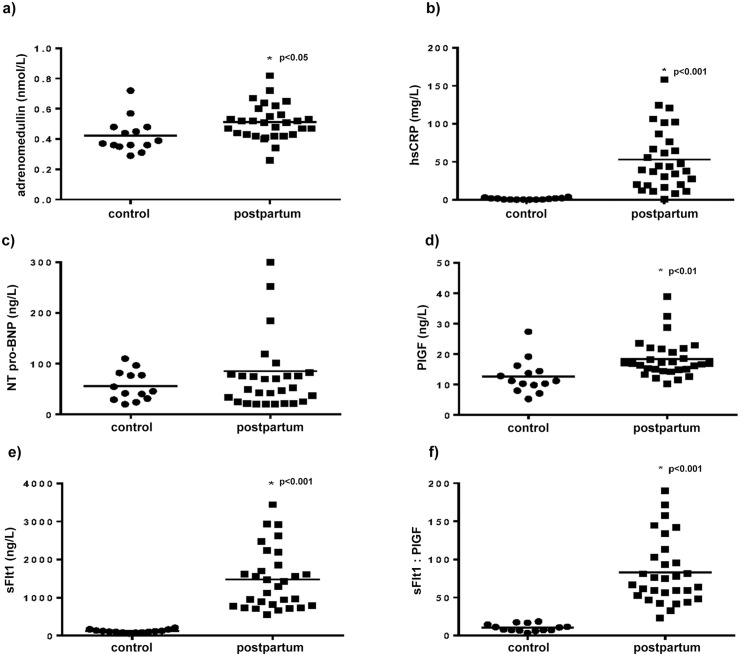
Methods and results: We conducted a cross-sectional study of 58 healthy postpartum women within 48 hours of delivery and 18 matched non-pregnant controls. Participants underwent cardiac assessment by echocardiography and strain analysis, including 3D echocardiography in 40 postpartum women. Results were compared with 12 retrospectively studied peripartum cardiomyopathy patients. Healthy postpartum women had significantly higher left ventricular volumes and mass, and lower ejection fraction and global longitudinal strain than non-pregnant controls. These parameters were significantly more impaired in peripartum cardiomyopathy patients but with overlapping ranges of values. Healthy postpartum women had higher levels of adrenomedullin, placental growth factor (PlGF) and soluble fms-like tyrosine kinase-1 (sFlt1) compared to controls. The postpartum state, adrenomedullin, sFlt1 and the sFlt1:PlGF ratio were independent predictors of LV remodelling and function in healthy postpartum women.
Conclusion: Healthy postpartum women demonstrate several echocardiographic indicators of left ventricular remodelling and reduced function, which are associated with altered levels of angiogenic and cardiac biomarkers.
Conflict of interest statement
Figures
References
-
- Sliwa K, Hilfiker-Kleiner D, Petrie MC, Mebazaa A, Pieske B, Buchmann E, et al. Current state of knowledge on aetiology, diagnosis, management, and therapy of peripartum cardiomyopathy: a position statement from the Heart Failure Association of the European Society of Cardiology Working Group on peripartum cardiomyopathy. European journal of heart failure. 2010;12(8):767–78. 10.1093/eurjhf/hfq120 . - DOI - PubMed
-
- Sliwa K, Hilfiker-Kleiner D, Mebazaa A, Petrie MC, Maggioni AP, Regitz-Zagrosek V, et al. EURObservational Research Programme: a worldwide registry on peripartum cardiomyopathy (PPCM) in conjunction with the Heart Failure Association of the European Society of Cardiology Working Group on PPCM. European journal of heart failure. 2014;16(5):583–91. 10.1002/ejhf.68 . - DOI - PubMed
-
- Bamfo JE, Kametas NA, Nicolaides KH, Chambers JB. Reference ranges for tissue Doppler measures of maternal systolic and diastolic left ventricular function. Ultrasound in obstetrics & gynecology: the official journal of the International Society of Ultrasound in Obstetrics and Gynecology. 2007;29(4):414–20. Epub 2007/03/03. 10.1002/uog.3966 . - DOI - PubMed
-
- Bamfo JE, Kametas NA, Nicolaides KH, Chambers JB. Maternal left ventricular diastolic and systolic long-axis function during normal pregnancy. European journal of echocardiography: the journal of the Working Group on Echocardiography of the European Society of Cardiology. 2007;8(5):360–8. 10.1016/j.euje.2006.12.004 . - DOI - PubMed
Publication types
MeSH terms
Substances
Grants and funding
LinkOut - more resources
Full Text Sources
Other Literature Sources
Miscellaneous
