


Prenatal Arsenic Exposure and Birth Outcomes among a Population Residing near a Mining-Related Superfund Site
- PMID: 26859631
- PMCID: PMC4977047
- DOI: 10.1289/ehp.1510070
Prenatal Arsenic Exposure and Birth Outcomes among a Population Residing near a Mining-Related Superfund Site
Abstract
Background: Limited epidemiologic data exist on prenatal arsenic exposure and fetal growth, particularly in the context of co-exposure to other toxic metals.
Objective: We examined whether prenatal arsenic exposure predicts birth outcomes among a rural U.S. population, while adjusting for exposure to lead and manganese.
Methods: We collected maternal and umbilical cord blood samples at delivery from 622 mother-infant pairs residing near a mining-related Superfund site in Northeast Oklahoma. Whole blood arsenic, lead, and manganese were measured using inductively coupled plasma mass spectrometry. We modeled associations between arsenic concentrations and birth weight, gestational age, head circumference, and birth weight for gestational age.
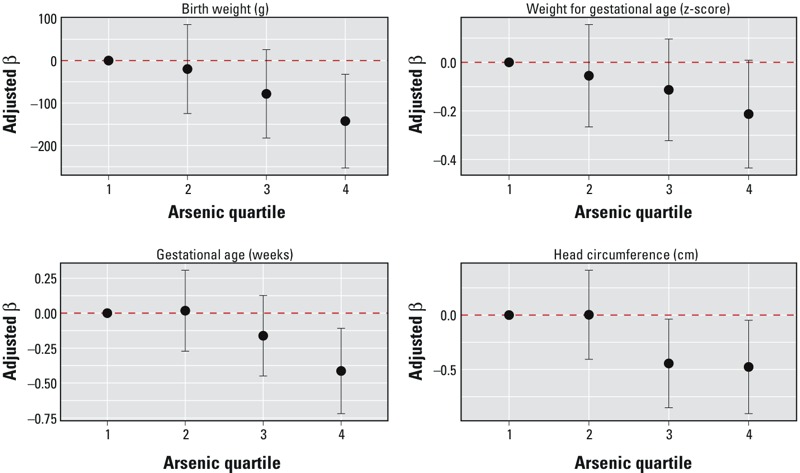
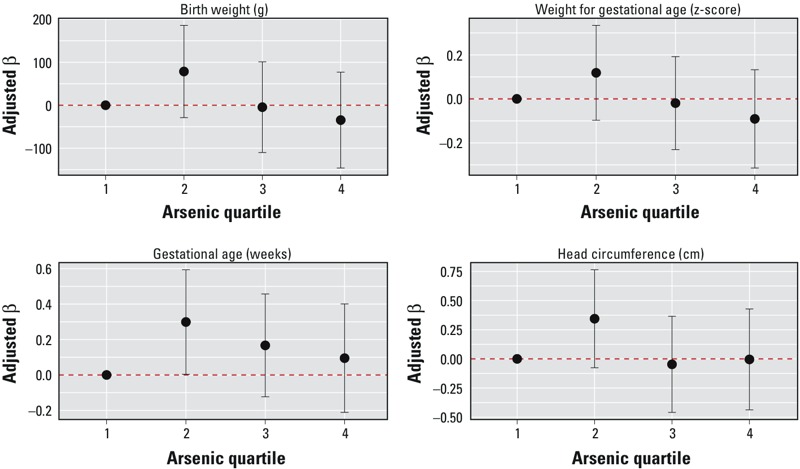
Results: Median (25th-75th percentile) maternal and umbilical cord blood metal concentrations, respectively, were as follows: arsenic, 1.4 (1.0-2.3) and 2.4 (1.8-3.3) μg/L; lead, 0.6 (0.4-0.9) and 0.4 (0.3-0.6) μg/dL; manganese, 22.7 (18.8-29.3) and 41.7 (32.2-50.4) μg/L. We estimated negative associations between maternal blood arsenic concentrations and birth outcomes. In multivariable regression models adjusted for lead and manganese, an interquartile range increase in maternal blood arsenic was associated with -77.5 g (95% CI: -127.8, -27.3) birth weight, -0.13 weeks (95% CI: -0.27, 0.01) gestation, -0.22 cm (95% CI: -0.42, -0.03) head circumference, and -0.14 (95% CI: -0.24, -0.04) birth weight for gestational age z-score units. Interactions between arsenic concentrations and lead or manganese were not statistically significant.
Conclusions: In a population with environmental exposure levels similar to the U.S. general population, maternal blood arsenic was negatively associated with fetal growth. Given the potential for relatively common fetal and early childhood arsenic exposures, our finding that prenatal arsenic can adversely affect birth outcomes is of considerable public health importance.
Citation: Claus Henn B, Ettinger AS, Hopkins MR, Jim R, Amarasiriwardena C, Christiani DC, Coull BA, Bellinger DC, Wright RO. 2016. Prenatal arsenic exposure and birth outcomes among a population residing near a mining-related Superfund site. Environ Health Perspect 124:1308-1315; http://dx.doi.org/10.1289/ehp.1510070.
Conflict of interest statement
Within the last 3 years, D.C.B. has provided paid expert witness testimony in several civil litigation cases involving exposure to neurotoxicants. D.C.B. has also provided expert witness testimony in a criminal case on behalf of the Capital Punishment Project of the American Civil Liberties Union. and is a paid member of the Biology and Medicine Panel of the Research Grants Council of Hong Kong. R.J. is employed by Local Environmental Action Demanded (L.E.A.D.) Agency, Inc., Vinita, OK, a 501 c 3 organization. The goals of L.E.A.D. are to educate the community on environmental concerns in Northeast Oklahoma, including conducting environmental workshops and seminars; to counter environmental hazards that put local communities at risk; and to partner with other environmental organizations throughout Oklahoma and the nation to address environmental hazards.
The other authors declare they have no actual or potential competing financial interests.
Figures
References
-
- ACOG (American College of Obstetricians and Gynecologists) Committee opinion no 611: method for estimating due date. Obstet Gynecol. 2014;124:863–866. - PubMed
-
- Ahmed S, Ahsan KB, Kippler M, Mily A, Wagatsuma Y, Hoque AM, et al. In utero arsenic exposure is associated with impaired thymic function in newborns possibly via oxidative stress and apoptosis. Toxicol Sci. 2012;129:305–314. - PubMed
-
- American College of Obstetricians and Gynecologists. ACOG practice bulletin no. 95: anemia in pregnancy. Obstet Gynecol. 2008;112(1):201–207. - PubMed
Publication types
MeSH terms
Substances
Grants and funding
LinkOut - more resources
Full Text Sources
Other Literature Sources
Medical
Research Materials