


Covered versus Uncovered Self-Expandable Metal Stents for Managing Malignant Distal Biliary Obstruction: A Meta-Analysis
- PMID: 26859673
- PMCID: PMC4747571
- DOI: 10.1371/journal.pone.0149066
Covered versus Uncovered Self-Expandable Metal Stents for Managing Malignant Distal Biliary Obstruction: A Meta-Analysis
Abstract
Aim: To compare the efficacy of using covered self-expandable metal stents (CSEMSs) and uncovered self-expandable metal stents (UCSEMSs) to treat objective jaundice caused by an unresectable malignant tumor.
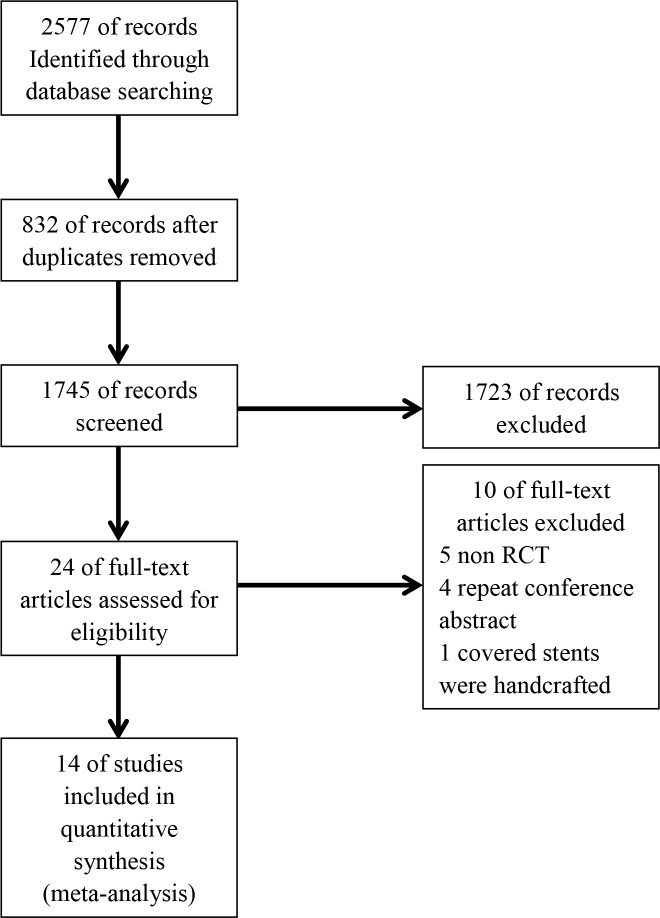
Methods: We performed a comprehensive electronic search from 1980 to May 2015. All randomized controlled trials comparing the use of CSEMSs and UCSEMSs to treat malignant distal biliary obstruction were included.
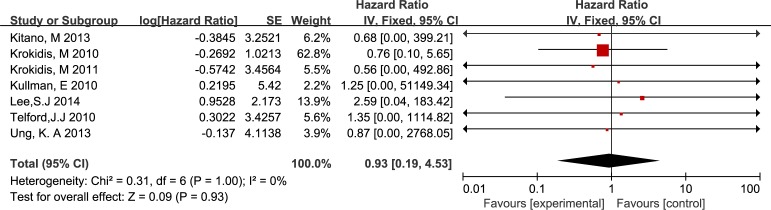
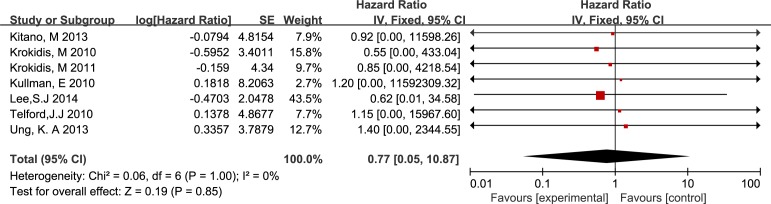
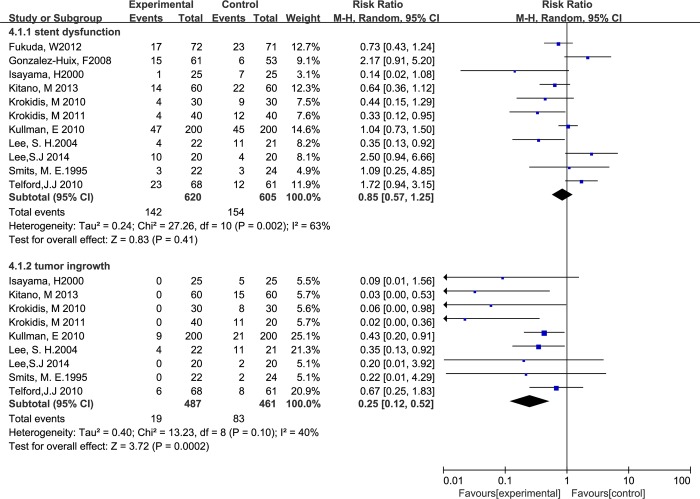
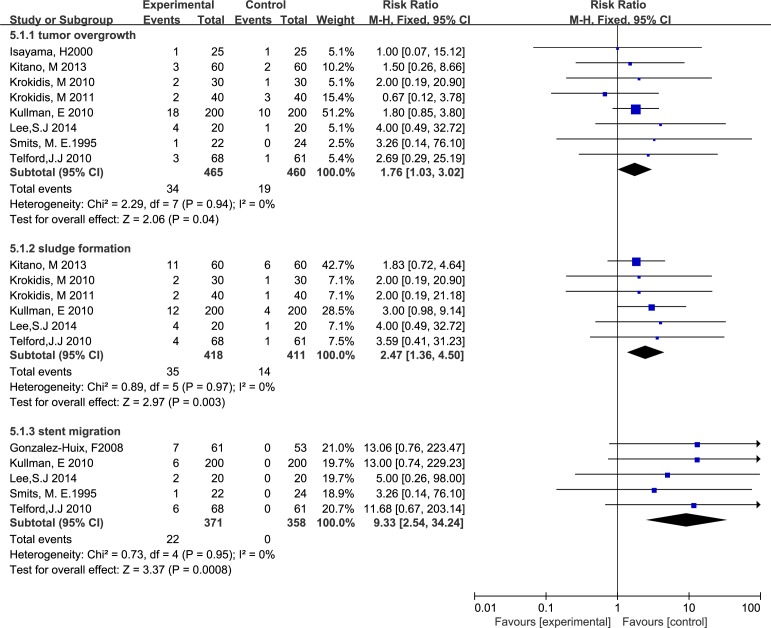
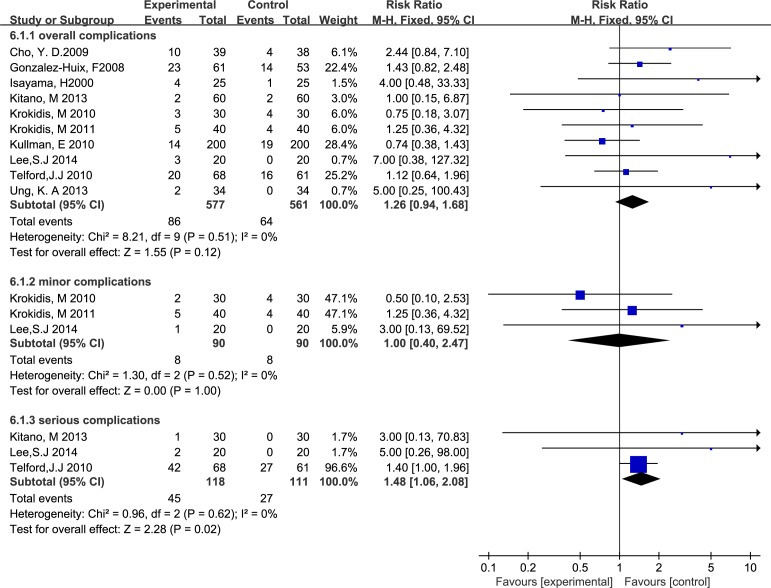
Results: The analysis included 1417 patients enrolled in 14 trials. We did not detect significant differences between the UCSEMS group and the CSEMS group in terms of cumulative stent patency (hazard ratio (HR) 0.93, 95% confidence interval (CI) 0.19-4.53; p = 0.93, I2 = 0%), patient survival (HR 0.77, 95% CI 0.05-10.87; p = 0.85, I2 = 0%), overall stent dysfunction (relative ratio (RR) 0.85, M-H, random, 95% CI 0.57-1.25; p = 0.83, I2 = 63%), the overall complication rate (RR 1.26, M-H, fixed, 95% CI 0.94-1.68; p = 0.12, I2 = 0%) or the change in serum bilirubin (weighted mean difference (WMD) -0.13, IV fixed, 95% CI 0.56-0.3; p = 0.55, I2 = 0%). However, we did detect a significant difference in the main causes of stent dysfunction between the two groups. In particular, the CSEMS group exhibited a lower rate of tumor ingrowth (RR 0.25, M-H, random, 95% CI 0.12-0.52; p = 0.002, I2 = 40%) but a higher rate of tumor overgrowth (RR 1.76, M-H, fixed, 95% CI 1.03-3.02; p = 0.04, I2 = 0%). Patients with CSEMSs also exhibited a higher migration rate (RR 9.33, M-H, fixed, 95% CI 2.54-34.24; p = 0.008, I2 = 0%) and a higher rate of sludge formation (RR 2.47, M-H, fixed, 95% CI 1.36-4.50; p = 0.003, I2 = 0%).
Conclusions: Our meta-analysis indicates that there is no significant difference in primary stent patency and stent dysfunction between CSEMSs and UCSEMSs during the period from primary stent insertion to primary stent dysfunction or patient death. However, when taking further management for occluded stents into consideration, CSEMSs is a better choice for patients with malignant biliary obstruction due to their removability.
Conflict of interest statement
Figures

References
-
- Gwon DI, Ko GY, Kim JH, Yoon HK, Lee IS, Kim KA, et al. A comparative analysis of PTFE-covered and uncovered stents for palliative treatment of malignant extrahepatic biliary obstruction. AJR American journal of roentgenology. 2010;195(6):W463–9. Epub 2010/11/26. 10.2214/AJR.10.4658 . - DOI - PubMed
-
- Costamagna G, Tringali A, Reddy DN, Deviere J, Bruno M, Ponchon T, et al. A new partially covered nitinol stent for palliative treatment of malignant bile duct obstruction: a multicenter single-arm prospective study. Endoscopy. 2011;43(4):317–24. Epub 2011/03/02. 10.1055/s-0030-1256294 . - DOI - PubMed
-
- Beissert M, Wittenberg G, Sandstede J, Beer M, Tschammler A, Burghardt W, et al. Metallic stents and plastic endoprostheses in percutaneous treatment of biliary obstruction. Zeitschrift fur Gastroenterologie. 2002;40(7):503–10. . - PubMed
Publication types
MeSH terms
LinkOut - more resources
Full Text Sources
Other Literature Sources
