


A discrete choice experiment studying students' preferences for scholarships to private medical schools in Japan
- PMID: 26860992
- PMCID: PMC4748598
- DOI: 10.1186/s12960-016-0102-2
A discrete choice experiment studying students' preferences for scholarships to private medical schools in Japan
Abstract
Background: The shortage of physicians in rural areas and in some specialties is a societal problem in Japan. Expensive tuition in private medical schools limits access to them particularly for students from middle- and low-income families. One way to reduce this barrier and lessen maldistribution is to offer conditional scholarships to private medical schools.
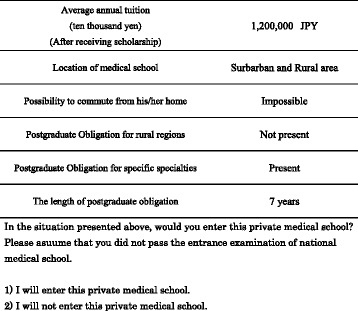
Methods: A discrete choice experiment is carried out on a total of 374 students considering application to medical schools. The willingness to receive a conditional scholarship program to private medical schools is analyzed.
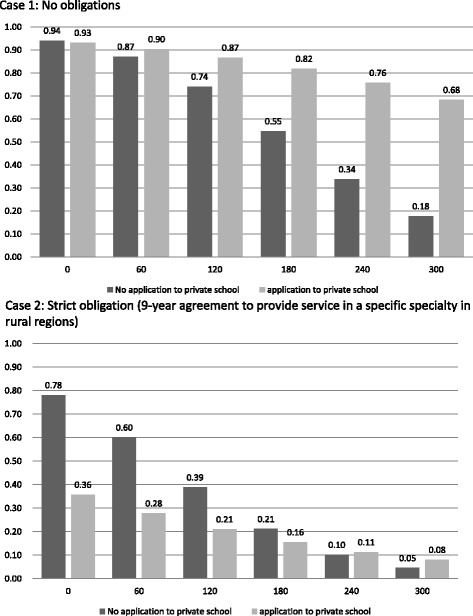
Results: The probability of attending private medical schools significantly decreased because of high tuition, a postgraduate obligation to provide a service in specific specialty areas, and the length of time of this obligation. An obligation to provide a service in rural regions had no significant effect on this probability. To motivate non-applicants to private medical schools to enroll in such schools, a decrease in tuition to around 1.2 million yen (US$ 12,000) or less, which is twice that of public schools, was found to be necessary. Further, it was found that non-applicants to private medical schools choose to apply to such schools even with restrictions if they have tuition support at the public school level.
Conclusions: Conditional scholarships for private medical schools may widen access to medical education and simultaneously provide incentives to work in insufficiently served areas.
Figures
References
-
- Organization for Economic Co-operation and Development(OECD) OECD health data 2013. Paris: OECD; 2013.
Publication types
MeSH terms
LinkOut - more resources
Full Text Sources
Other Literature Sources
Medical
