


Marine Origin Polysaccharides in Drug Delivery Systems
- PMID: 26861358
- PMCID: PMC4771987
- DOI: 10.3390/md14020034
Marine Origin Polysaccharides in Drug Delivery Systems
Abstract
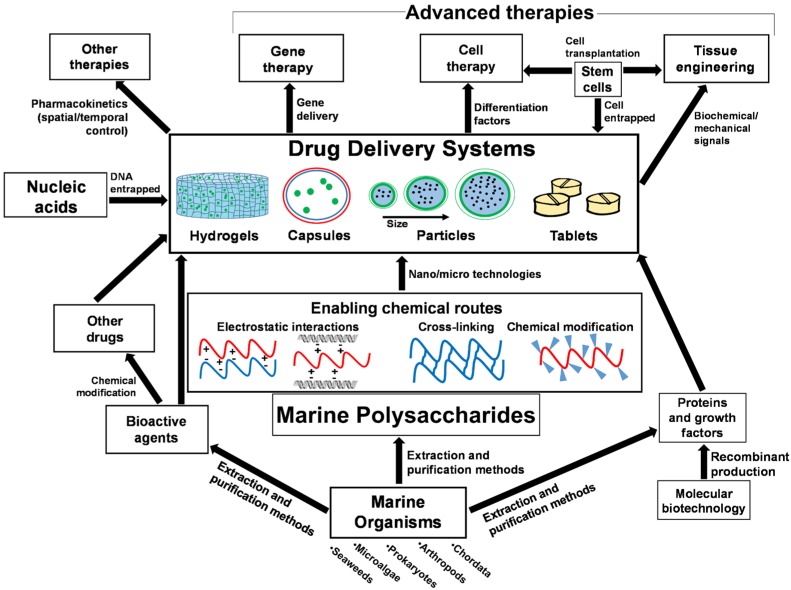
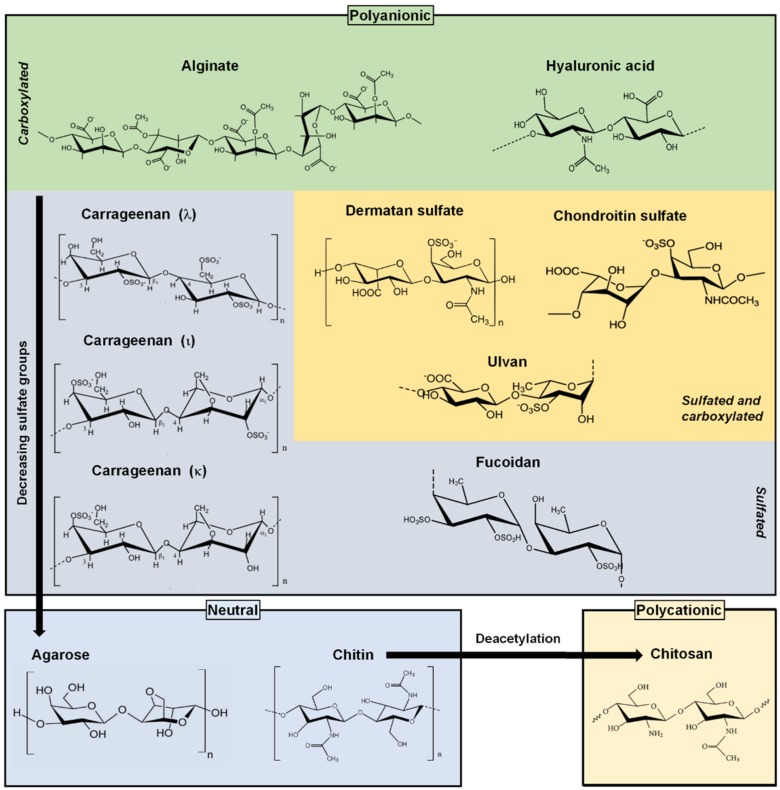
Oceans are a vast source of natural substances. In them, we find various compounds with wide biotechnological and biomedical applicabilities. The exploitation of the sea as a renewable source of biocompounds can have a positive impact on the development of new systems and devices for biomedical applications. Marine polysaccharides are among the most abundant materials in the seas, which contributes to a decrease of the extraction costs, besides their solubility behavior in aqueous solvents and extraction media, and their interaction with other biocompounds. Polysaccharides such as alginate, carrageenan and fucoidan can be extracted from algae, whereas chitosan and hyaluronan can be obtained from animal sources. Most marine polysaccharides have important biological properties such as biocompatibility, biodegradability, and anti-inflammatory activity, as well as adhesive and antimicrobial actions. Moreover, they can be modified in order to allow processing them into various shapes and sizes and may exhibit response dependence to external stimuli, such as pH and temperature. Due to these properties, these biomaterials have been studied as raw material for the construction of carrier devices for drugs, including particles, capsules and hydrogels. The devices are designed to achieve a controlled release of therapeutic agents in an attempt to fight against serious diseases, and to be used in advanced therapies, such as gene delivery or regenerative medicine.
Keywords: biomaterials; drug delivery; marine excipients; polysaccharide/drug conjugates; polysaccharides.
Figures
References
-
- Pomponi S.A. The bioprocess-technological potential of the sea. J. Biotechnol. 1999;70:5–13. doi: 10.1016/S0168-1656(99)00053-X. - DOI
-
- Silva T.H., Duarte A.R., Moreira-Silva J., Mano J.F., Reis R.L. Biomaterials from marine-origin biopolymers. In: Mano J.F., editor. Biomimetic Approaches for Biomaterials Development. Wiley-VCH Verlag; Weinheim, Germany: 2012. pp. 1–23.
Publication types
MeSH terms
Substances
LinkOut - more resources
Full Text Sources
Other Literature Sources
