


Readthrough transcription: How are DoGs made and what do they do?
- PMID: 26861889
- PMCID: PMC5449079
- DOI: 10.1080/15476286.2016.1149680
Readthrough transcription: How are DoGs made and what do they do?
Abstract
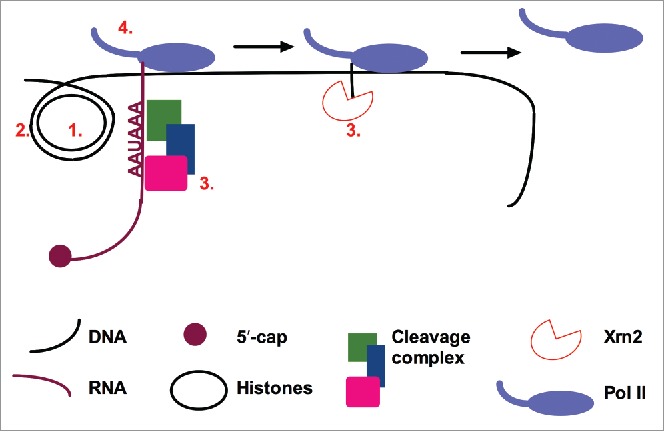
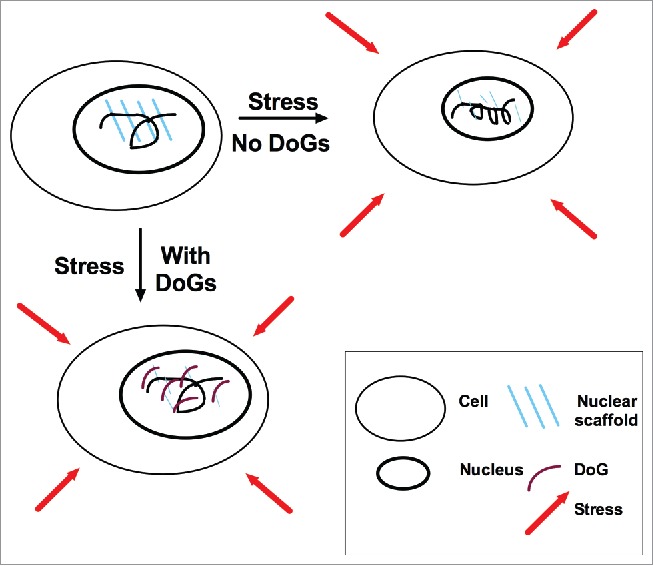
In recent years, the realization that most of the genome is transcribed has transformed the study of mammalian gene expression. Much effort has gone into investigating how this pervasive transcription is regulated and what the functions of the resulting transcripts are, if any. We recently discovered that stress-induced transcriptional readthrough generates very long downstream of gene containing transcripts (DoGs), which may explain up to 20% of intergenic transcription. DoGs are induced by osmotic stress at the level of transcription by a mechanism that depends on calcium release from the endoplasmic reticulum mediated by IP3 receptors. Here, we discuss DoG induction and function in the context of the literature, with special focus on 2 outstanding questions. First, we discuss possible molecular mechanisms underlying DoG induction through reduced transcription termination. Second, we explore how DoGs may function in maintaining euchromatin after nuclear scaffold stress. In short, we review important aspects of DoG biogenesis and function, and provide an outlook for continued DoG study.
Keywords: DoG; redthrough transcription; transcription termination.
Figures
References
-
- Cech TR, Steitz JA. The noncoding RNA revolution-trashing old rules to forge new ones. Cell 2014; 157:77-94; PMID:24679528; http://dx.doi.org/10.1016/j.cell.2014.03.008 - DOI - PubMed
-
- Ulitsky I, Bartel DP. lincRNAs: genomics, evolution, and mechanisms. Cell 2013; 154:26-46; PMID:23827673; http://dx.doi.org/10.1016/j.cell.2013.06.020 - DOI - PMC - PubMed
-
- Guttman M, Amit I, Garber M, French C, Lin MF, Feldser D, Huarte M, Zuk O, Carey BW, Cassady JP, et al.. Chromatin signature reveals over a thousand highly conserved large non-coding RNAs in mammals. Nature 2009; 458:223-7; PMID:19182780; http://dx.doi.org/10.1038/nature07672 - DOI - PMC - PubMed
-
- De Santa F, Barozzi I, Mietton F, Ghisletti S, Polletti S, Tusi BK, Muller H, Ragoussis J, Wei CL, Natoli G. A large fraction of extragenic RNA pol II transcription sites overlap enhancers. PLoS Biol 2010; 8:e1000384; PMID:20485488; http://dx.doi.org/10.1371/journal.pbio.1000384 - DOI - PMC - PubMed
-
- Kim TK, Hemberg M, Gray JM, Costa AM, Bear DM, Wu J, Harmin DA, Laptewicz M, Barbara-Haley K, Kuersten S. Widespread transcription at neuronal activity-regulated enhancers. Nature 2010; 465:182-7; PMID:20393465; http://dx.doi.org/10.1038/nature09033 - DOI - PMC - PubMed
Publication types
MeSH terms
Substances
Grants and funding
LinkOut - more resources
Full Text Sources
Other Literature Sources
