


New photosensitizers for photodynamic therapy
- PMID: 26862179
- PMCID: PMC4811612
- DOI: 10.1042/BJ20150942
New photosensitizers for photodynamic therapy
Abstract
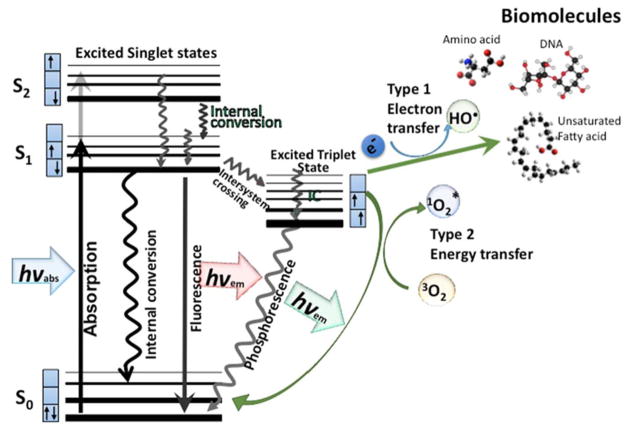
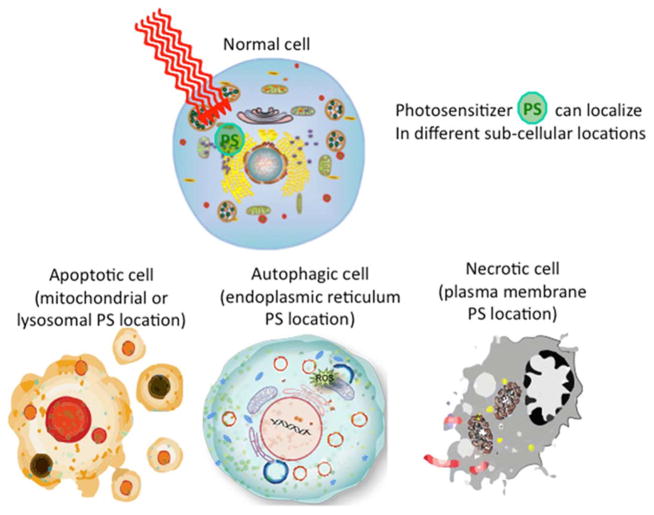
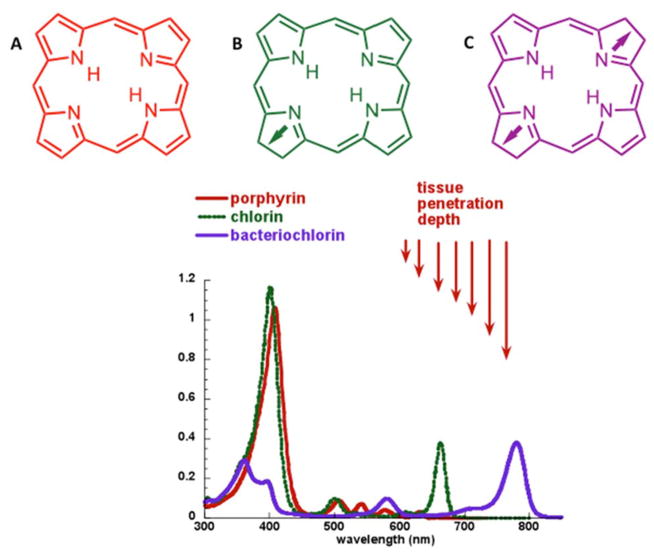
Photodynamic therapy (PDT) was discovered more than 100 years ago, and has since become a well-studied therapy for cancer and various non-malignant diseases including infections. PDT uses photosensitizers (PSs, non-toxic dyes) that are activated by absorption of visible light to initially form the excited singlet state, followed by transition to the long-lived excited triplet state. This triplet state can undergo photochemical reactions in the presence of oxygen to form reactive oxygen species (including singlet oxygen) that can destroy cancer cells, pathogenic microbes and unwanted tissue. The dual-specificity of PDT relies on accumulation of the PS in diseased tissue and also on localized light delivery. Tetrapyrrole structures such as porphyrins, chlorins, bacteriochlorins and phthalocyanines with appropriate functionalization have been widely investigated in PDT, and several compounds have received clinical approval. Other molecular structures including the synthetic dyes classes as phenothiazinium, squaraine and BODIPY (boron-dipyrromethene), transition metal complexes, and natural products such as hypericin, riboflavin and curcumin have been investigated. Targeted PDT uses PSs conjugated to antibodies, peptides, proteins and other ligands with specific cellular receptors. Nanotechnology has made a significant contribution to PDT, giving rise to approaches such as nanoparticle delivery, fullerene-based PSs, titania photocatalysis, and the use of upconverting nanoparticles to increase light penetration into tissue. Future directions include photochemical internalization, genetically encoded protein PSs, theranostics, two-photon absorption PDT, and sonodynamic therapy using ultrasound.
Keywords: naturally occurring photosensitizers; photochemical mechanisms; photodynamic therapy; photosensitizers; synthetic dyes; tetrapyrroles.
© 2016 Authors; published by Portland Press Limited.
Figures
References
-
- Moan J, Peng Q. An outline of the hundred-year history of PDT. Anticancer Res. 2003;23:3591–3600. - PubMed
-
- Foote CS. Mechanisms of photosensitized oxidation. There are several different types of photosensitized oxidation which may be important in biological systems. Science. 1968;162:963–970. - PubMed
-
- Allison RR, Sibata CH. Oncologic photodynamic therapy photosensitizers: a clinical review. Photodiagnosis Photodyn Ther. 2010;7:61–75. - PubMed
-
- Chen B, Roskams T, de Witte PA. Antivascular tumor eradication by hypericin-mediated photodynamic therapy. Photochem Photobiol. 2002;76:509–513. - PubMed
Publication types
MeSH terms
Substances
Grants and funding
LinkOut - more resources
Full Text Sources
Other Literature Sources
Medical
