Analysis of public oral toxicity data from REACH registrations 2008-2014
- PMID: 26863198
- PMCID: PMC5461469
- DOI: 10.14573/altex.1510054
Analysis of public oral toxicity data from REACH registrations 2008-2014
Abstract
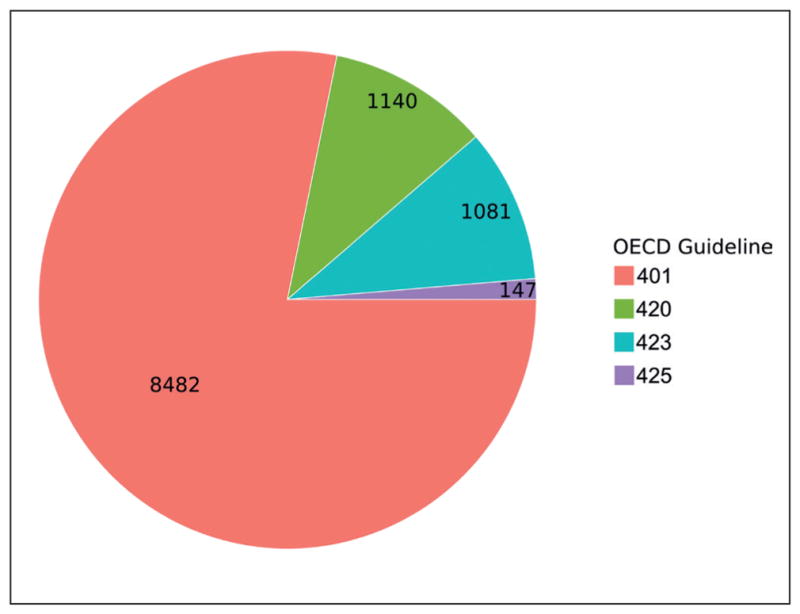
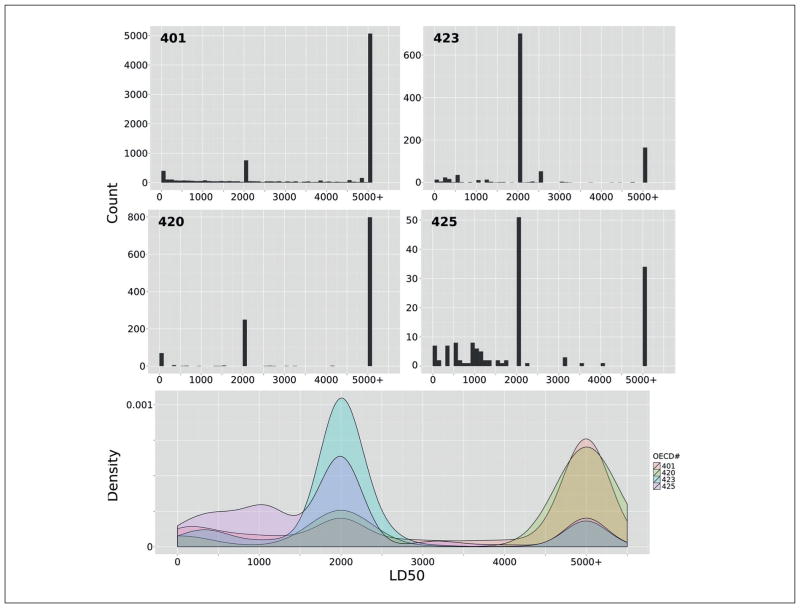
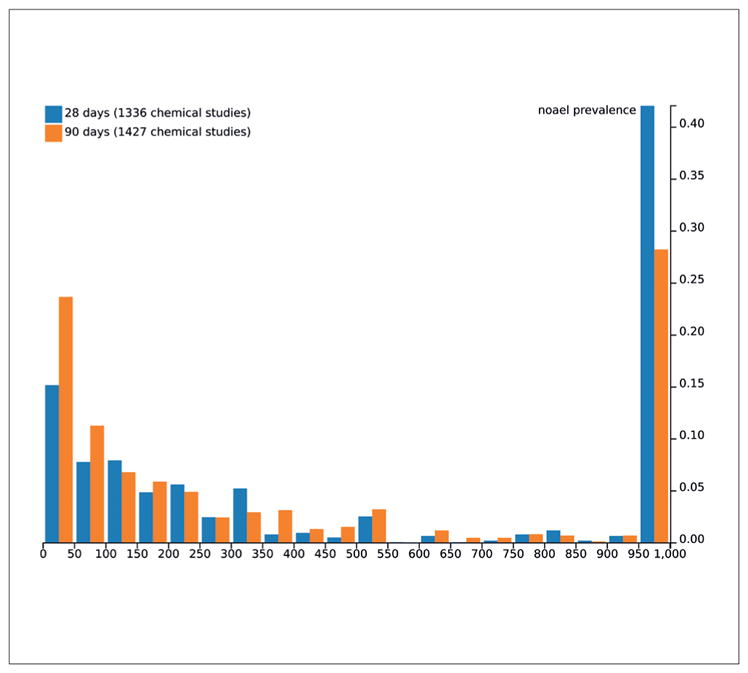
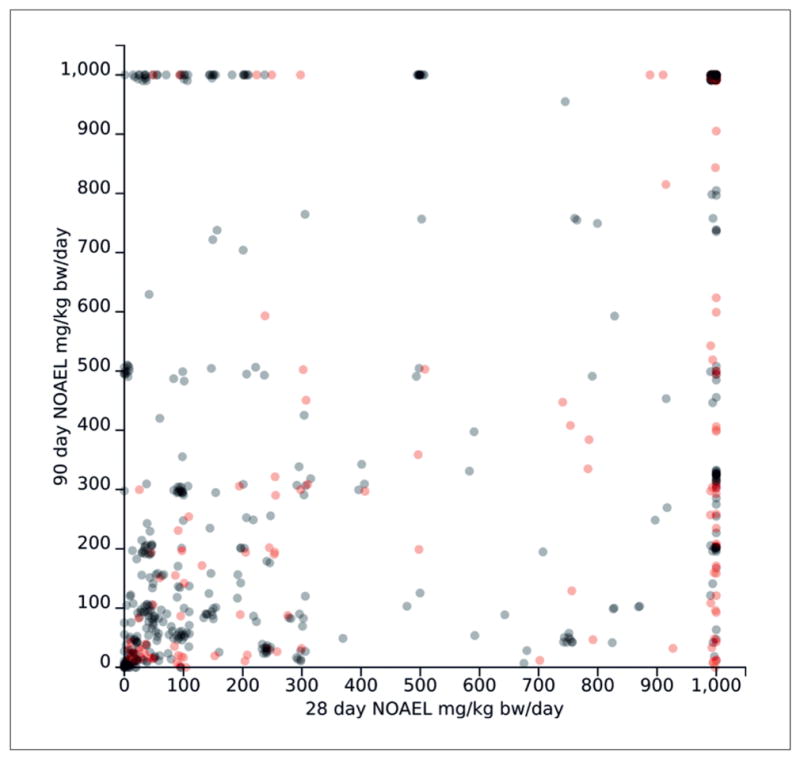
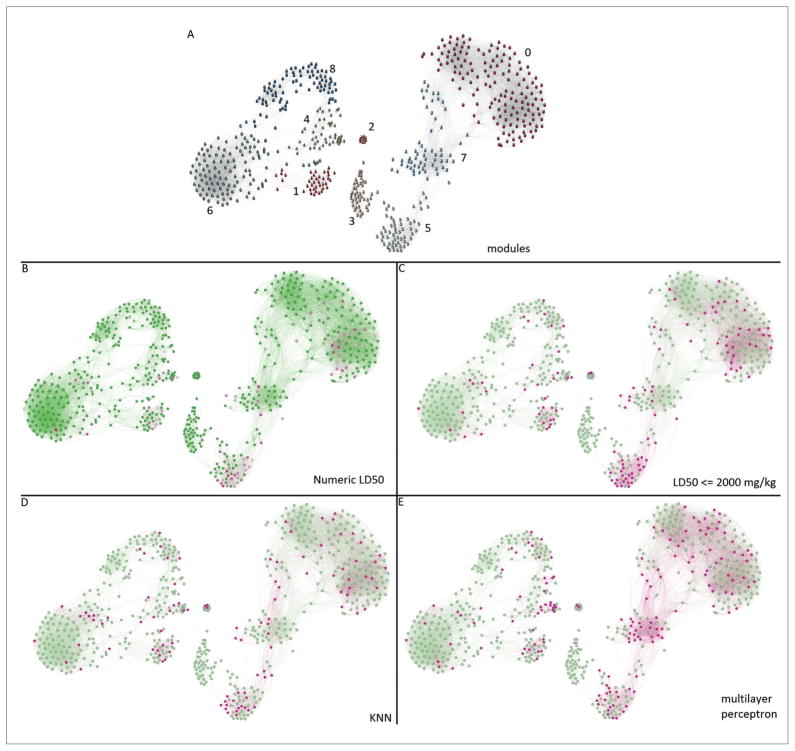
The European Chemicals Agency, ECHA, made available a total of 13,832 oral toxicity studies for 8,568 substances up to December 2014. 75% of studies were from the retired OECD Test Guideline 401 (11% TG 420, 11% TG 423 and 1.5% TG 425). Concordance across guidelines, evaluated by comparing LD50 values ≥ 2000 or < 2000 mg/kg body weight from chemicals tested multiple times between different guidelines, was at least 75% and for their own repetition more than 90%. In 2009, Bulgheroni et al. created a simple model for predicting acute oral toxicity using no observed adverse effect levels (NOAEL) from 28-day repeated dose toxicity studies in rats. This was reproduced here for 1,625 substances. In 2014, Taylor et al. suggested no added value of the 90-day repeated dose oral toxicity test given the availability of a low 28-day study with some constraints. We confirm that the 28-day NOAEL is predictive (albeit imperfectly) of 90-day NOAELs, however, the suggested constraints did not affect predictivity. 1,059 substances with acute oral toxicity data (268 positives, 791 negatives, all Klimisch score 1) were used for modeling: The Chemical Development Kit was used to generate 27 molecular descriptors and a similarity-informed multilayer perceptron showing 71% sensitivity and 72% specificity. Additionally, the k-nearest neighbors (KNN) algorithm indicated that similarity-based approaches alone may be poor predictors of acute oral toxicity, but can be used to inform the multilayer perceptron model, where this was the feature with highest information value.
Keywords: LD50; acute toxicity; chemical safety; computational toxicology; regulatory toxicology.
Conflict of interest statement
The authors have no conflict of interest to state.
Figures
References
-
- Aha DW, Kibler D, Albert MK. Instance-based learning algorithms. Machine Learning. 1991;6:37–66.
-
- Aulmann W, Pechacek N. REACH (and CLP). Its role in regulatory toxicology. In: Reichl F-X, Schwenk M, editors. Regulatory Toxicology. Berlin, Heidelberg: Springer; 2014. pp. 779–795. http://doi.org/10.1007/978-3-642-35374-1_92. - DOI
-
- Bastian M, Heymann S, Jacomy M. Gephi: An open source software for exploring and manipulating networks. International AAAI Conference on Weblogs and Social Media (ICWSM) 2009;8:361–362. https://gephi.org/users/publications/
-
- Blondel VD, Guillaume JL, Lambiotte R, Lefebvre E. Fast unfolding of communities in large networks. J Statist Mechanics: Theory and Experiment. 2008;10:P10008. http://doi.org/10.1088/1742-5468/2008/10/P10008. - DOI
-
- Bolton EE, Wang Y, Thiessen PA, Bryant SH. PubChem: Integrated Platform of Small Molecules and Biological Activities. Vol. 4. Amsterdam: Elsevier; 2008. pp. 217–241. http://doi.org/10.1016/S1574-1400(08)00012-1. - DOI
Publication types
MeSH terms
Substances
Grants and funding
LinkOut - more resources
Full Text Sources
Other Literature Sources
Miscellaneous