. 2016 Feb 10;11(2):e0148958.
doi: 10.1371/journal.pone.0148958. eCollection 2016.

Haemosporidian Parasites of Antelopes and Other Vertebrates from Gabon, Central Africa

Affiliations

Haemosporidian Parasites of Antelopes and Other Vertebrates from Gabon, Central Africa

Larson Boundenga et al. PLoS One. .

Abstract

Re-examination, using molecular tools, of the diversity of haemosporidian parasites (among which the agents of human malaria are the best known) has generally led to rearrangements of traditional classifications. In this study, we explored the diversity of haemosporidian parasites infecting vertebrate species (particularly mammals, birds and reptiles) living in the forests of Gabon (Central Africa), by analyzing a collection of 492 bushmeat samples. We found that samples from five mammalian species (four duiker and one pangolin species), one bird and one turtle species were infected by haemosporidian parasites. In duikers (from which most of the infected specimens were obtained), we demonstrated the existence of at least two distinct parasite lineages related to Polychromophilus species (i.e., bat haemosporidian parasites) and to sauropsid Plasmodium (from birds and lizards). Molecular screening of sylvatic mosquitoes captured during a longitudinal survey revealed the presence of these haemosporidian parasite lineages also in several Anopheles species, suggesting a potential role in their transmission. Our results show that, differently from what was previously thought, several independent clades of haemosporidian parasites (family Plasmodiidae) infect mammals and are transmitted by anopheline mosquitoes.


Conflict of interest statement

Competing Interests: The authors have declared that no competing interests exist.

Figures

Fig 1
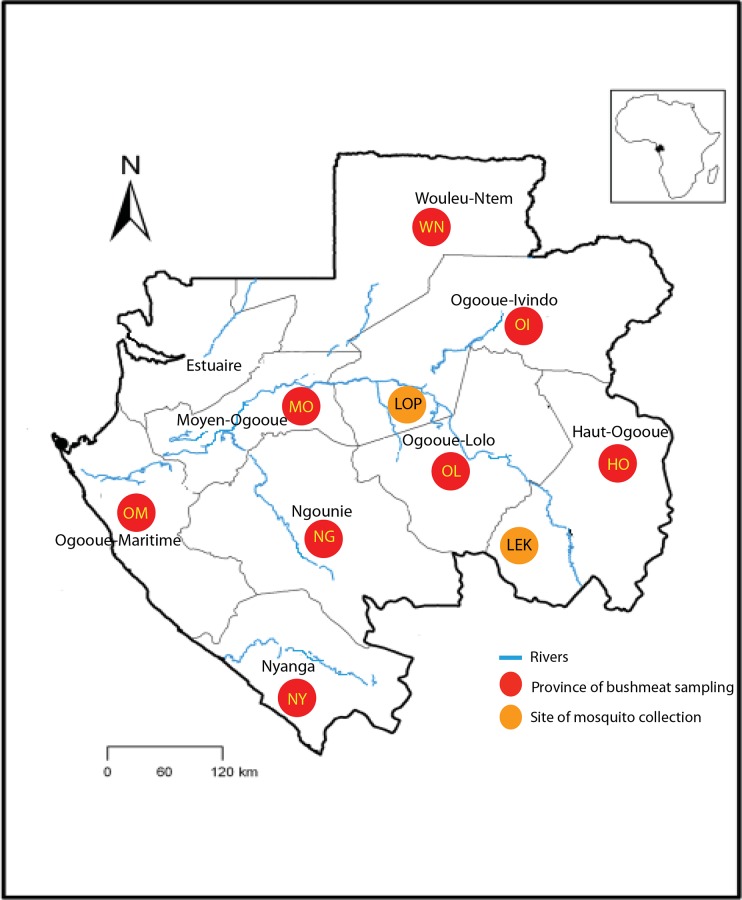
Fig 1. Location of the Gabon provinces where bushmeat samples were collected (OL: Ogooue-Lolo; OM: Ogooue-Maritime, OI: Ogooue-Ivindo, NG: Ngounie; NY: Nyanga; HO: Haut-Ogooue; MO: Moyen-Ogooue; WN: Woleu-Ntem) and of the two wildlife reserves where the longitudinal survey of sylvan Anopheles was carried out (LOP: La Lopé and LEK: La Lékédi).
Fig 2
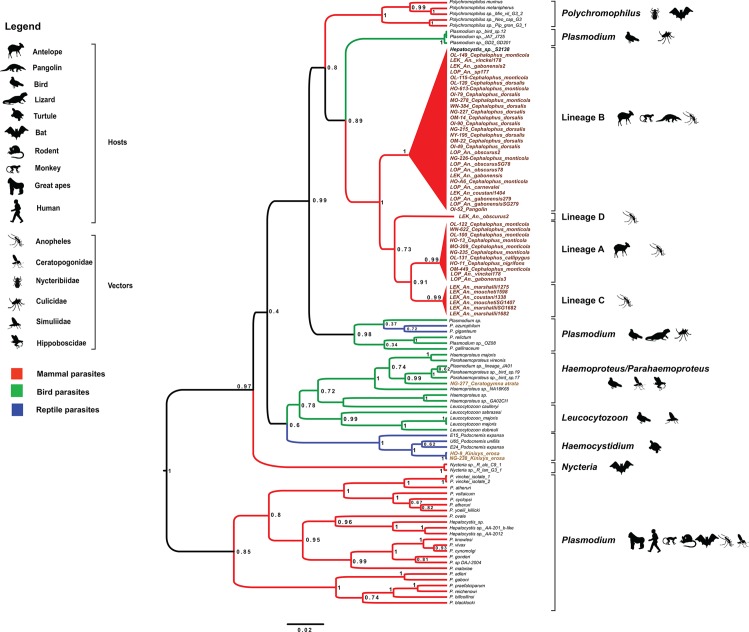
Fig 2. Phylogenetic relationships between the Cyt-b sequences of haemosporidian parasites obtained in our study and reference Cyt-b sequences (names in black) from existing databases.
The tree was constructed using a Bayesian outgroup-free method with relaxed molecular clock assumptions. The names of our isolates include: 1) the abbreviation of the sampling site (LOP: La Lopé and LEK: Lékédi) or province (OL: Ogooue-Lolo; OM: Ogooue-Maritime, OI: Ogooue-Ivindo, NG: Ngounie; NY: Nyanga; HO: Haut-Ogooue; MO: Moyen-Ogooue; WN: Woleu-Ntem), 2) the sample number, 3) the name of the host species in which it was found (vertebrate host or anopheles) (for instance, OL115-Cepholophus monticola), 4) SG if the parasite was detected in the salivary glands (for anopheles only). The tree was built based on 757 bp-long Cyt-b sequences. Branch colors indicate different groups of vertebrates. Posterior probabilities are given at each node. More details on the different reference sequences can be found in Table A in S1 File.
Fig 3
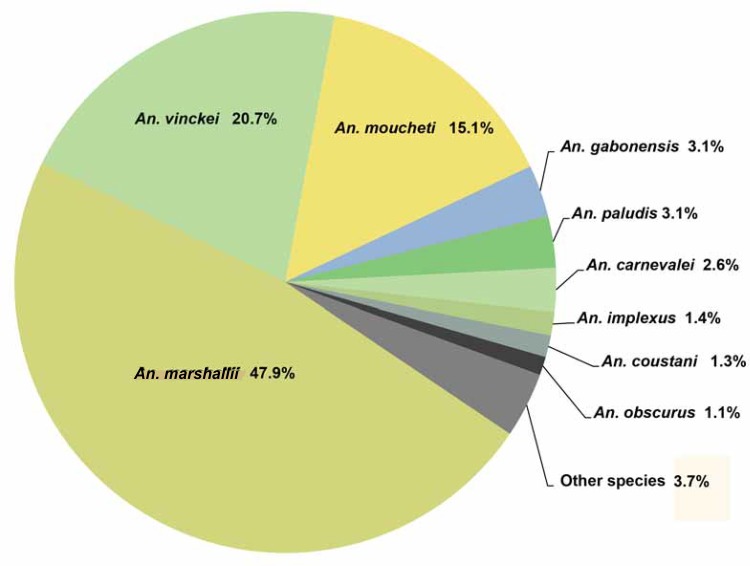
Fig 3. Diversity of Anopheles mosquitoes collected in the two wildlife reserves (La Lopé and La Lékédi) in Gabon from October 2012 to December 2013.
Only species representing more than 1% of the entire population are indicated. The other species are grouped in the “other species” category.

References

    1. WHO. WORLD MALARIA REPORT 2013. Geneva: World Health Organization; 2013.
    1. Perkins SL. Malaria's many mates: past, present, and future of the systematics of the order Haemosporida. The Journal of parasitology. 2014;100(1):11–25. Epub 2013/09/26. 10.1645/13-362.1 . - DOI - PubMed
    1. Keeling PJ, Rayner JC. The origins of malaria: there are more things in heaven and earth. Parasitology. 2014:1–10. Epub 2014/06/26. 10.1017/S0031182014000766 . - DOI - PMC - PubMed
    1. Valkiunas G, Sehgal RN, Iezhova TA, Smith TB. Further observations on the blood parasites of birds in Uganda. Journal of wildlife diseases. 2005;41(3):580–7. Epub 2005/10/26. 10.7589/0090-3558-41.3.580 . - DOI - PubMed
    1. Garnham PC. Immunity against the different stages of malaria parasites. Bulletin de la Societe de pathologie exotique et de ses filiales. 1966;59(4):549–57. Epub 1966/07/01. 6014215. - PubMed

Publication types

LinkOut - more resources