


Common genetic architecture underlying young children's food fussiness and liking for vegetables and fruit
- PMID: 26864359
- PMCID: PMC4807704
- DOI: 10.3945/ajcn.115.122945
Common genetic architecture underlying young children's food fussiness and liking for vegetables and fruit
Abstract
Background: Food fussiness (FF) is common in early childhood and is often associated with the rejection of nutrient-dense foods such as vegetables and fruit. FF and liking for vegetables and fruit are likely all heritable phenotypes; the genetic influence underlying FF may explain the observed genetic influence on liking for vegetables and fruit. Twin analyses make it possible to get a broad-based estimate of the extent of the shared genetic influence that underlies these traits.
Objective: We quantified the extent of the shared genetic influence that underlies FF and liking for vegetables and fruit in early childhood with the use of a twin design.
Design: Data were from the Gemini cohort, which is a population-based sample of twins born in England and Wales in 2007. Parents of 3-y-old twins (n= 1330 pairs) completed questionnaire measures of their children's food preferences (liking for vegetables and fruit) and the FF scale from the Children's Eating Behavior Questionnaire. Multivariate quantitative genetic modeling was used to estimate common genetic influences that underlie FF and liking for vegetables and fruit.
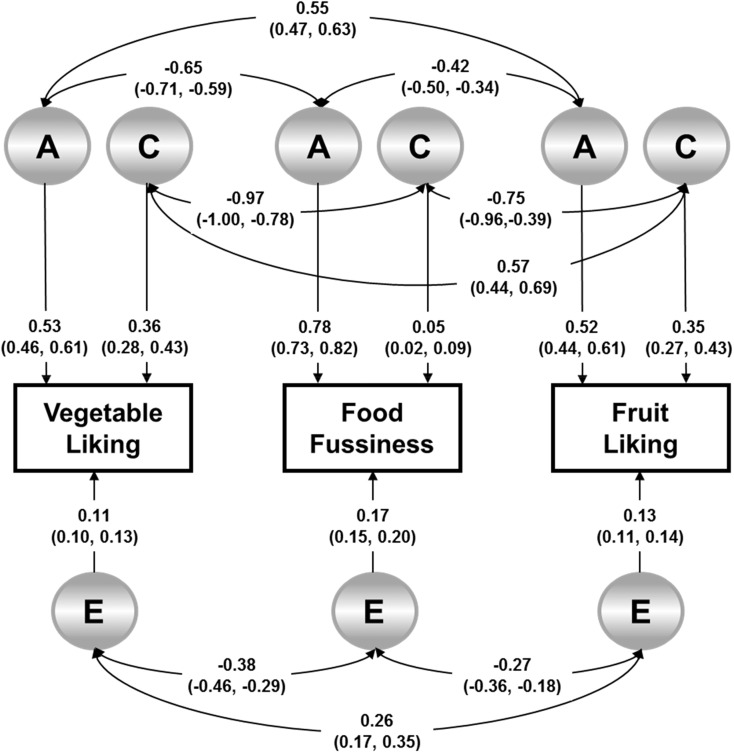
Results: Genetic correlations were significant and moderate to large in size between FF and liking for both vegetables (-0.65) and fruit (-0.43), which indicated that a substantial proportion of the genes that influence FF also influence liking. Common genes that underlie FF and liking for vegetables and fruit largely explained the observed phenotypic correlations between them (68-70%).
Conclusions: FF and liking for fruit and vegetables in young children share a large proportion of common genetic factors. The genetic influence on FF may determine why fussy children typically reject fruit and vegetables.
Keywords: child; eating; food; fussiness; genetic; heritability; infant; liking; preferences.
Figures
Comment in
-
Shadows of temperament in child eating patterns: implications for family and parenting research.Am J Clin Nutr. 2016 Apr;103(4):961-2. doi: 10.3945/ajcn.116.132258. Epub 2016 Mar 16. Am J Clin Nutr. 2016. PMID: 26984483 No abstract available.
Similar articles
-
The relationship between appetite and food preferences in British and Australian children.Int J Behav Nutr Phys Act. 2015 Sep 17;12:116. doi: 10.1186/s12966-015-0275-4. Int J Behav Nutr Phys Act. 2015. PMID: 26381382 Free PMC article.
-
Nature and nurture in children's food preferences.Am J Clin Nutr. 2014 Apr;99(4):911-7. doi: 10.3945/ajcn.113.077867. Epub 2014 Jan 29. Am J Clin Nutr. 2014. PMID: 24477038
-
Food fussiness and food neophobia share a common etiology in early childhood.J Child Psychol Psychiatry. 2017 Feb;58(2):189-196. doi: 10.1111/jcpp.12647. Epub 2016 Oct 14. J Child Psychol Psychiatry. 2017. PMID: 27739065 Free PMC article.
-
Understanding Food Fussiness and Its Implications for Food Choice, Health, Weight and Interventions in Young Children: The Impact of Professor Jane Wardle.Curr Obes Rep. 2017 Mar;6(1):46-56. doi: 10.1007/s13679-017-0248-9. Curr Obes Rep. 2017. PMID: 28205158 Review.
-
The importance of exposure for healthy eating in childhood: a review.J Hum Nutr Diet. 2007 Aug;20(4):294-301. doi: 10.1111/j.1365-277X.2007.00804.x. J Hum Nutr Diet. 2007. PMID: 17635306 Review.
Cited by
-
Validity of the Adult Eating Behavior Questionnaire and Its Relationship with Parent-Reported Eating Behaviors among Adolescents in Portugal.Nutrients. 2022 Mar 19;14(6):1301. doi: 10.3390/nu14061301. Nutrients. 2022. PMID: 35334958 Free PMC article.
-
Effect of a Baby-Led Approach to Complementary Feeding on Infant Growth and Overweight: A Randomized Clinical Trial.JAMA Pediatr. 2017 Sep 1;171(9):838-846. doi: 10.1001/jamapediatrics.2017.1284. JAMA Pediatr. 2017. PMID: 28692728 Free PMC article. Clinical Trial.
-
Maternal feeding practices and fussy eating in toddlerhood: a discordant twin analysis.Int J Behav Nutr Phys Act. 2016 Jul 13;13:81. doi: 10.1186/s12966-016-0408-4. Int J Behav Nutr Phys Act. 2016. PMID: 27412445 Free PMC article.
-
Young adult nutrition and weight correlates of picky eating during childhood.Public Health Nutr. 2020 Apr;23(6):987-995. doi: 10.1017/S136898001900346X. Epub 2019 Dec 6. Public Health Nutr. 2020. PMID: 31806063 Free PMC article.
-
Complementary Feeding Methods, Feeding Problems, Food Neophobia, and Picky Eating among Polish Children.Children (Basel). 2023 Dec 29;11(1):45. doi: 10.3390/children11010045. Children (Basel). 2023. PMID: 38255359 Free PMC article.
References
-
- Carruth BR, Ziegler PJ, Gordon A, Barr SI. Prevalence of picky eaters among infants and toddlers and their caregivers’ decisions about offering a new food. J Am Diet Assoc 2004;104(1 Suppl 1):s57–64. - PubMed
-
- Cashdan E. A sensitive period for learning about food. Hum Nat. 1994;5:279–91. - PubMed
-
- Jacobi C, Agras WS, Bryson S, Hammer LD. Behavioral validation, precursors, and concomitants of picky eating in childhood. J Am Acad Child Adolesc Psychiatry 2003;42:76–84. - PubMed
-
- Dovey TM, Staples PA, Gibson EL, Halford JC. Food neophobia and ‘picky/fussy’ eating in children: a review. Appetite 2008;50:181–93. - PubMed
Publication types
MeSH terms
Grants and funding
LinkOut - more resources
Full Text Sources
Other Literature Sources
