Review
. 2016 Mar;5(1):51-64.
doi: 10.1007/s13679-016-0191-1.

The Second Brain: Is the Gut Microbiota a Link Between Obesity and Central Nervous System Disorders?

Affiliations
Review

The Second Brain: Is the Gut Microbiota a Link Between Obesity and Central Nervous System Disorders?

Javier Ochoa-Repáraz et al. Curr Obes Rep. 2016 Mar.

Abstract

The gut-brain axis is a bi-directional integrated system composed by immune, endocrine, and neuronal components by which the gap between the gut microbiota and the brain is significantly impacted. An increasing number of different gut microbial species are now postulated to regulate brain function in health and disease. The westernized diet is hypothesized to be the cause of the current obesity levels in many countries, a major socio-economical health problem. Experimental and epidemiological evidence suggest that the gut microbiota is responsible for significant immunologic, neuronal, and endocrine changes that lead to obesity. We hypothesize that the gut microbiota, and changes associated with diet, affect the gut-brain axis and may possibly contribute to the development of mental illness. In this review, we discuss the links between diet, gut dysbiosis, obesity, and immunologic and neurologic diseases that impact brain function and behavior.

Keywords: CNS diseases; Diet; Dysbiosis; Gut microbiota; Gut-brain axis; Obesity.


Conflict of interest statement

Conflict of Interest: Javier Ochoa-Repáraz and Lloyd H. Kasper declare that they have no conflict of interest.

Figures

Figure 1
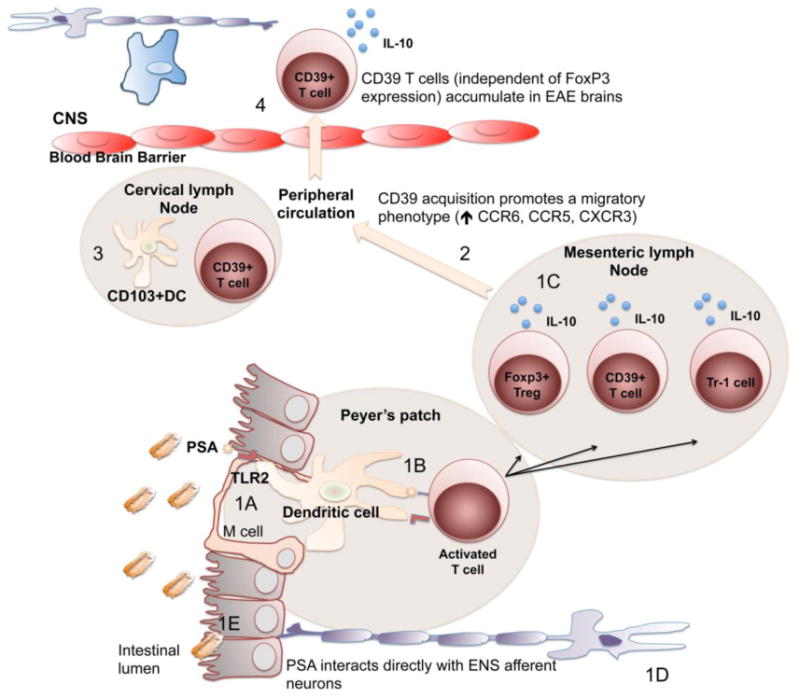
Figure 1. The gut-brain axis concept applied for the symbiont factor polysaccharide A (PSA) of B. fragilis
The gut-associated lymphoid tissue (GALT) is the largest reservoir for immune cells. Because its relevance sampling the environment, the GALT is composed or specialized areas where microbe-host interactions occur: the intestinal epithelium is a physical and biochemical barrier that separates the lumen, where microbes inhabit, from the lamina propria, enriched in immune cells. The intestine also contains the Peyer's patches, lymphoid tissues with cells that facilitate antigen sampling, such as the M cells, and antigen presenting cells (dendritic cells, monocyte/macrophages, and B cells), and effector cells such as T cells. 1A) Conventional and plasmacytoid dendritic cells have been shown to recognize polysaccharide A (PSA) produced by the human commensal B. fragilis in the context of toll like receptor-2 (TLR2). PSA is internalized by dendritic cells and presented to naïve T cells by the major histocompatibility class – II. 1B) With required costimulation, naïve T cells are activated and differentiated into three distinct types of regulatory T cells: regulatory T cells (Tregs) that express the transcription factor foxhead box P3 (FoxP3), T cells that express the ectoenzyme CD39, responsible for the catabolism of ATP into AMP (CD39+Tregs), and T cells that are regulatory but do not express FoxP3, called Tr1 cells. All three subtypes induced in vivo and in vitro by PSA are characterized by their production of anti-inflammatory IL-10 cytokine, and by their immunosuppressive function. 1C) The dendritic cell – T cell interaction can occur in the Peyer's patches but also in the mesenteric lymph nodes where dendritic cells may migrate once exposed to antigens, such as PSA. 1D) PSA has also been shown to interact directly with afferent neurons of the enteric nervous system (ENS). 1E) B. fragilis has been shown to stabilize a leaky gut. 2) The acquisition of a CD39 phenotype by T cells once activated by dendritic cells exposed to PSA, independently of FoxP3 expression, enhances the migratory function of T cells. 3) CD39+T cells, both FoxP3+ and FoxP3-, accumulate in the cervical lymph nodes of EAE mice. Also, a specialized subset of generally gut derived dendritic cells that express CD103 that accumulate upon oral treatment of EAE mice with PSA. CD103+DCs accumulated in response to PSA are tolerogenic, and induce Treg differentiation. 4) Enhanced frequencies of CD39+T cells, both FoxP3+ and FoxP3-, are found in the brains of EAE mice. Accumulation of these regulatory cells occurs in cervical lymph nodes and brains in mice treated orally with PSA only when EAE is induced, and not in healthy animals immunized with the polysaccharide.
Figure 2
Figure 2
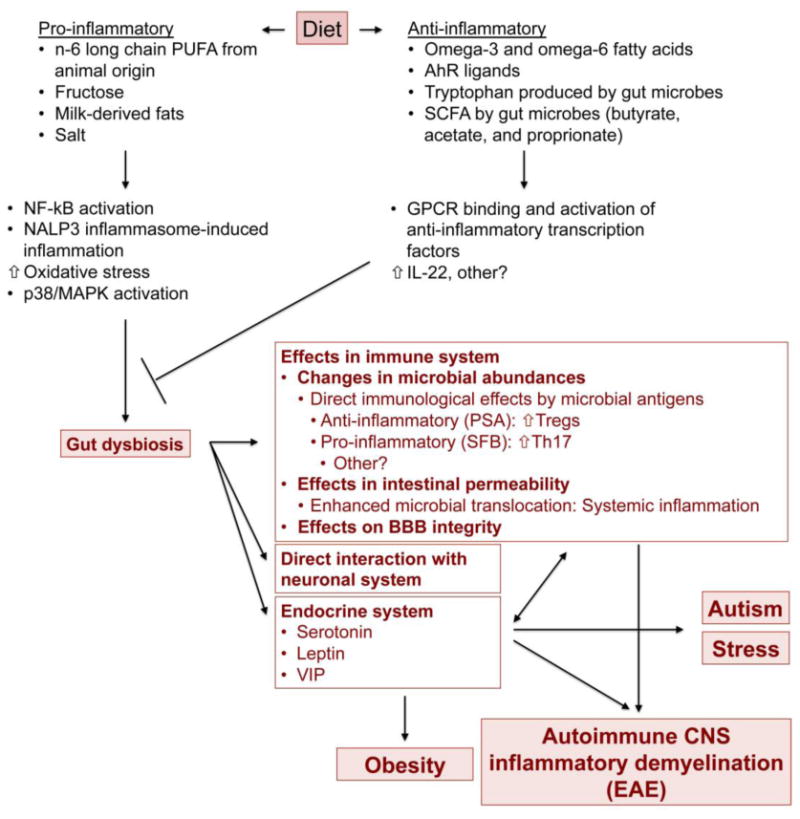
Diagram of the hypothetical effects of diet in gut dysbiosis and in obesity and CNS diseases, based on experimental models. Different dietary components that are believed to promote diverse pro-inflammatory pathways have been associated with gut dysbiosis, postulated as major factor for gut inflammatory diseases, but also hypothesized to be responsible for obesity, autoimmune CNS inflammatory diseases, such as the demyelinating MS, and for affective neurological disorders. Several proinflammatory triggering dietary factors have been associated with the significant changes that westernized diet in the gut microbiota. Other dietary components promote anti-inflammatory responses that could help maintaining a balanced gut microbiota. Both pro- and anti-inflammatory triggering dietary factors can have direct effects on the immune, endocrine and neuronal system, but also indirectly affect them by their catabolism by gut microbes. For instance, some short-chain fatty acids (SCFA) and trypotophan are produced by gut microbes in response to diet and constitute essential ligands for immune GPCR receptors that mediate in anti-inflammatory responses. Furthermore, bacterial antigens, such as PSA produced by B. fragilis have major immunomodulatory roles. The mechanisms by which dietary factors regulate CNS diseases could involve changes in the microbial populations that express immunomodulatory factors that directly interact with immune cells, but also indirectly by their production of metabolites (such as short chain fatty acids ) as products of food catabolism with effects in the immune, neuronal and endocrine systems. Furthermore, the different compartments of the gut-brain axis interact significantly. Although very substantial research on this field is currently ongoing, the bi-directional gut-brain axis is a highly complex system, and many aspects of the multifactorial interactions need to be elucidated using experimental models, but more importantly in human studies.

References

    1. Ley RE, Peterson DA, Gordon JI. Ecological and evolutionary forces shaping microbial diversity in the human intestine. Cell. 2006;124(4):837–48. - PubMed
    1. Lederberg J, Mccray A. ‘Ome Sweet’ Omics -- A Genealogical Treasury of Words. The Scientist. 2001;17
    1. Jiménez E, Marín ML, Martín R, et al. Is meconium from healthy newborns actually sterile? Res Microbiol. 2008;159(3):187–93. - PubMed
    1. Bäckhed F, Roswall J, Peng Y, et al. Dynamics and Stabilization of the Human Gut Microbiome during the First Year of Life. Cell Host Microbe. 2015;17(5):690–703. - PubMed
    1. Marietta E, Rishi A, Taneja V. Immunogenetic control of the Intestinal Microbiota. Immunology. 2015;145(3):313–22. - PMC - PubMed

Publication types