Review
. 2016 Feb 10;283(1824):20152592.
doi: 10.1098/rspb.2015.2592.

Interactions among ecosystem stressors and their importance in conservation

Affiliations
Review

Interactions among ecosystem stressors and their importance in conservation

Isabelle M Côté et al. Proc Biol Sci. .

Abstract

Interactions between multiple ecosystem stressors are expected to jeopardize biological processes, functions and biodiversity. The scientific community has declared stressor interactions-notably synergies-a key issue for conservation and management. Here, we review ecological literature over the past four decades to evaluate trends in the reporting of ecological interactions (synergies, antagonisms and additive effects) and highlight the implications and importance to conservation. Despite increasing popularity, and ever-finer terminologies, we find that synergies are (still) not the most prevalent type of interaction, and that conservation practitioners need to appreciate and manage for all interaction outcomes, including antagonistic and additive effects. However, it will not be possible to identify the effect of every interaction on every organism's physiology and every ecosystem function because the number of stressors, and their potential interactions, are growing rapidly. Predicting the type of interactions may be possible in the near-future, using meta-analyses, conservation-oriented experiments and adaptive monitoring. Pending a general framework for predicting interactions, conservation management should enact interventions that are robust to uncertainty in interaction type and that continue to bolster biological resilience in a stressful world.

Keywords: ecological experiments; ecological surprises; global change; non-additive effects.


Figures

Figure 1.
Figure 1.
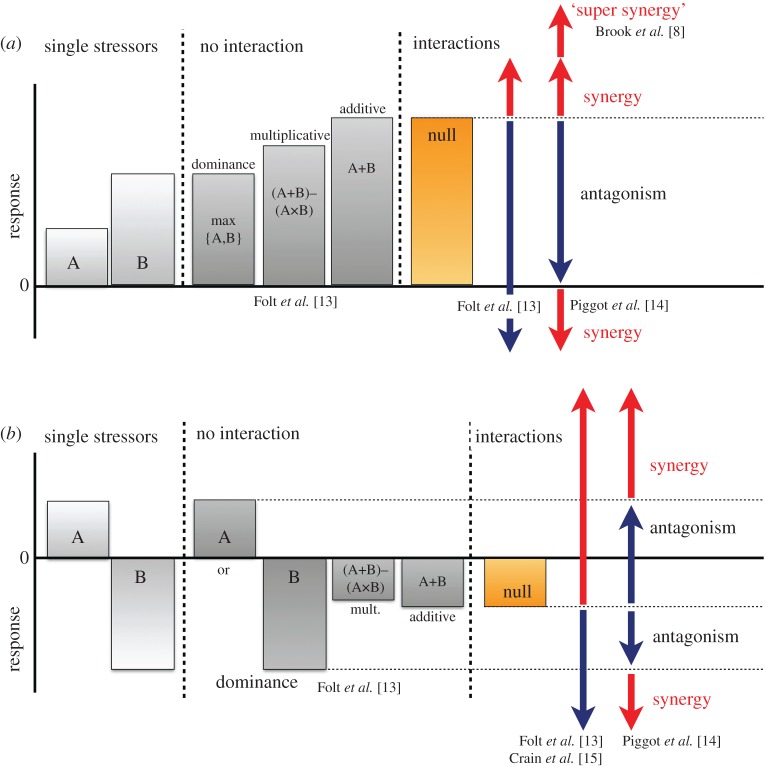
Models for defining ecological synergies and other interactions between multiple stressors. (a) Two stressors (A and B) impact a biological response in the same direction when acting separately. Their combined effect could simply be equal to the effect of one of the two stressor, i.e. a dominance effect, or be additive, i.e. the sum of the two stressor effects with or without a multiplicative-risk correction. Alternatively, stressors can interact either antagonistically or synergistically. Null models (from an additive or multiplicative risk expectation; we use the additive expectation as the null model here) provide the threshold for distinguishing between these interactions. Interaction type becomes difficult to label when the combined response is in a direction opposite that of the individual stressors (antagonism by Folt et al. [13] versus synergy by Piggot et al. [14]). Some authors [8] also identify an area of ‘super-synergy’ in relation to minimum population size. (b) Two stressors have opposing effects on a biological response. Here, some authors use a null model to define interaction types [13,15], while others advocate using the effects of each stressor to classify interactions [14]. (Online version in colour.)
Figure 2.
Figure 2.
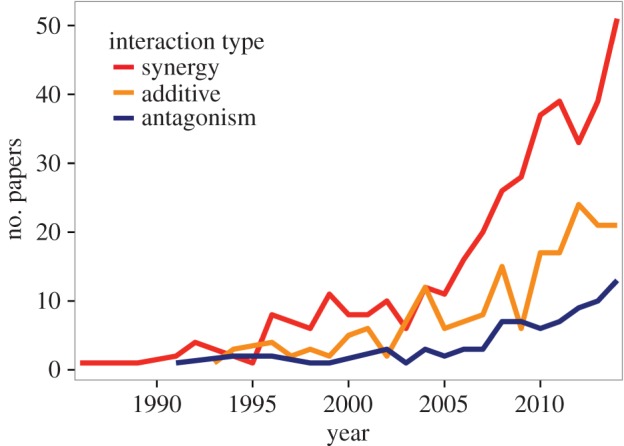
Trends in annual mentions of each of the three conventional types of interactions among multiple stressors in the ecological literature between 1986 and 2014 (for methodological details, see the electronic supplementary material). (Online version in colour.)
Figure 3.
Figure 3.
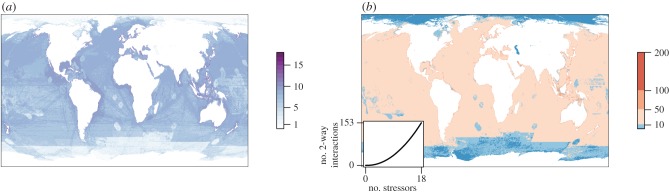
The number of potential interactions increases nonlinearly with the number of stressors. (a) The number of different ocean stressors globally (data from [3]); (b) the number of potential two-way interactions based on the number of stressors in each grid cell. Inset shows how the number of two-way interactions accelerates with the number of stressors. See the electronic supplementary material for methods. (Online version in colour.)
Figure 4.
Figure 4.
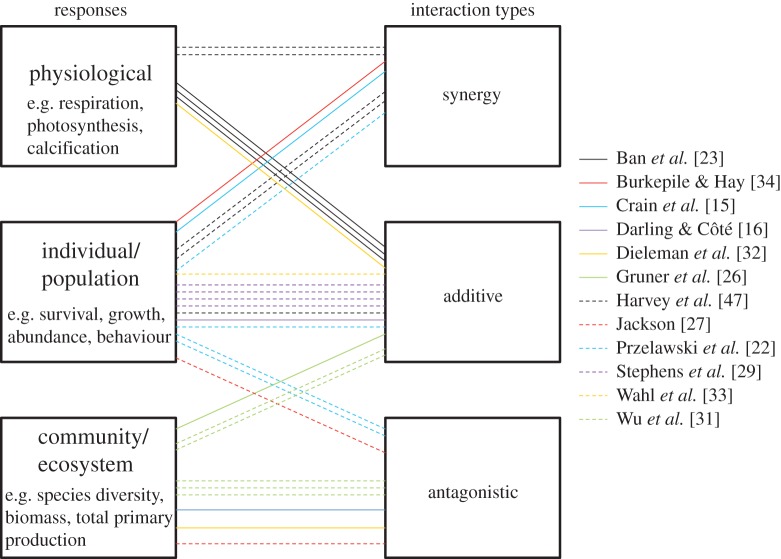
Links between various categories of responses to multiple stressors and the types of interactions occurring between these stressors. Coloured lines represent response-specific interaction types reported in published meta-analyses of the ecological effects of multiple stressors on a variety of ecosystems (table 1). Multiple lines of the same colour represent multiple responses reported in a given study. Note that responses were sometimes reported as individual metrics (e.g. survival, growth) or as aggregated responses (e.g. survival and growth combined into a single population-level response).)

References

    1. Millennium Ecosystem Assessment. 2005. Ecosystems and human well-being: synthesis. Washington, DC: Island Press.
    1. Geldmann J, Joppa LN, Burgess ND. 2014. Mapping change in human pressure globally on land and within protected areas. Conserv. Biol. 28, 1604–1616. ( 10.1111/cobi.12332) - DOI - PubMed
    1. Halpern BS, et al. 2015. Spatial and temporal changes in cumulative human impacts on the world's ocean. Nat. Comm. 6, 7615 ( 10.1038/ncomms8615) - DOI - PMC - PubMed
    1. Butchart SHM, et al. 2010. Global biodiversity: indicators of recent declines. Science, 328, 1164–1168. ( 10.1126/science.1187512) - DOI - PubMed
    1. Barnosky AD, et al. 2011. Has the Earth's sixth mass extinction already arrived? Nature 471, 51–57. ( 10.1038/nature09678) - DOI - PubMed

Publication types