


Dietary Broccoli Lessens Development of Fatty Liver and Liver Cancer in Mice Given Diethylnitrosamine and Fed a Western or Control Diet
- PMID: 26865652
- PMCID: PMC4763488
- DOI: 10.3945/jn.115.228148
Dietary Broccoli Lessens Development of Fatty Liver and Liver Cancer in Mice Given Diethylnitrosamine and Fed a Western or Control Diet
Abstract
Background: The high-fat and high-sugar Westernized diet that is popular worldwide is associated with increased body fat accumulation, which has been related to the development of nonalcoholic fatty liver disease (NAFLD). Without treatment, NAFLD may progress to hepatocellular carcinoma (HCC), a cancer with a high mortality rate. The consumption of broccoli in the United States has greatly increased in the last 2 decades. Epidemiologic studies show that incorporating brassica vegetables into the daily diet lowers the risk of several cancers, although, to our knowledge, this is the first study to evaluate HCC prevention through dietary broccoli.
Objective: We aimed to determine the impact of dietary broccoli on hepatic lipid metabolism and the progression of NAFLD to HCC. Our hypothesis was that broccoli decreases both hepatic lipidosis and the development of HCC in a mouse model of Western diet-enhanced liver cancer.
Methods: Adult 5-wk-old male B6C3F1 mice received a control diet (AIN-93M) or a Western diet (high in lard and sucrose, 19% and 31%, wt:wt, respectively), with or without freeze-dried broccoli (10%, wt:wt). Starting the following week, mice were treated once per week with diethylnitrosamine (DEN; 45 mg/kg body weight intraperitoneally at ages 6, 7, 8, 10, 11, and 12 wk). Hepatic gene expression, lipidosis, and tumor outcomes were analyzed 6 mo later, when mice were 9 mo old.
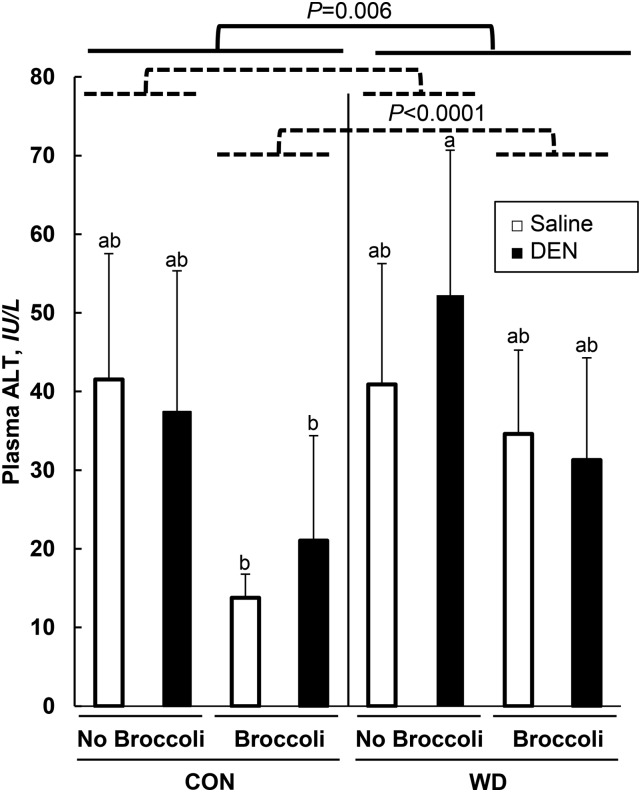
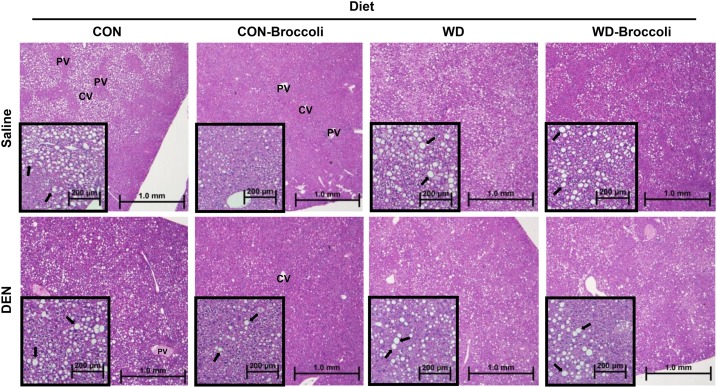
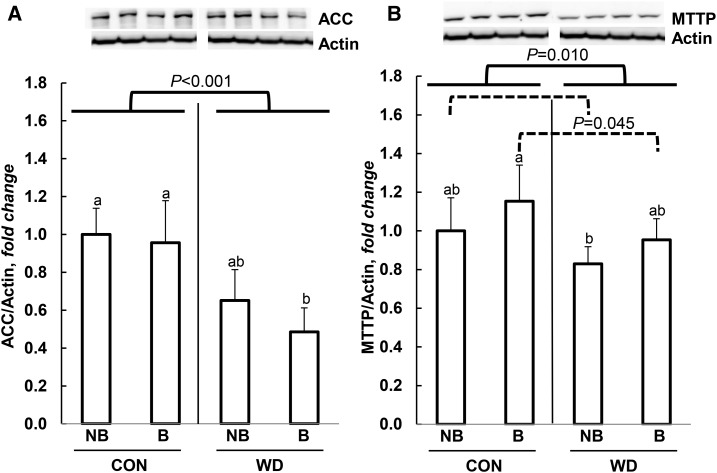
Results: Mice receiving broccoli exhibited lower hepatic triglycerides (P < 0.001) and NAFLD scores (P < 0.0001), decreased plasma alanine aminotransferase (P < 0.0001), suppressed activation of hepatic CD68(+) macrophages (P < 0.0001), and slowed initiation and progression of hepatic neoplasm. Hepatic Cd36 was downregulated by broccoli feeding (P = 0.006), whereas microsomal triglyceride transfer protein was upregulated (P = 0.045), supporting the finding that dietary broccoli decreased hepatic triglycerides.
Conclusion: Long-term consumption of whole broccoli countered both NAFLD development enhanced by a Western diet and hepatic tumorigenesis induced by DEN in male B6C3F1 mice.
Keywords: NAFLD; Western diet; broccoli; diethylnitrosamine; liver cancer.
© 2016 American Society for Nutrition.
Conflict of interest statement
Author disclosures: Y-J Chen, MA Wallig, and EH Jeffery, no conflicts of interest.
Figures
References
-
- Williams CD, Stengel J, Asike MI, Torres DM, Shaw J, Contreras M, Landt CL, Harrison SA. Prevalence of nonalcoholic fatty liver disease and nonalcoholic steatohepatitis among a largely middle-aged population utilizing ultrasound and liver biopsy: a prospective study. Gastroenterology 2011;140:124–31. - PubMed
-
- World Health Organization. Liver cancer: estimated incidence, mortality and prevalence worldwide in 2012 [Internet]. [cited 2015 Jul 6]. Available from: http://globocan.iarc.fr/Pages/fact_sheets_cancer.aspx.
-
- American Cancer Society. Cancer facts and figures 2015 [Internet]. Atlanta, GA: American Cancer Society, 2015 [cited 2015 Jun 3]. Available from: http://www.cancer.org/acs/groups/content/@ editorial/documents/document/....
-
- Laursen L. A preventable cancer. Nature 2014;516:S2–3. - PubMed
Publication types
MeSH terms
Substances
Grants and funding
LinkOut - more resources
Full Text Sources
Other Literature Sources
Medical
