New Strategies in Breast Cancer: Immunotherapy
- PMID: 26867935
- PMCID: PMC9359478
- DOI: 10.1158/1078-0432.CCR-15-1315
New Strategies in Breast Cancer: Immunotherapy
Abstract
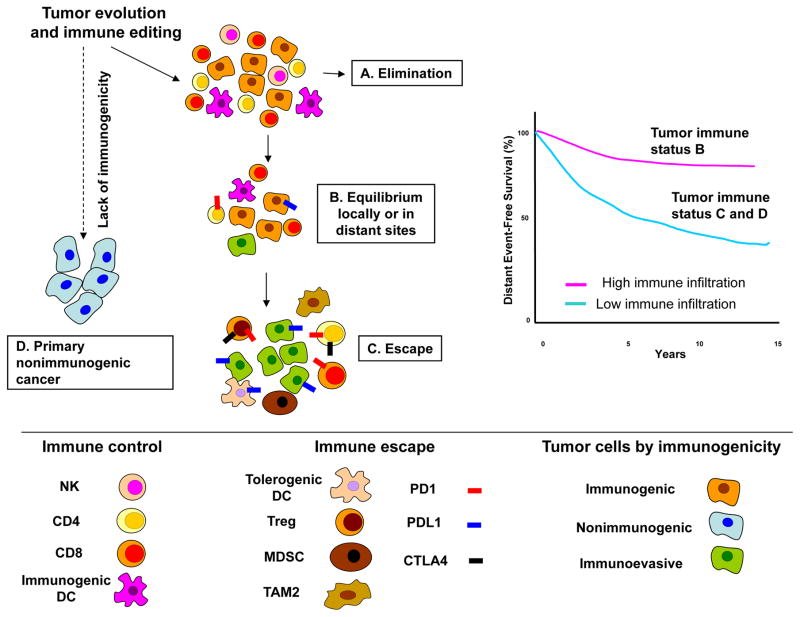
More than 70% of breast cancers contain lymphocytic infiltration in the stroma, and preclinical studies suggest that immunoediting and partial control of cancer progression by the local immune microenvironment operate in most breast cancers. Consistent with this hypothesis, a large number of studies demonstrated a favorable prognostic and chemotherapy response predictive role for immune infiltration in breast cancer. The evidence is particularly strong for triple-negative and HER2-positive cancers. The development of clinically effective immune checkpoint inhibitors now provides an opportunity to test the therapeutic potential of augmenting the local antitumor immune response. Several phase I clinical trials using single-agent anti-PD-1 and anti-PD-L1 antibodies demonstrated objective tumor response rates, with remarkably durable responses, in heavily pretreated, metastatic, triple-negative cancers and somewhat lower responses in estrogen receptor-positive cancers. Currently, close to 50 ongoing, or soon to open, clinical trials evaluate the role of this new treatment modality in breast cancer. Clin Cancer Res; 22(9); 2105-10. ©2016 AACR.
©2016 American Association for Cancer Research.
Conflict of interest statement
L. Pusztai reports receiving research support from AstraZeneca, Genentech, and Merck and speakers bureau honoraria from Merck. G. Bianchini reports receiving speakers bureau honoraria from Roche. No potential conflicts of interest were disclosed by the other authors.
Figures
References
-
- Iwamoto T, Bianchini G, Booser D, Qi Y, Coutant C, Shiang C, et al. Gene pathways associated with prognosis and chemotherapy sensitivity in molecular subtypes of breast cancer. J Natl Cancer Inst. 2011;103:264–72. - PubMed
-
- Denkert C, Loibl S, Noske A, Roller M, Muller BM, Komor M, et al. Tumor-associated lymphocytes as an independent predictor of response to neoadjuvant chemotherapy in breast cancer. J Clin Oncol. 2010;28:105–13. - PubMed
-
- Denkert C, Von Minckwitz G, Brase JC, Sinn BV, Gade S, Kronenwett R, et al. Tumor-infiltrating lymphocytes and response to neoadjuvant chemotherapy with or without carboplatin in human epidermal growth factor receptor 2–positive and triple-negative primary breast cancers. J Clin Oncol. 2015;33:983–91. - PubMed
Publication types
MeSH terms
Substances
Grants and funding
LinkOut - more resources
Full Text Sources
Other Literature Sources
Medical
Research Materials
Miscellaneous