. 2016 Feb 11;8(3):507-18.
doi: 10.1093/gbe/evw018.

Duplication and Diversification of Dipteran Argonaute Genes, and the Evolutionary Divergence of Piwi and Aubergine

Affiliations

Duplication and Diversification of Dipteran Argonaute Genes, and the Evolutionary Divergence of Piwi and Aubergine

Samuel H Lewis et al. Genome Biol Evol. .

Abstract

Genetic studies of Drosophila melanogaster have provided a paradigm for RNA interference (RNAi) in arthropods, in which the microRNA and antiviral pathways are each mediated by a single Argonaute (Ago1 and Ago2) and germline suppression of transposable elements is mediated by a trio of Piwi-subfamily Argonaute proteins (Ago3, Aub, and Piwi). Without a suitable evolutionary context, deviations from this can be interpreted as derived or idiosyncratic. Here we analyze the evolution of Argonaute genes across the genomes and transcriptomes of 86 Dipteran species, showing that variation in copy number can occur rapidly, and that there is constant flux in some RNAi mechanisms. The lability of the RNAi pathways is illustrated by the divergence of Aub and Piwi (182-156 Ma), independent origins of multiple Piwi-family genes in Aedes mosquitoes (less than 25Ma), and the recent duplications of Ago2 and Ago3 in the tsetse fly Glossina morsitans. In each case the tissue specificity of these genes has altered, suggesting functional divergence or innovation, and consistent with the action of dynamic selection pressures across the Argonaute gene family. We find there are large differences in evolutionary rates and gene turnover between pathways, and that paralogs of Ago2, Ago3, and Piwi/Aub show contrasting rates of evolution after duplication. This suggests that Argonautes undergo frequent evolutionary expansions that facilitate functional divergence.

Keywords: Argonaute; Diptera; Piwi; RNAi; gene duplication.


Figures

F<sc>ig</sc>. 1.—
Fig. 1.—
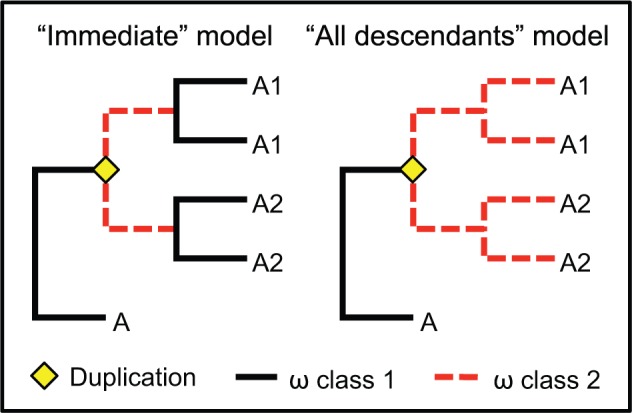
The two models fitted to branches after duplication events. Immediate models the expectation if selection pressures change only briefly after duplication, whereas All descendants models the expectation if paralogs evolve at a consistently different rate.
F<sc>ig</sc>. 2.—
Fig. 2.—
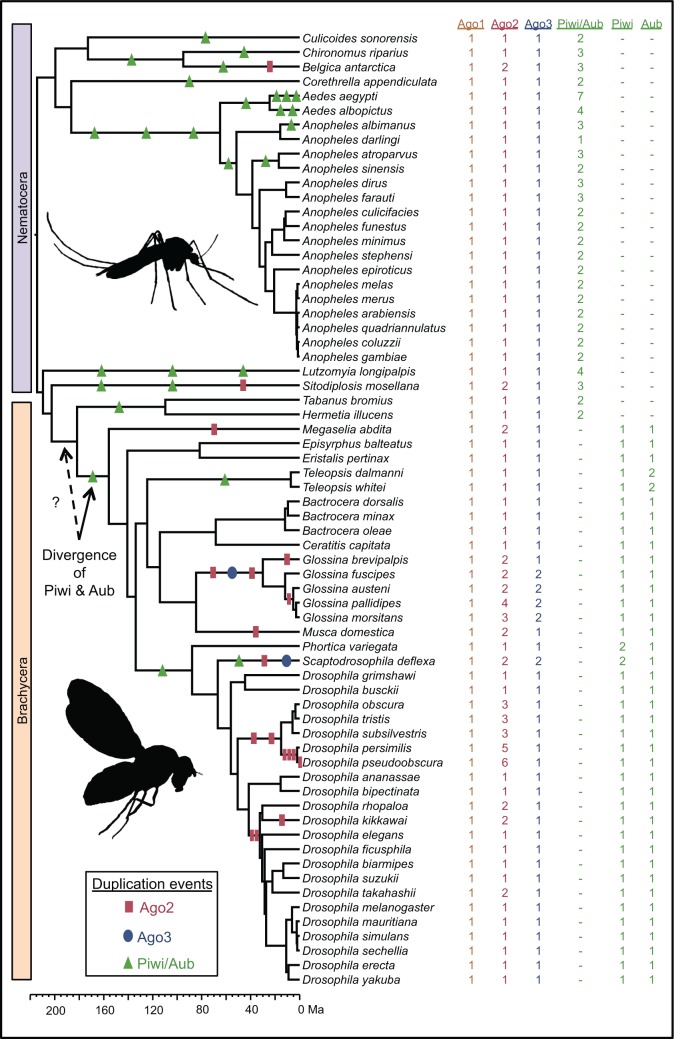
Counts of each Argonaute subclade. Shown are counts for a subsample of 66 Dipteran species with at least one gene in each subclade (out of a total of 86 species). Gene duplication events were inferred by parsimony, and are illustrative only (gene loss is not depicted due to space constraints, thus for some taxa gene counts do not correspond to the number of gene duplications). The rate of gene turnover differs between different Argonautes and lineages, and the divergence of Piwi and Aub occurred 182–156 Ma. Silhuoettes by Warren Photographic and Ramiro Morales-Hojas.
F<sc>ig</sc>. 3.—
Fig. 3.—
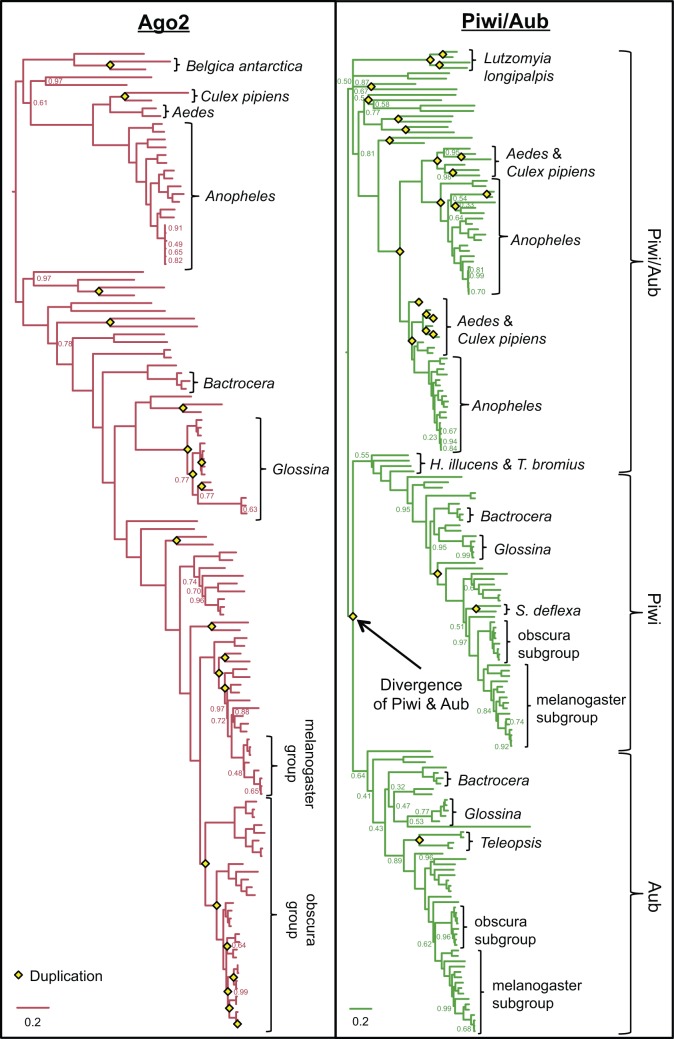
Bayesian gene trees of Ago2 and Piwi/Aub. Ago2 has expanded rapidly in Glossina and the obscura group of Drosophila, whereas Piwi/Aub has undergone numerous duplications in Aedes, Anopheles, and many other Nematoceran taxa.
F<sc>ig</sc>. 4.—
Fig. 4.—
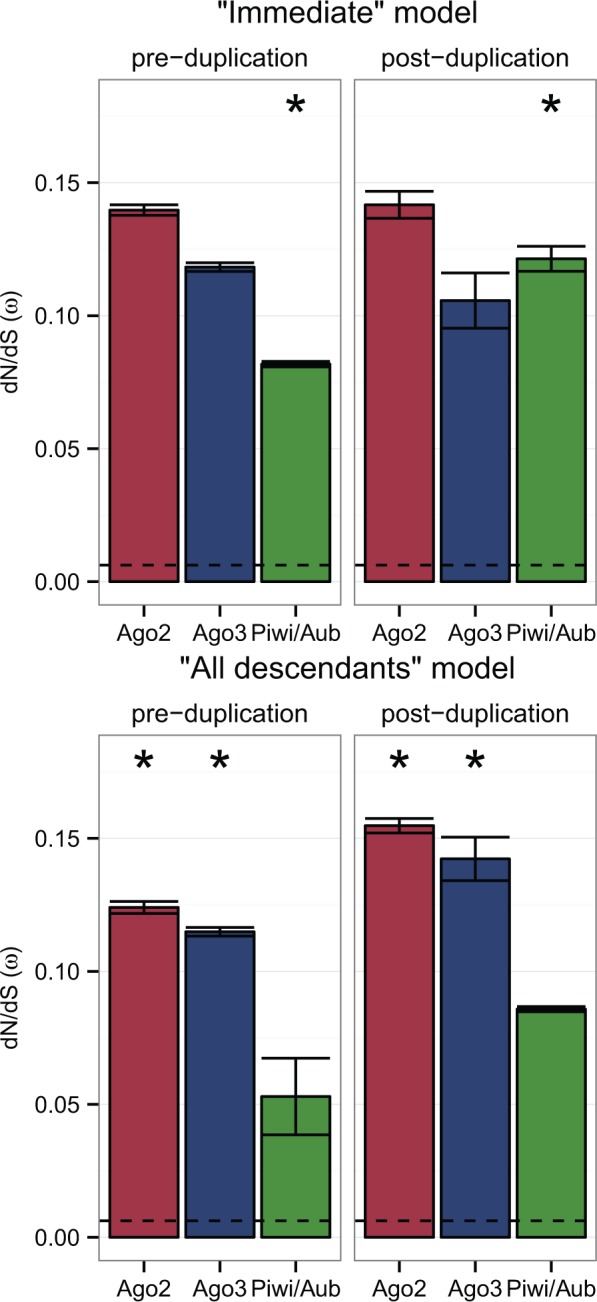
Evolutionary rate estimates before and after duplication, under the Immediate and All descendants models. Asterisks indicate the most highly supported model, and the dashed line indicates the ω value for Ago1 under the M0 model. Duplicates of Piwi/Aub evolve more quickly immediately after duplication, whereas Ago2 and Ago3 paralogs experience a sustained increase in evolutionary rate.
F<sc>ig</sc>. 5.—
Fig. 5.—
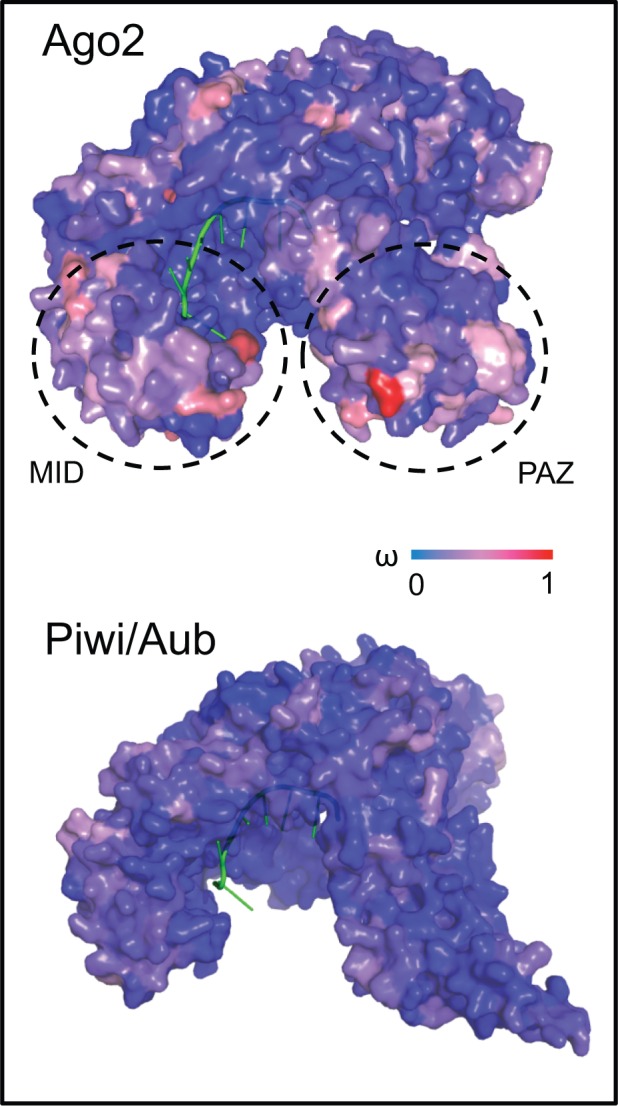
Evolutionary rates mapped onto 3D structures of Ago2 and Piwi/Aub, each binding a sRNA guide. In Ago2, hotspots of evolution are seen at the entrance of the RNA binding pocket; in contrast, evolutionary rate (ω) across the structure of Piwi/Aub is uniformly low. The MID and PAZ protein domains are indicated for Ago2.

References

    1. Altschul SF, et al. 1997. Gapped BLAST and PSI-BLAST: a new generation of protein database search programs. Nucleic Acids Res. 25:3389–3402. - PMC - PubMed
    1. Anisimova M, Bielawski JP, Yang Z. 2001. Accuracy and power of the likelihood ratio test in detecting adaptive molecular evolution. Mol Biol Evol. 18:1585–1592. - PubMed
    1. Arensburger P, Hice RH, Wright JA, Craig NL, Atkinson PW. 2011. The mosquito Aedes aegypti has a large genome size and high transposable element load but contains a low proportion of transposon-specific piRNAs. BMC Genomics 12:606. - PMC - PubMed
    1. Assis R, Bachtrog D. 2013. Neofunctionalization of young duplicate genes in Drosophila. Proc Natl Acad Sci U S A. 110:17409–17414. - PMC - PubMed
    1. Benoit JB, et al. 2014. A novel highly divergent protein family identified from a viviparous insect by RNA-seq analysis: a potential target for tsetse fly-specific abortifacients. PLoS Genet. 10:6–10. - PMC - PubMed

Publication types

LinkOut - more resources