Review
. 2016 Feb;28(2):314-25.
doi: 10.1105/tpc.15.00911. Epub 2016 Feb 11.

Creating Order from Chaos: Epigenome Dynamics in Plants with Complex Genomes

Affiliations
Review

Creating Order from Chaos: Epigenome Dynamics in Plants with Complex Genomes

Nathan M Springer et al. Plant Cell. 2016 Feb.

Abstract

Flowering plants have strikingly distinct genomes, although they contain a similar suite of expressed genes. The diversity of genome structures and organization is largely due to variation in transposable elements (TEs) and whole-genome duplication (WGD) events. We review evidence that chromatin modifications and epigenetic regulation are intimately associated with TEs and likely play a role in mediating the effects of WGDs. We hypothesize that the current structure of a genome is the result of various TE bursts and WGDs and it is likely that the silencing mechanisms and the chromatin structure of a genome have been shaped by these events. This suggests that the specific mechanisms targeting chromatin modifications and epigenomic patterns may vary among different species. Many crop species have likely evolved chromatin-based mechanisms to tolerate silenced TEs near actively expressed genes. These interactions of heterochromatin and euchromatin are likely to have important roles in modulating gene expression and variability within species.


Figures

Figure 1.
Figure 1.
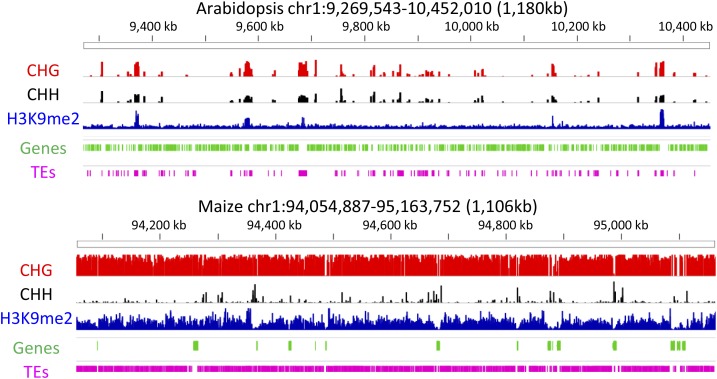
Striking Differences in Genome and Epigenome Organization in Different Plant Species. The organization of genes (green) and TEs (pink) is shown for portions of the maize and Arabidopsis genomes (annotations from TAIR10 [ftp://ftp.arabidopsis.org/home/tair/Genes/TAIR10_genome_release/] and maize RefGen2.0 [ftp://ftp.gramene.org/pub/gramene/maizesequence.org/release-5b/]). The relative abundance of three chromatin modifications, CHG DNA methylation (red), CHH DNA methylation (black), and H3K9me2 methylation (blue), are also shown (primary maize data are from West et al. [2014], Arabidopsis DNA methylation is from Schmitz et al. [2011], and H3K9me2 data are from Stroud et al. [2014]). Whereas Arabidopsis is quite gene rich and only has limited regions with CHG or H3K9me2, maize has fewer genes and the majority of the genome is decorated with CHG methylation and H3K9me2. While CHG and CHH often occur together in Arabidopsis, CHG and H3K9me2 are closely related in maize, and there are limited regions with high CHH in maize, most of which is close to genes.
Figure 2.
Figure 2.
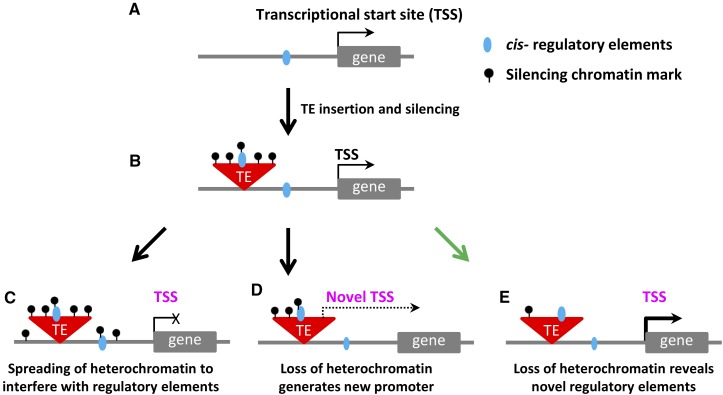
Potential Interactions between TE Chromatin State and Expression of Nearby Genes. (A) and (B) A simple model in which a new TE insertion occurs near a gene. The new TE insertion accumulates chromatin modifications associated with silencing. (C) to (E) Various scenarios of altered TE chromatin and gene expression are illustrated. (C) The silencing chromatin marks present within the TE could spread to surrounding sequences and alter the accessibility of cis-regulatory elements resulting in reduced gene expression. (D) Loss of heterochromatic chromatin modifications near the edge of the transposon could result in activation of an outward reading promoter that would influence gene expression. (E) The loss of heterochromatic modification within the TE could expose cis-regulatory that would then alter expression of a nearby gene. The loss of heterochromatic chromatin modifications in the TE could be a stochastic effect or could be due to spreading of euchromatin from a highly active nearby gene.
Figure 3.
Figure 3.
Illustration of Potential for Altered siRNA, TE, and Gene Expression in Newly Formed Allopolyploids. Two parental species with varying TE content and homologous siRNA populations are diagrammed. These are brought together in the same nucleus in the allopolyploid, and in this case we diagram novel (pink) or reduced/loss of (blue) siRNA levels for specific TEs. This could lead to altered chromatin at the TEs as well as increases or decreases in the expression of adjacent changes.

Comment in

References

    1. Adams K.L., Wendel J.F. (2005). Polyploidy and genome evolution in plants. Curr. Opin. Plant Biol. 8: 135–141. - PubMed
    1. Ahmed I., Sarazin A., Bowler C., Colot V., Quesneville H. (2011). Genome-wide evidence for local DNA methylation spreading from small RNA-targeted sequences in Arabidopsis. Nucleic Acids Res. 39: 6919–6931. - PMC - PubMed
    1. Baker K., Dhillon T., Colas I., Cook N., Milne I., Milne L., Bayer M., Flavell A.J. (2015). Chromatin state analysis of the barley epigenome reveals a higher-order structure defined by H3K27me1 and H3K27me3 abundance. Plant J. 84: 111–124. - PMC - PubMed
    1. Barber W.T., Zhang W., Win H., Varala K.K., Dorweiler J.E., Hudson M.E., Moose S.P. (2012). Repeat associated small RNAs vary among parents and following hybridization in maize. Proc. Natl. Acad. Sci. USA 109: 10444–10449. - PMC - PubMed
    1. Barkan A., Martienssen R.A. (1991). Inactivation of maize transposon Mu suppresses a mutant phenotype by activating an outward-reading promoter near the end of Mu1. Proc. Natl. Acad. Sci. USA 88: 3502–3506. - PMC - PubMed

Publication types

LinkOut - more resources