. 2016 Feb 4:7:55.
doi: 10.3389/fpls.2016.00055. eCollection 2016.

BdCESA7, BdCESA8, and BdPMT Utility Promoter Constructs for Targeted Expression to Secondary Cell-Wall-Forming Cells of Grasses

Affiliations

BdCESA7, BdCESA8, and BdPMT Utility Promoter Constructs for Targeted Expression to Secondary Cell-Wall-Forming Cells of Grasses

Deborah L Petrik et al. Front Plant Sci. .

Abstract

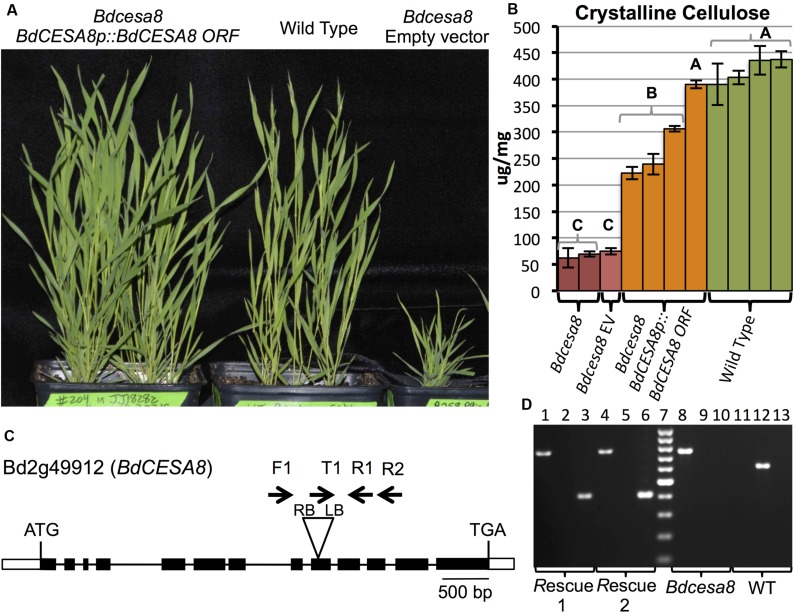
Utility vectors with promoters that confer desired spatial and temporal expression patterns are useful tools for studying gene and cellular function and for industrial applications. To target the expression of DNA sequences of interest to cells forming plant secondary cell walls, which generate most of the vegetative biomass, upstream regulatory sequences of the Brachypodium distachyon lignin biosynthetic gene BdPMT and the cellulose synthase genes BdCESA7 and BdCESA8 were isolated and cloned into binary vectors designed for Agrobacterium-mediated transformation of monocots. Expression patterns were assessed using the β-glucuronidase gene GUSPlus and X-glucuronide staining. All three promoters showed strong expression levels in stem tissue at the base of internodes where cell wall deposition is most active, in both vascular bundle xylem vessels and tracheids, and in interfascicular tissues, with expression less pronounced in developmentally older tissues. In leaves, BdCESA7 and BdCESA8 promoter-driven expression was strongest in leaf veins, leaf margins, and trichomes; relatively weaker and patchy expression was observed in the epidermis. BdPMT promoter-driven expression was similar to the BdCESA promoters expression patterns, including strong expression in trichomes. The intensity and extent of GUS staining varied considerably between transgenic lines, suggesting that positional effects influenced promoter activity. Introducing the BdPMT and BdCESA8 Open Reading Frames into BdPMT and BdCESA8 utility promoter binary vectors, respectively, and transforming those constructs into Brachypodium pmt and cesa8 loss-of-function mutants resulted in rescue of the corresponding mutant phenotypes. This work therefore validates the functionality of these utility promoter binary vectors for use in Brachypodium and likely other grass species. The identification, in Bdcesa8-1 T-DNA mutant stems, of an 80% reduction in crystalline cellulose levels confirms that the BdCESA8 gene is a secondary-cell-wall-forming cellulose synthase.

Keywords: Brachypodium; binary vectors; cellulose; lignin; monocot; p-coumarate; tissue-specific expression.


Figures
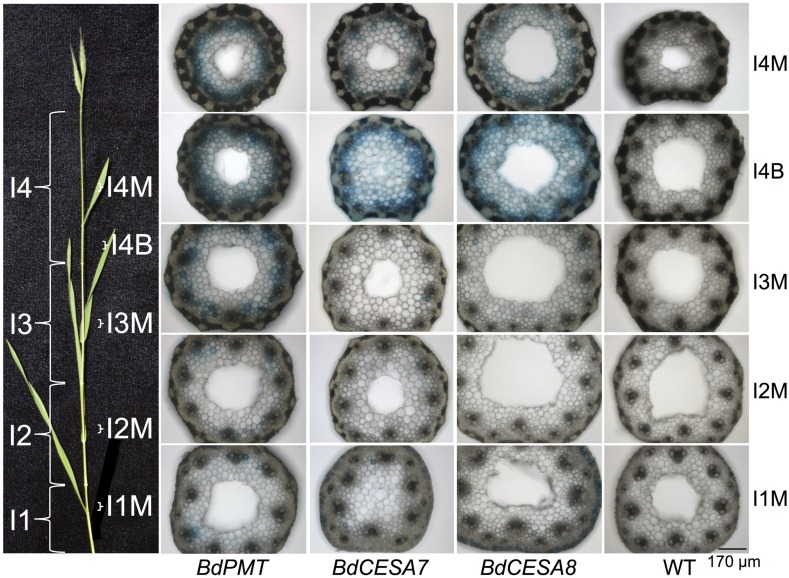
FIGURE 1
FIGURE 1
GUS-stained Brachypodium distachyon stem cross sections from 37-day-old plants transformed with the BdPMT (first column), BdCESA7 (second column), and BdCESA8prom::GUSPlus (third column) constructs. Wild type (WT) control sections are shown in the fourth column. Sections for a given line were from the same culm. All sections were stained the same duration so as to show relative expression levels. Pictured on the left is a culm with its internodes (I) labeled along with the locations from which each section was taken. B = base and M = middle of internode. Scale bar for sections = 170 μm.
FIGURE 2
FIGURE 2
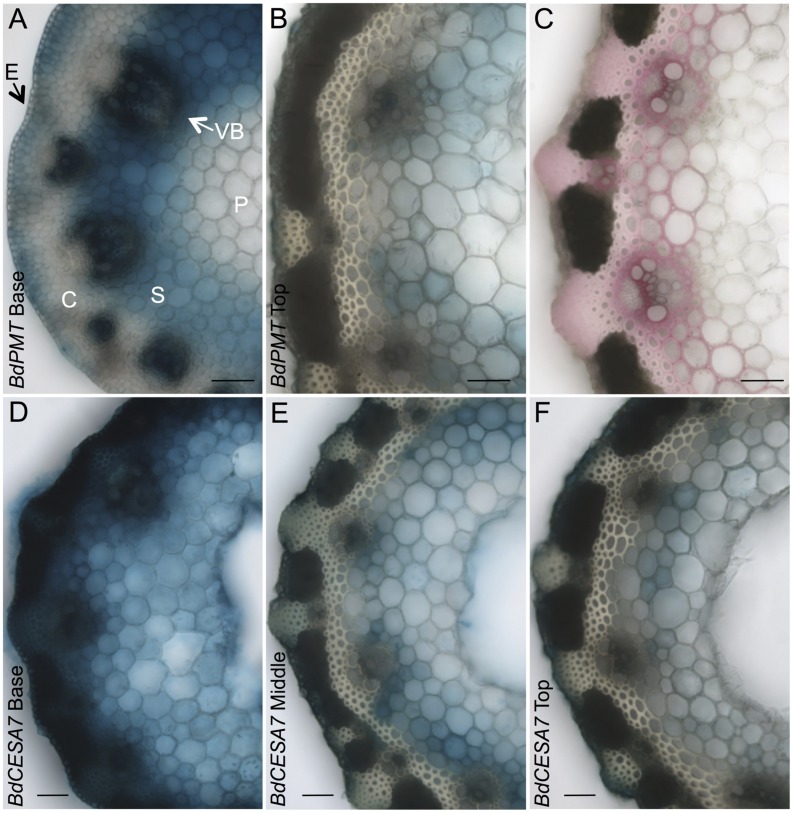
GUS- and phloroglucinol-stained stem cross sections from 37-day-old plants. (A,B) BdPMTprom::GUSPlus sections from the base (A) and top (B) of the apical internode. (C) Stem section from the top of an apical internode stained with phloroglucinol to visualize lignin (red coloration). (D–F) BdCESA7prom::GUSPlus sections from the base (D), middle (E), and top (F) of the apical internode. Sections for a given line were from the same internode. All sections were GUS-stained the same duration so as to show relative expression levels. Note that some of blue color in the pith may be from diffusion of the colorimetric product. E = Epidermis; C = Cortex; VB = Vascular Bundle; S = Sclerenchyma; P = Parenchyma. Scale bar = 50 μm.
FIGURE 3
FIGURE 3
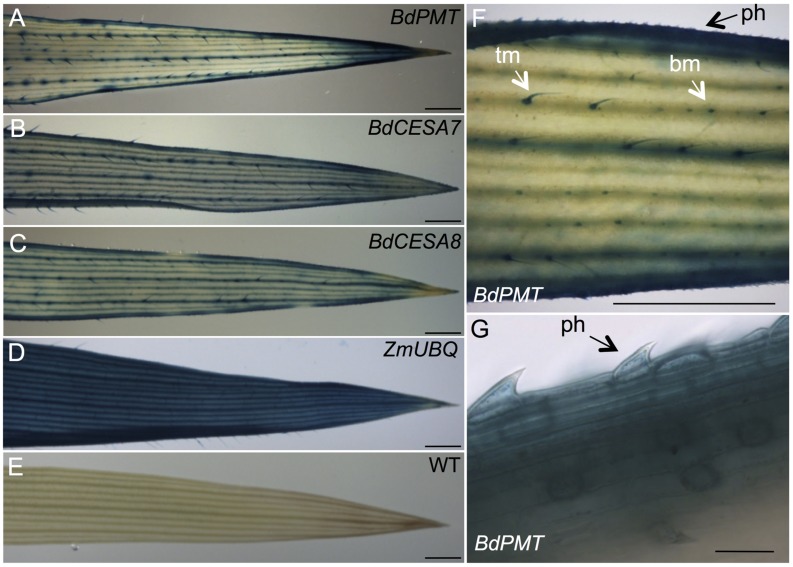
GUS-stained leaf snippets from 37-day-old plants. (A) BdPMTprom::GUSPlus. (B) BdCESA7prom::GUSPlus. (C) BdCESA8prom::GUSPlus. (D) ZmUBQprom::GUSPlus. (E) Wild type. (F,G) Close-up views of GUS-stained BdPMTprom::GUSPlus leaves. ph = prickle hair. Tm = trichome macrohair; bm = bicellular microhair. Scale bars in A–F = 1 mm. Scale bar in G = 30 μm.
FIGURE 4
FIGURE 4
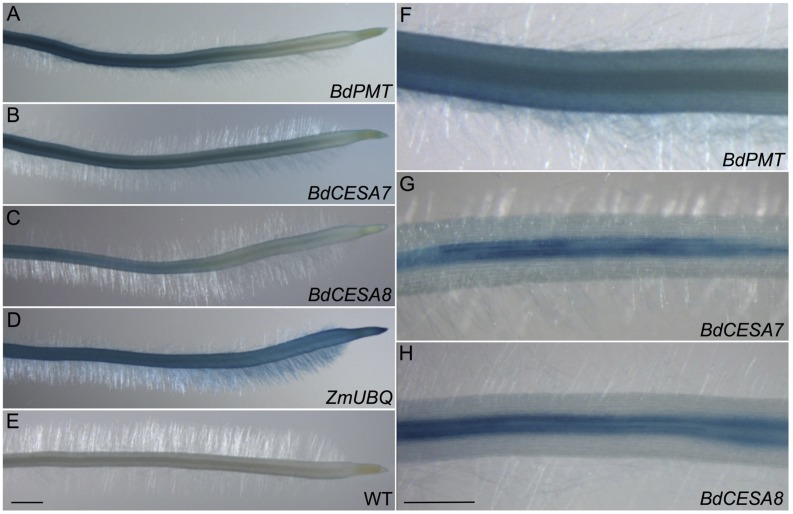
GUS-stained roots from 3-day-old seedlings. (A,F) BdPMTprom::GUSPlus. (B,G) BdCESA7prom::GUSPlus. (C,H) BdCESA8prom::GUSPlus. (D) ZmUBQprom::GUSPlus. (E) Wild type. Scale bar = 1 mm for A–E, 0.5 mm for F–H.
FIGURE 5
FIGURE 5
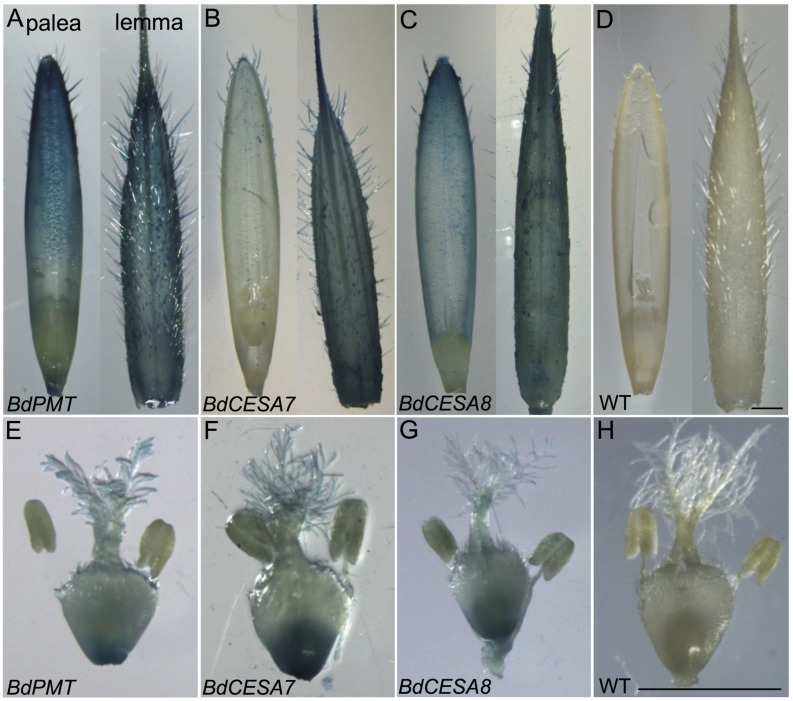
GUS-stained florets and internal floral organs prior to seed fill. (A,E) BdPMTprom::GUSPlus. (B,F) BdCESA7prom::GUSPlus. (C,G) BdCESA8prom::GUSPlus. (D,H) Wild type. Shown in (A–D) are the palea (left) and lemma (right). Shown in (E–H) are the pistil and anthers. Scale bars = 1 mm.
FIGURE 6
FIGURE 6
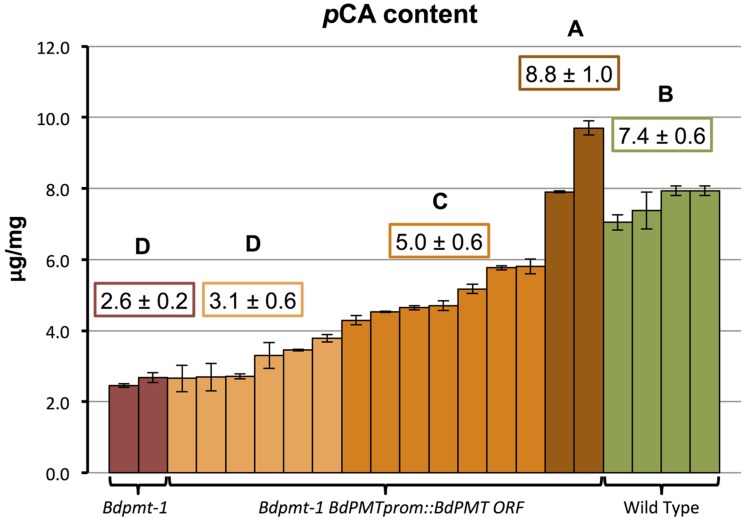
Quantification of p-coumaric acid (pCA) released by 2 M NaOH from senesced stems of the following plants: Bdpmt-1; T0-generation Bdpmt-1 harboring BdPMTprom::BdPMT ORF (15 independent events grouped into three statistically different groups where light orange = <50% rescue, dark orange (50—75% rescue, and brown (100% or greater rescue). Means for different groups are shown in color-coded boxes. Letters represent statistically different groups. Bars represent standard errors of three technical replicates.
FIGURE 7
FIGURE 7
Transgenic rescue of the Bdcesa8-1 stunted culm growth and reduced cellulose phenotypes. (A) T1-generation homozygous Bdcesa8-1 plants harboring the BdCESA8prom::BdCESA8 ORF construct (left pot) exhibit culm growth comparable to WT plants (center pot). Right pot contains a homozygous Bdcesa8-1 plant transformed with the empty vector (no rescue). (B) Crystalline cellulose content of senesced stems from the following plants: Bdcesa8-1; Bdcesa8-1 containing the empty vector (Bdcesa8 EV); Bdcesa8-1 containing BdCESA8prom::BdCESA8 ORF; Wild type. Bars represent standard errors, three technical replicates. Different letters represent statistical differences. (C) Diagram of the BdCESA8 gene Bd2g49912 drawn to scale. Bars and lines represent exons and introns, respectively. Shown is the location of the T-DNA insertion (triangle) in the Bdcesa8-1 mutant line JJ18282 along with relative primer locations (arrows). RB and LB represent T-DNA right border and left border. (D) Agarose gel-electrophoresed PCR products, scoring for the presence of the Bdcesa8-1 T-DNA (lanes 1, 4, 8, 11; primers Bdcesa8-1_T-DNA_LB_T1 (T1) + BdCESA8_EXON11_R2 (R2), 756 bp product) or the absence of the T-DNA (lanes 2, 5, 9, 12; primers BdCESA8_INTRON7_F1 (F1) + BdCESA8_EXON10_R1 (R1), 627 bp product) as well as the presence or absence of the BdCESA8prom::BdCESA8 ORF rescue construct (lanes 3, 6, 10, 13; primers BdCESA8_EXON13_F + NOST_R, 408 bp product). Rescue 1 and 2 are two independent Bdcesa8-1 plants transformed with BdCESA8prom::BdCESA8 ORF (plants shown in A). Lane 7 is the Fermentas GeneRuler 100 bp ladder (cat #SM0241).

References

    1. Beeckman T., Przemeck G. K., Stamatiou G., Lau R., Terryn N., De Rycke R., et al. (2002). Genetic complexity of cellulose synthase a gene function in Arabidopsis embryogenesis. Plant Physiol. 130 1883–1893. 10.1104/pp.102.010603 - DOI - PMC - PubMed
    1. Bragg J., Wu J., Gordon S., Guttman M., Thilmony R., Lazo G., et al. (2012). Generation and characterization of the Western Regional Research Center Brachypodium T-DNA insertional mutant collection. PLoS ONE 7:e41916 10.1371/journal.pone.0041916 - DOI - PMC - PubMed
    1. Breyne P., van Montagu M., Depicker N., Gheysen G. (1992). Characterization of a plant scaffold attachment region in a DNA fragment that normalizes transgene expression in tobacco. Plant Cell 4 463–471. 10.1105/tpc.4.4.463 - DOI - PMC - PubMed
    1. Carroll A., Somerville C. R. (2009). Cellulosic biofuels. Annu. Rev. Plant Biol. 160 165–182. 10.1146/annurev.arplant.043008.092125 - DOI - PubMed
    1. Chapple C., Ladisch M., Meilan R. (2007). Loosening lignin’s grip on biofuel production. Nat. Biotechnol. 25 746–748. 10.1038/nbt0707-746 - DOI - PubMed