


Low Vitamin-D Levels Combined with PKP3-SIGIRR-TMEM16J Host Variants Is Associated with Tuberculosis and Death in HIV-Infected and -Exposed Infants
- PMID: 26872154
- PMCID: PMC4752266
- DOI: 10.1371/journal.pone.0148649
Low Vitamin-D Levels Combined with PKP3-SIGIRR-TMEM16J Host Variants Is Associated with Tuberculosis and Death in HIV-Infected and -Exposed Infants
Abstract
Background: This study examined the associations of 25-hydroxyvitamin D and specific host genetic variants that affect vitamin D levels or its effects on immune function, with the risk of TB or mortality in children.
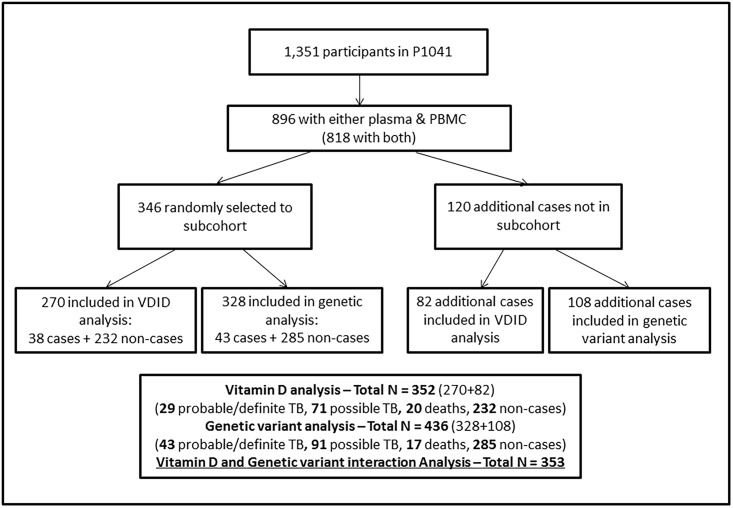
Methods: A case-cohort sample of 466 South African infants enrolled in P1041 trial (NCT00080119) underwent 25-hydroxyvitamin D testing by chemiluminescent immunoassay. Single nucleotide polymorphisms (SNPs) that alter the effect of vitamin D [e.g. vitamin D receptor (VDR)], vitamin D levels [e.g. vitamin D binding protein (VDBP)], or toll like receptor (TLR) expression (SIGIRR including adjacent genes PKP3 and TMEM16J) were identified by real-time PCR. Outcomes were time to TB, and to the composite of TB or death by 192 weeks of follow-up. Effect modification between vitamin D status and SNPs for outcomes was assessed.
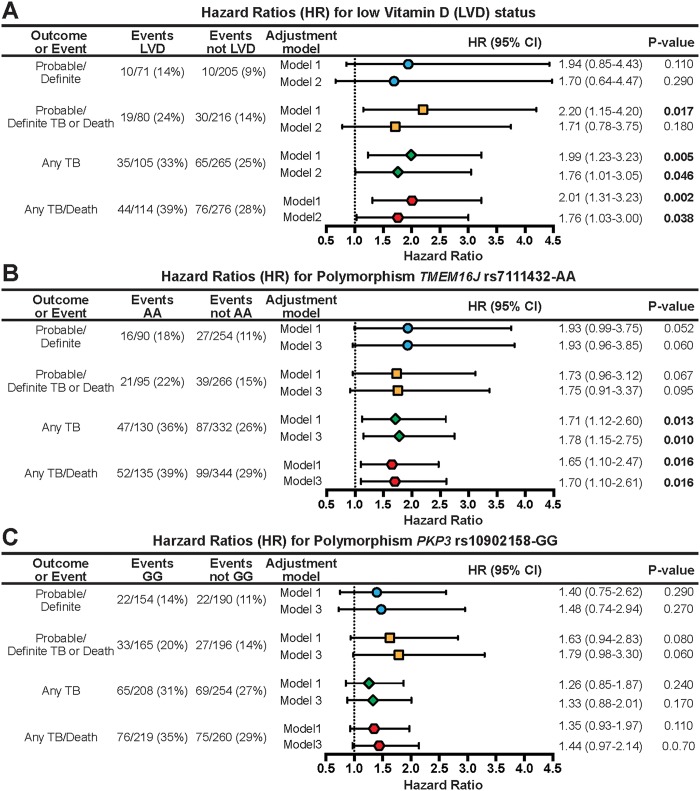
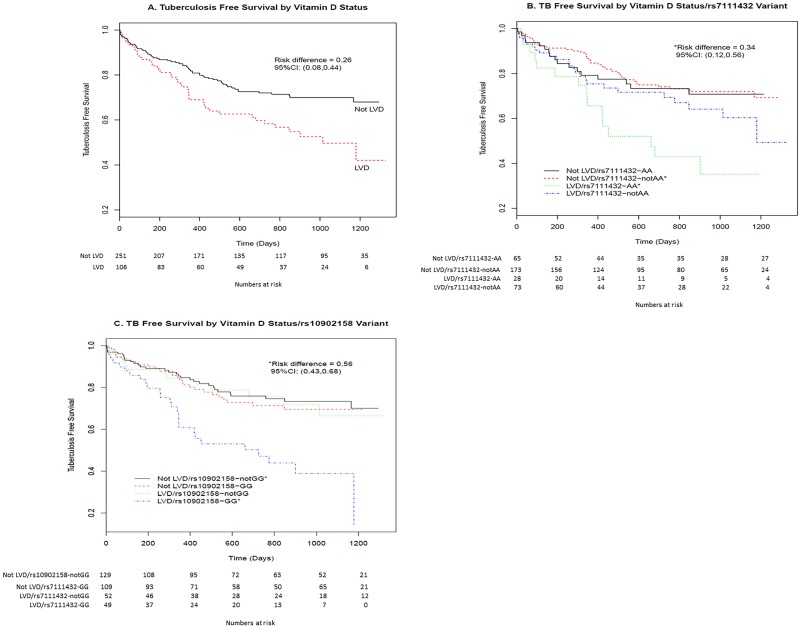
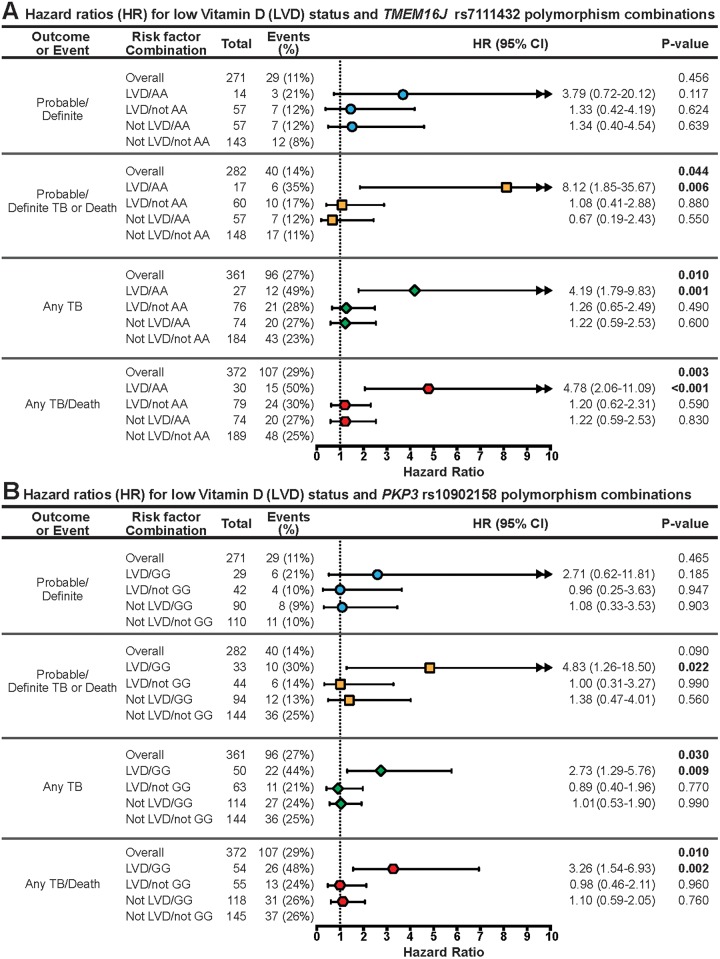
Findings: Median age at 25-hydroxyvitamin D determination was 8 months; 11% were breastfed, 51% were HIV-infected and 26% had low 25-hydroxyvitamin D (<32ng/mL). By 192 weeks, 138 incident TB cases (43 definite/probable, and 95 possible) and 26 deaths occurred. Adjusting for HIV status and potential confounders, low 25-hydroxyvitamin D was associated with any TB (adjusted hazard ratio [aHR] 1.76, 95% CI 1.01-3.05; p = 0.046) and any TB or death (aHR 1.76, 95% CI 1.03-3.00; p = 0.038). Children with low 25-hydroxyvitamin D and TMEM 16J rs7111432-AA or PKP3 rs10902158-GG were at increased risk for probable/definite TB or death (aHR 8.12 and 4.83, p<0.05) and any TB or death (aHR 4.78 and 3.26, p<0.005) respectively; SNPs in VDBP, VDR, and vitamin D precursor or hydroxylation genes were not. There was significant interaction between low 25-hydroxyvitamin D and, TMEM 16J rs7111432-AA (p = 0.04) and PKP3 rs10902158-GG (p = 0.02) SNPs.
Conclusions: Two novel SNPs, thought to be associated with innate immunity, in combination with low vitamin D levels were identified as increasing a young child's risk of developing TB disease or death. Identifying high-risk children and providing targeted interventions such as vitamin D supplementation may be beneficial.
Trial registration: ClinicalTrials.gov NCT00080119.
Conflict of interest statement
Figures
References
-
- Hesseling AC, Cotton MF, Jennings T, Whitelaw A, Johnson LF, Eley B, et al. High incidence of tuberculosis among HIV-infected infants: evidence from a South African population-based study highlights the need for improved tuberculosis control strategies. Clinical infectious diseases: an official publication of the Infectious Diseases Society of America. 2009;48(1):108–14. 10.1086/595012 . - DOI - PubMed
-
- WHO. Global Tuberculosis Report Geneva, Switzerland: World Health Organization; 2013.
-
- Graham SM, Ahmed T, Amanullah F, Browning R, Cardenas V, Casenghi M, et al. Evaluation of tuberculosis diagnostics in children: 1. Proposed clinical case definitions for classification of intrathoracic tuberculosis disease. Consensus from an expert panel. J Infect Dis. 2012;205 Suppl 2:S199–208. 10.1093/infdis/jis008 - DOI - PMC - PubMed
Publication types
MeSH terms
Substances
Associated data
Grants and funding
- UM1AI106716/AI/NIAID NIH HHS/United States
- HHSN267200800001G/DK/NIDDK NIH HHS/United States
- UM1 AI068632/AI/NIAID NIH HHS/United States
- M01 RR016587/RR/NCRR NIH HHS/United States
- 5R01NS077874/NS/NINDS NIH HHS/United States
- UM1AI068632/AI/NIAID NIH HHS/United States
- HHSN267200800001C/HD/NICHD NIH HHS/United States
- UM1 AI069453/AI/NIAID NIH HHS/United States
- R01 NS077874/NS/NINDS NIH HHS/United States
- UM1 AI068616/AI/NIAID NIH HHS/United States
- UM1AI069465/AI/NIAID NIH HHS/United States
- UM1AI068616/AI/NIAID NIH HHS/United States
- UM1 AI069465/AI/NIAID NIH HHS/United States
- UM1 AI106716/AI/NIAID NIH HHS/United States
- UM1 AI069536/AI/NIAID NIH HHS/United States
LinkOut - more resources
Full Text Sources
Other Literature Sources
Medical
Miscellaneous
