


Mid- to Long-Term Outcomes of Cervical Disc Arthroplasty versus Anterior Cervical Discectomy and Fusion for Treatment of Symptomatic Cervical Disc Disease: A Systematic Review and Meta-Analysis of Eight Prospective Randomized Controlled Trials
- PMID: 26872258
- PMCID: PMC4752293
- DOI: 10.1371/journal.pone.0149312
Mid- to Long-Term Outcomes of Cervical Disc Arthroplasty versus Anterior Cervical Discectomy and Fusion for Treatment of Symptomatic Cervical Disc Disease: A Systematic Review and Meta-Analysis of Eight Prospective Randomized Controlled Trials
Abstract
Purpose: This study aimed to investigate the mid- to long-term outcomes of cervical disc arthroplasty (CDA) versus anterior cervical discectomy and fusion (ACDF) for the treatment of 1-level or 2-level symptomatic cervical disc disease.
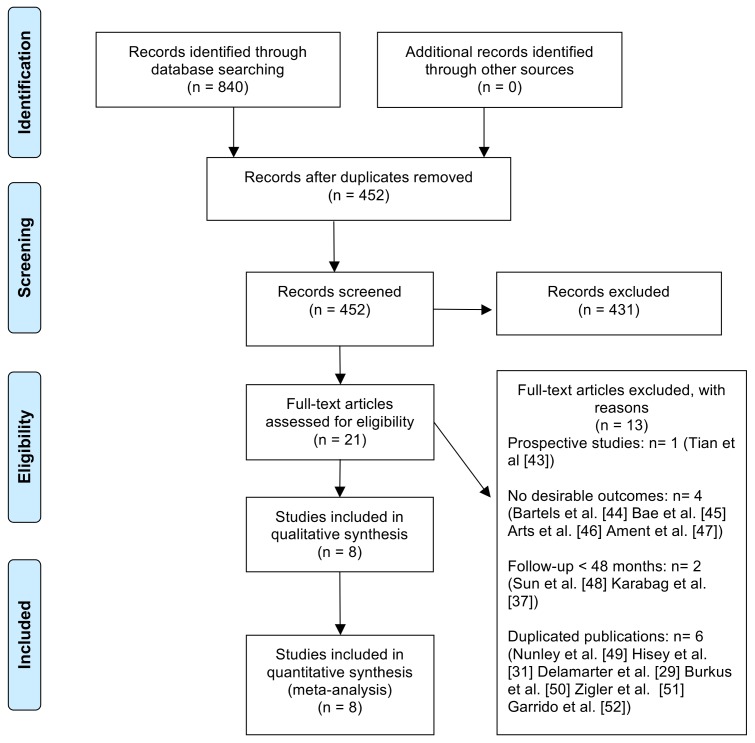
Methods: Medline, Embase, and the Cochrane Central Register of Controlled Trials databases were searched to identify relevant randomized controlled trials that reported mid- to long-term outcomes (at least 48 months) of CDA versus ACDF. All data were analyzed by Review Manager 5.3 software. The relative risk (RR) and 95% confidence intervals (CIs) were calculated for dichotomous variables. The weighted mean difference (WMD) and 95%CIs were calculated for continuous variables. A random effect model was used for heterogeneous data; otherwise, a fixed effect model was used.
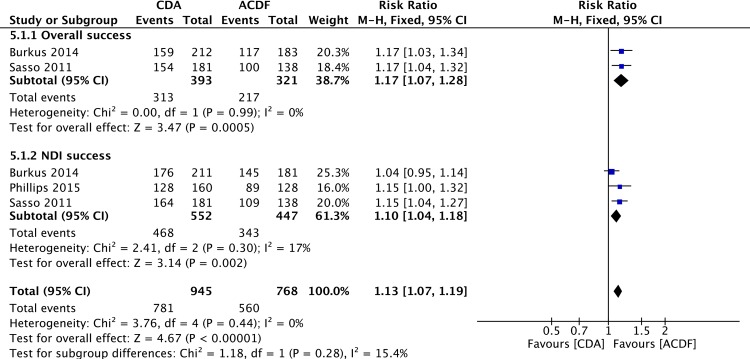
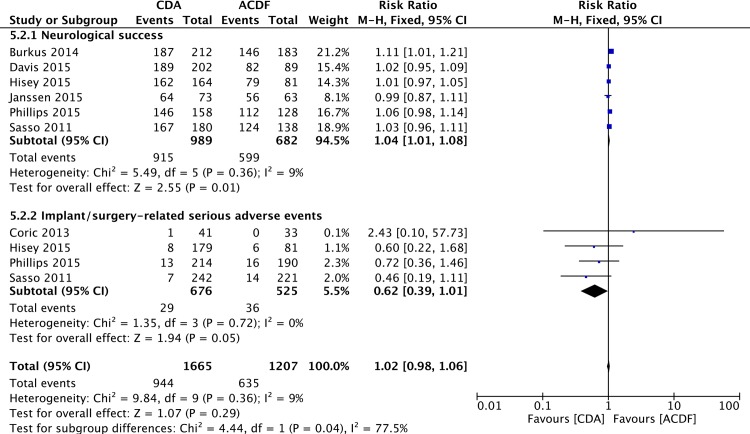
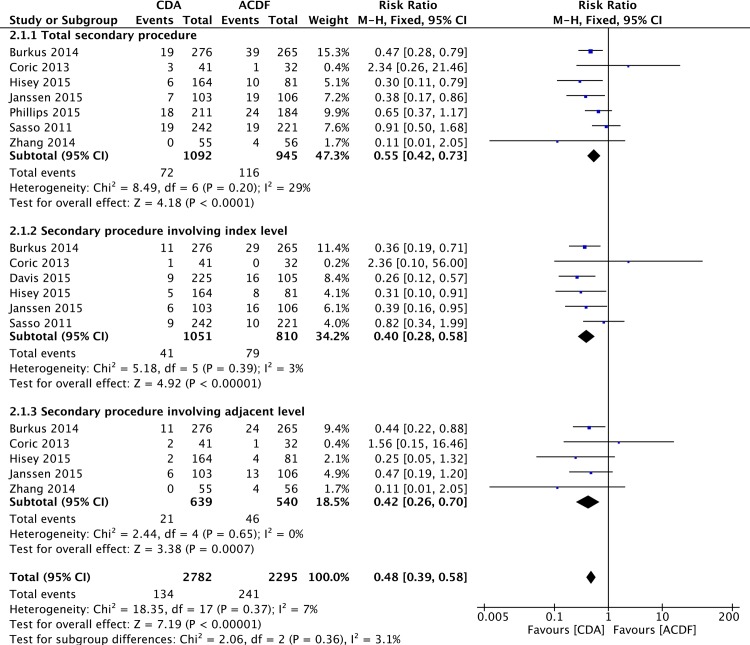
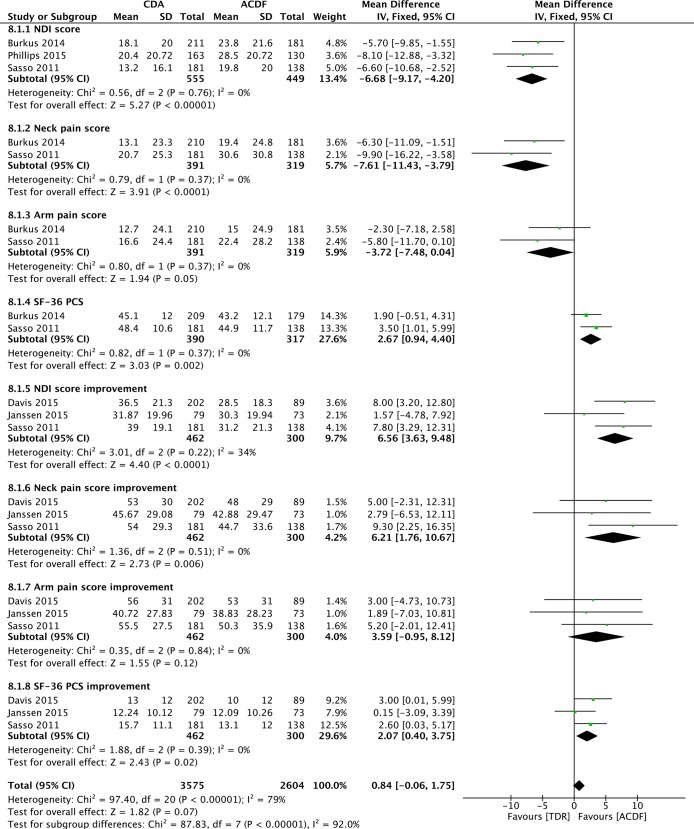
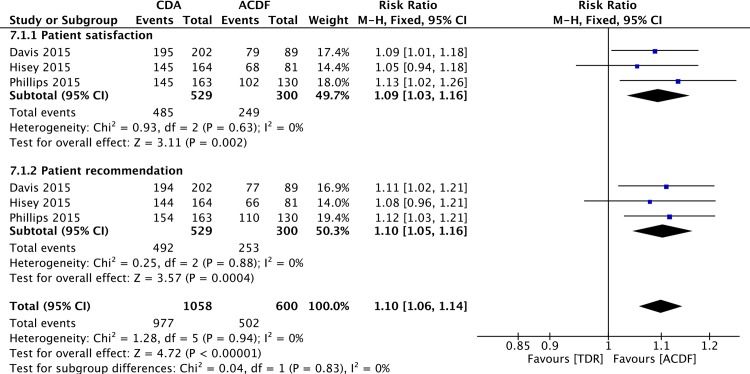
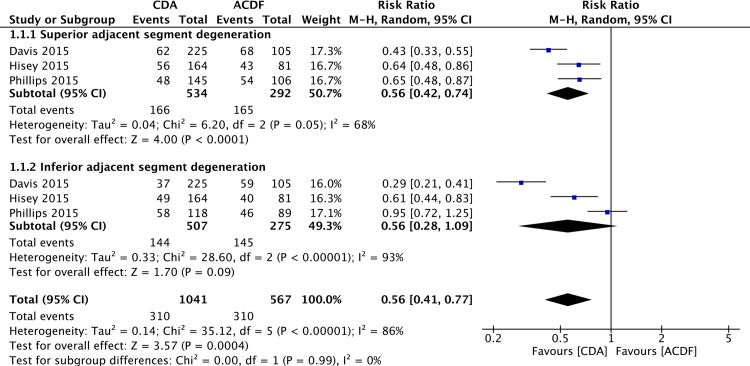
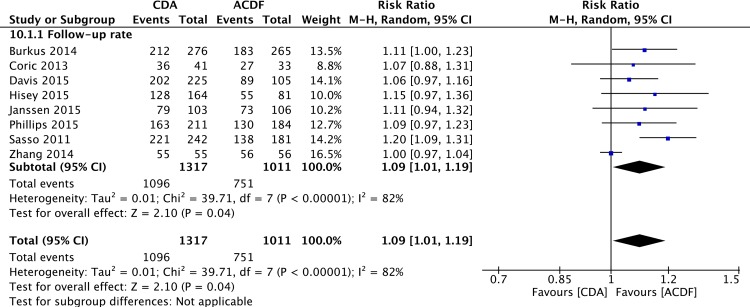
Results: Eight prospective randomized controlled trials (RCTs) were retrieved in this meta-analysis, including 1317 and 1051 patients in CDA and ACDF groups, respectively. Patients after an ACDF had a significantly lower rate of follow-up than that after CDA. Pooled analysis showed patients in CDA group achieved significantly higher rates of overall success, Neck Disability Index (NDI) success, neurological success and significantly lower rates of implant/surgery-related serious adverse events and secondary procedure compared with that in ACDF group. The long-term functional outcomes (NDI, Visual Analog Scale (VAS) neck and arm pain scores, the Short Form 36 Health Survey physical component score (SF-36 PCS)), patient satisfaction and recommendation, and the incidence of superior adjacent segment degeneration also favored patients in CDA group with statistical difference. Regarding inferior adjacent segment degeneration, patients in CDA group had a lower rate without statistical significance.
Conclusions: This meta-analysis showed that cervical disc arthroplasty was superior over anterior discectomy and fusion for the treatment of symptomatic cervical disc disease in terms of overall success, NDI success, neurological success, implant/surgery-related serious adverse events, secondary procedure, functional outcomes, patient satisfaction and recommendation, and superior adjacent segment degeneration.
Conflict of interest statement
Figures
References
-
- Rao RD, Currier BL, Albert TJ, Bono CM, Marawar SV, Poelstra KA, et al. Degenerative cervical spondylosis: clinical syndromes, pathogenesis, and management. J Bone Joint Surg Am. 2007; 89(6): 1360–78. - PubMed
-
- Bohlman HH, Emery SE, Goodfellow DB, Jones PK. Robinson anterior cervical discectomy and arthrodesis for cervical radiculopathy. Long-term follow-up of one hundred and twenty-two patients. J Bone Joint Surg Am. 1993; 75(9): 1298–307. - PubMed
-
- Hilibrand AS, Carlson GD, Palumbo MA, Jones PK, Bohlman HH. Radiculopathy and myelopathy at segments adjacent to the site of a previous anterior cervical arthrodesis. J Bone Joint Surg Am. 1999; 81(4): 519–28. - PubMed
-
- Majd ME, Vadhva M, Holt RT. Anterior cervical reconstruction using titanium cages with anterior plating. Spine (Phila Pa 1976). 1999; 24(15): 1604–10. - PubMed
Publication types
MeSH terms
Supplementary concepts
LinkOut - more resources
Full Text Sources
Other Literature Sources
Medical
