Review
. 2016 Mar;41(3):219-230.
doi: 10.1016/j.tibs.2016.01.002. Epub 2016 Feb 10.

Pyruvate and Metabolic Flexibility: Illuminating a Path Toward Selective Cancer Therapies

Affiliations
Review

Pyruvate and Metabolic Flexibility: Illuminating a Path Toward Selective Cancer Therapies

Kristofor A Olson et al. Trends Biochem Sci. 2016 Mar.

Abstract

Dysregulated metabolism is an emerging hallmark of cancer, and there is abundant interest in developing therapies to selectively target these aberrant metabolic phenotypes. Sitting at the decision-point between mitochondrial carbohydrate oxidation and aerobic glycolysis (i.e., the 'Warburg effect'), the synthesis and consumption of pyruvate is tightly controlled and is often differentially regulated in cancer cells. This review examines recent efforts toward understanding and targeting mitochondrial pyruvate metabolism, and addresses some of the successes, pitfalls, and significant challenges of metabolic therapy to date.

Keywords: cancer; metabolic flexibility; metabolic heterogeneity; metabolism; pyruvate; stem cells.


Figures

Figure 1
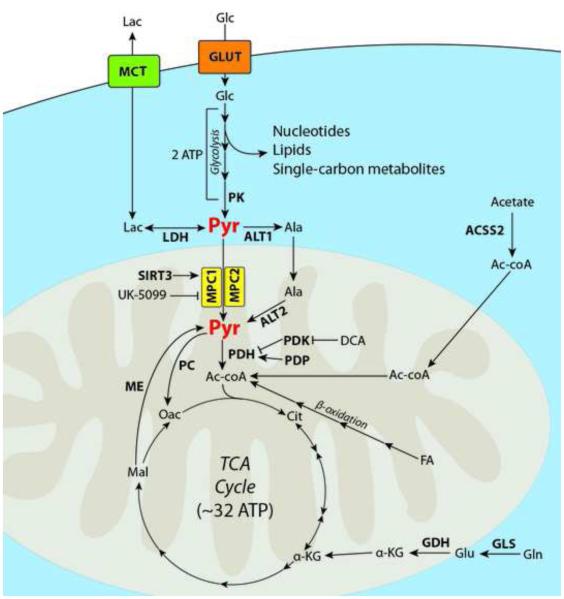
Figure 1. The centrality of pyruvate metabolism
Glucose (Glc) enters the cell via the GLUT family of transporters. It is then catabolized by several enzymes during the process of glycolysis, yielding two molecules of adenosine triphosphate (ATP). Intermediates of glycolysis contribute to nucleotide and lipid biosynthesis, as well as single-carbon donors. The final enzyme of glycolysis, pyruvate kinase (PK), yields 2 molecules of pyruvate (Pyr). Pyruvate can either be utilized in other biosynthetic reactions (such as an amine receptor for alanine transaminase (ALT)), reduced to lactate (Lac) by lactate dehydrogenase (LDH) and excreted from the cell via the monocarboxylate transporters (MCT), or transported into the mitochondrial matrix via the mitochondrial pyruvate carrier (MPC). The MPC can be activated by deacetylation of K45 and K46 by Sirtuin 3, and inhibited by the small molecule UK-5099. Once in the mitochondria, pyruvate can be oxidized via pyruvate dehydrogenase (PDH) to form acetyl-coenzyme A (Ac-coA). The PDH kinases (PDK) phosphorylate PDH to make it inactive. This phosphorylation can be reversed by the PDH phosphatases (PDP), or prevented by the PDK inhibitor dichloroacetate (DCA). Acetyl-CoA is then condensed with Oxaloacetate (Oac) to form citrate (Cit) and begin the first turn of the tricarboxylic acid (TCA) cycle to yield an additional ~30-34 molecules of ATP. In some conditions, acetyl-coA can be generated from scavenged acetate via acetyl-coa synthetase 2 (ACSS2), or via β-oxidation of fatty acids (FA). Some cancers cells in vitro heavily rely on glutamine (Gln) to replenish TCA cycle intermediates by converting it to glutamate (Glu) via glutaminase (GLS), and then to α-ketoglutarate (α-KG) via glutamate dehydrogenase (GDH). In other situations, pyruvate may additionally be consumed by pyruvate carboxylase (PC) to form oxaloacetate and bypass the TCA cycle. Similarly, pyruvate can be replenished in the mitochondria from malate (Mal) by malic enzyme (ME). Transporters are illustrated in rounded boxes, proteins and relevant enzymes are shown in bold, major biochemical pathways are shown in italic, metabolites and small molecules are shown in regular type, with the exception of pyruvate.
Figure 2
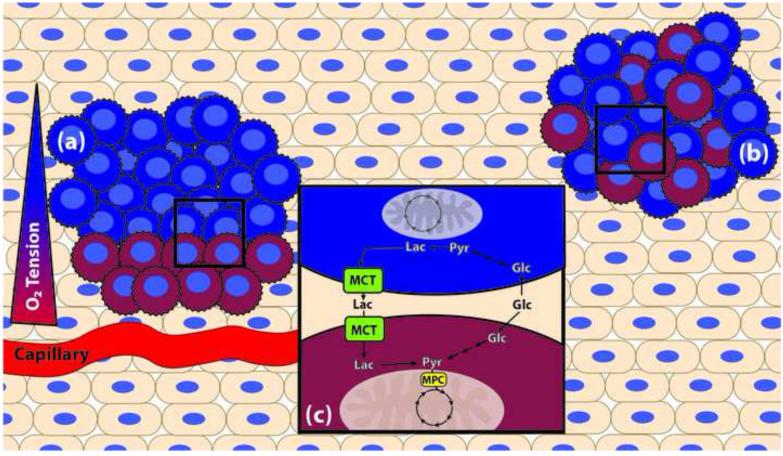
Figure 2. Metabolic tumor heterogeneity
Within a given tumor, adjacent cancer cells may operate under different metabolic regimes, lending to whole-tumor flexibility even if individual cancer cells (jagged edges) have limited metabolic flexibility. In the figure, two metabolic regimes are represented: one performing more mitochondrial oxidation (red), and one performing more aerobic glycolysis (blue). The architecture of metabolically heterogeneous tumors may be stratified by proximity of cancer cells to vasculature, depending on nutrient and oxygen availability (a). Tumor heterogeneity may also be more interspersed, where stochastic mutations during the oncogenic process select for individual cells that may complement the metabolic needs of an adjacent cell or cancer cell (b). In this example (c), the blue cells perform glycolysis to convert glucose (Glc) to pyruvate (Pyr) and then to lactate (Lac) which is exported from the cell via the monocarboxylate transporter (MCT). The adjacent red cells can take up that lactate (via another MCT), and convert it to pyruvate for use in mitochondrial oxidation. It is likely that tumors are comprised of many more metabolic phenotypes than the simplistic two-part system illustrated here, based on the numerous mutations and aberrations to their metabolic machinery that are mutually selected for during oncogenesis.

Similar articles

Cited by

References

    1. Azzi A. memory of Donald Nicholson. IUBMB Life. 2012;648:659–660.
    1. Petersen KF, et al. Effect of aging on muscle mitochondrial substrate utilization in humans. Proc. Natl. Acad. Sci. U.S.A. 2015 DOI: 10.1073/pnas.1514844112. - PMC - PubMed
    1. Takubo K, et al. Regulation of glycolysis by Pdk functions as a metabolic checkpoint for cell cycle quiescence in hematopoietic stem cells. Cell Stem Cell. 2013;12:49–61. - PMC - PubMed
    1. Yu W-M, et al. Metabolic Regulation by the Mitochondrial Phosphatase PTPMT1 Is Required for Hematopoietic Stem Cell Differentiation. Cell Stem Cell. 2013;12:62–74. - PMC - PubMed
    1. Vacanti NM, et al. Regulation of Substrate Utilization by the Mitochondrial Pyruvate Carrier. Molecular Cell. 2014;56:425–435. - PMC - PubMed

Publication types