Review
. 2016 Jul;15(3):385-93.
doi: 10.1007/s10689-016-9882-8.

Update on Lynch syndrome genomics

Affiliations
Review

Update on Lynch syndrome genomics

Päivi Peltomäki. Fam Cancer. 2016 Jul.

Abstract

Four main DNA mismatch repair (MMR) genes have been identified, MLH1, MSH2, MSH6, and PMS2, which when mutated cause susceptibility to Lynch syndrome (LS). LS is one of the most prevalent hereditary cancer syndromes in man and accounts for 1-3 % of unselected colorectal carcinomas and some 15 % of those with microsatellite instability and/or absent MMR protein. The International Society for Gastrointestinal Hereditary Tumours (InSiGHT) maintains a database for LS-associated mutations since 1996. The database was recently reorganized to efficiently gather published and unpublished data and to classify the variants according to a five-tiered scheme linked to clinical recommendations. This review provides an update of germline mutations causing susceptibility to LS based on information available in the InSiGHT database and the latest literature. MMR gene mutation profiles, correlations between genotype and phenotype, and possible mechanisms leading to the characteristic spectrum of tumors in LS are discussed in light of the different functions of MMR proteins, many of which directly serve cancer avoidance.

Keywords: DNA mismatch repair; Epimutation; Lynch syndrome; Mutation; Tumor spectrum.


Figures
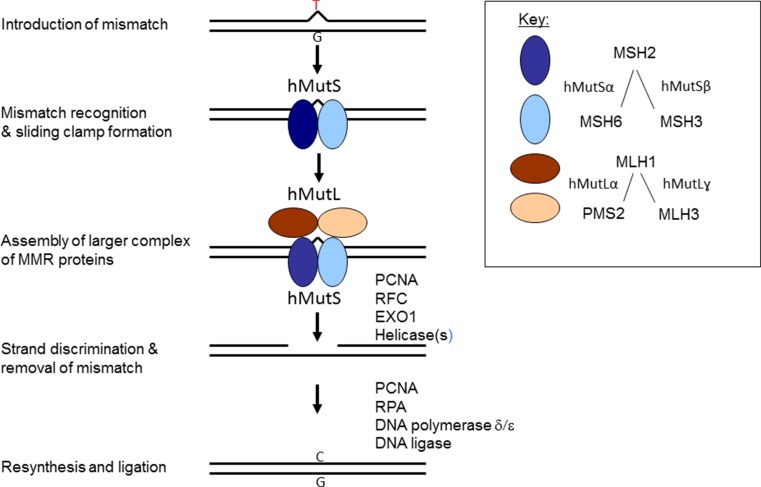
Fig. 1
Fig. 1
The different hMutS and hMutL complexes in human MMR. In addition to MMR proteins, the repair process requires a number of other proteins, such as proliferating cell nuclear antigen (PCNA), replication factor C (RFC), EXO1 (a 5′–3′ exonuclease), DNA helicases, RPA (replication protein A, a single-stranded DNA binding protein), DNA polymerases, and DNA ligase
Fig. 2
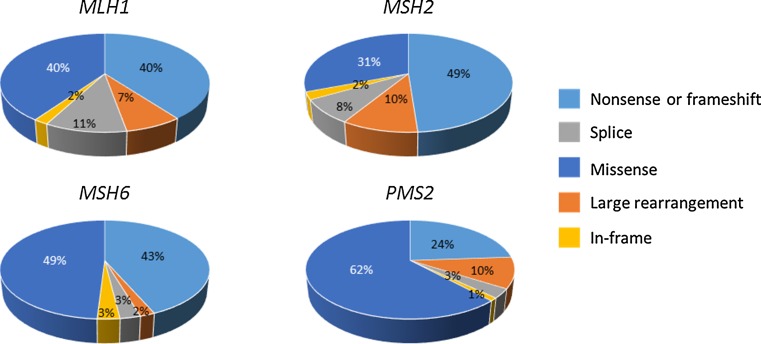
Fig. 2
Distributions of the types of germline variants across each MMR gene. The analysis is based on data deposited in the InSiGHT database [17] and is restricted to variants with coding changes. The total numbers of variants per gene included in the analysis are 1104 for MLH1, 883 for MSH2, 414 for MSH6, and 197 for PMS2
Fig. 3
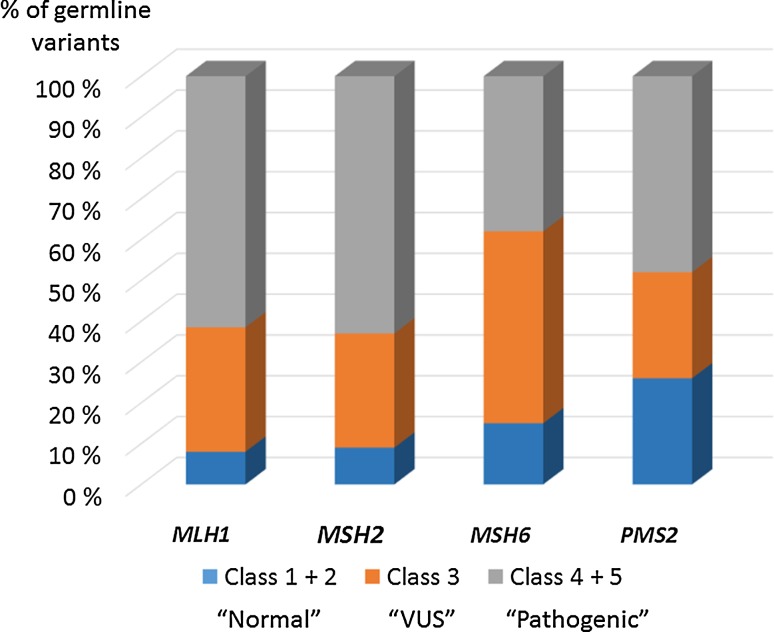
Fig. 3
Distributions of the different pathogenicity classes within the LS-associated MMR genes. The relative shares of normal variants (pathogenicity classes 1 and 2), VUSes (class 3), and pathogenic mutations (classes 4 and 5) reported for each MMR gene in the InSiGHT database [16] are depicted. The analysis includes 932 sequence variants for MLH1, 842 for MSH2, 449 for MSH6, and 137 for PMS2
Fig. 4
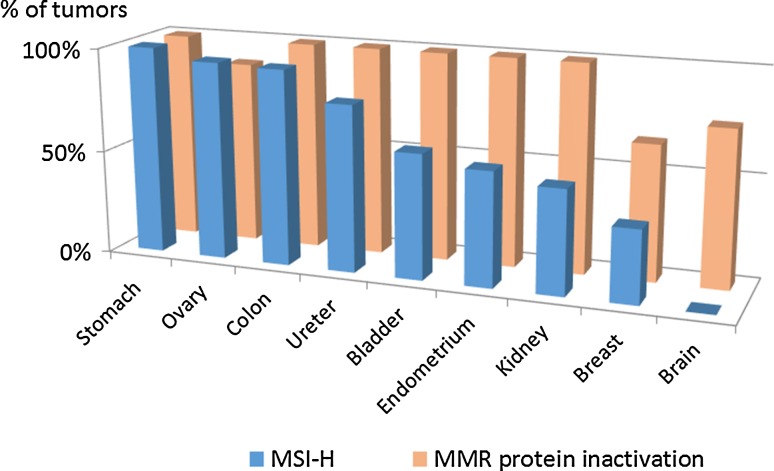
Fig. 4
Tumor-specific patterns of MMR defects. Percentages of tumors with MSI-high and MMR protein inactivation among cancers arising in different organs in germline carriers of MMR gene mutations from a nation-wide registry [57, 61, 62] are shown

References

    1. Modrich P. Mechanisms in eukaryotic mismatch repair. J Biol Chem. 2006;281:30305–30309. doi: 10.1074/jbc.R600022200. - DOI - PMC - PubMed
    1. Peltomäki P. Role of DNA mismatch repair defects in the pathogenesis of human cancer. J Clin Oncol. 2003;21:1174–1179. doi: 10.1200/JCO.2003.04.060. - DOI - PubMed
    1. Bridge G, Rashid S, Martin SA. DNA mismatch repair and oxidative DNA damage: implications for cancer biology and treatment. Cancers. 2014;6:1597–1614. doi: 10.3390/cancers6031597. - DOI - PMC - PubMed
    1. Stojic L, Brun R, Jiricny J. Mismatch repair and DNA damage signalling. DNA Repair. 2004;3:1091–1101. doi: 10.1016/j.dnarep.2004.06.006. - DOI - PubMed
    1. Surtees JA, Argueso JL, Alani E. Mismatch repair proteins: key regulators of genetic recombination. Cytogenet Genome Res. 2004;107:146–159. doi: 10.1159/000080593. - DOI - PubMed

Publication types

MeSH terms