Combination transarterial chemoembolization and radiofrequency ablation therapy for early hepatocellular carcinoma
- PMID: 26874512
- PMCID: PMC4773726
- DOI: 10.3904/kjim.2015.112
Combination transarterial chemoembolization and radiofrequency ablation therapy for early hepatocellular carcinoma
Abstract
Background/aims: We compared the recurrence of hepatocellular carcinoma (HCC) and the survival of patients who received radiofrequency ablation (RFA) after transarterial chemoembolization (TACE) with patients treated with TACE or RFA alone.
Methods: This study included 201 patients with HCC, who were consecutively enrolled at Seoul St. Mary's Hospital between December 2004 and February 2010. Inclusion criteria were a single HCC ≤ 5.0 cm or up to three HCCs ≤ 3.0 cm. We used a propensity score model to compare HCC patients (n = 87) who received RFA after TACE (TACE + RFA) with those who received TACE (n = 71) or RFA alone (n = 43).
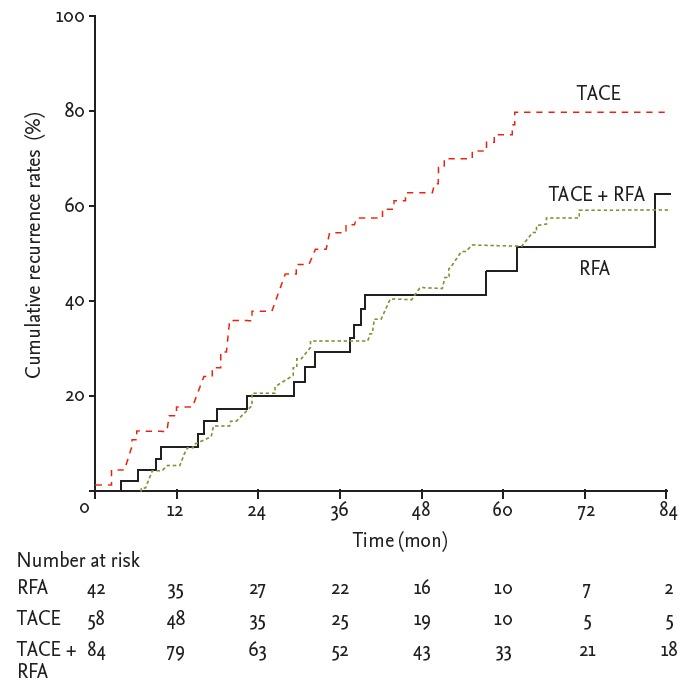
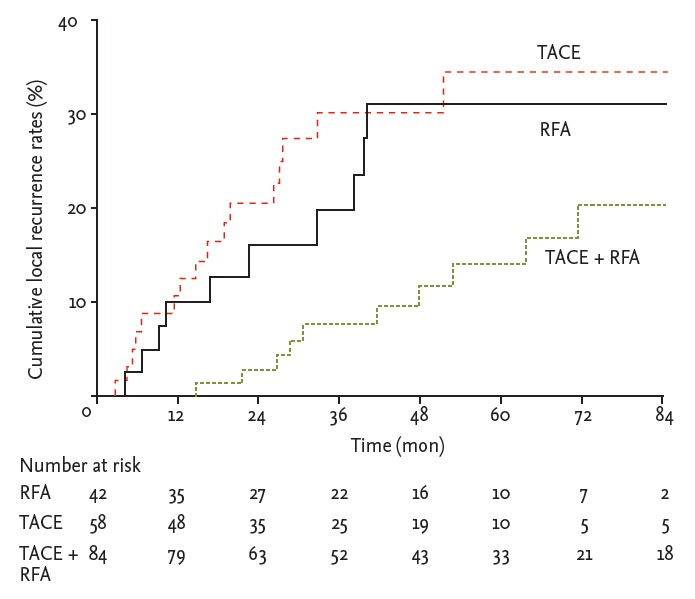
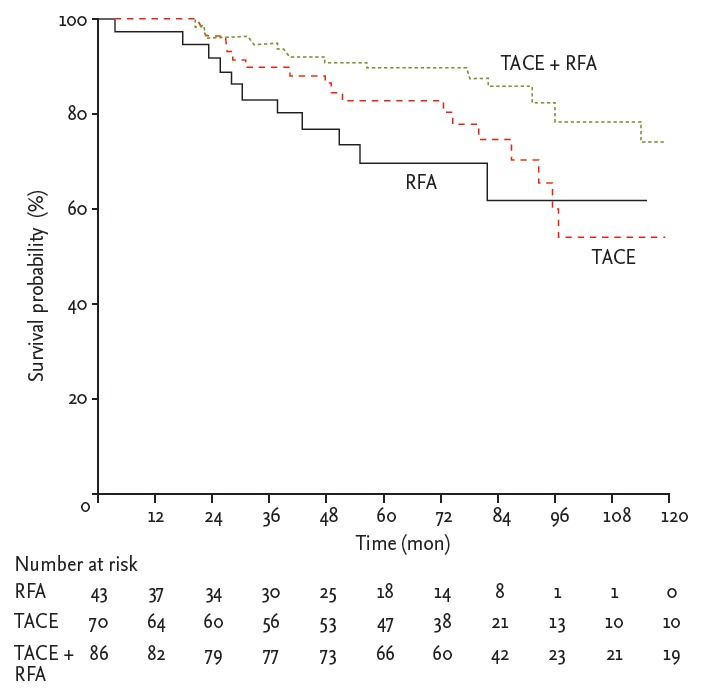
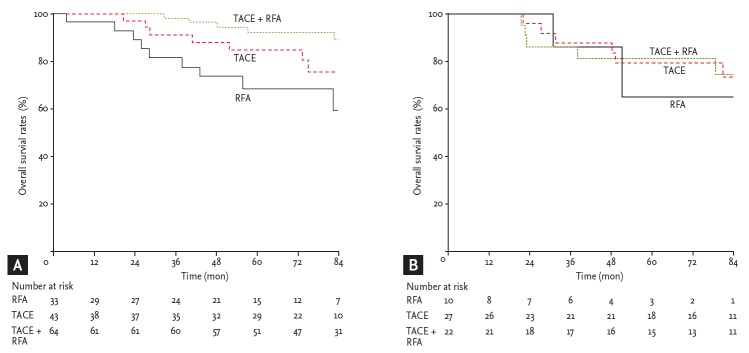
Results: The median follow-up period was 33.3 months (range, 6.8 to 80.9). The TACE + RFA group showed significantly lower local recurrence than the RFA or TACE groups (hazard ratio [HR], 0.309; 95% confidence interval [CI], 0.130 to 0.736; p = 0.008; and HR, 0.352; 95% CI, 0.158 to 0.787; p = 0.011, respectively). The overall survival was significantly better in the TACE + RFA group compared to the RFA group (HR, 0.422; 95% CI, 0.185 to 0.964; p = 0.041). However, the survival benefit was not different between the TACE + RFA and TACE groups (p = 0.124). Subgroup analysis showed that among patients with a tumor size < 3 cm, the TACE + RFA group had significantly better long-term survival than those in the TACE or RFA groups (p = 0.017, p = 0.004, respectively).
Conclusions: TACE + RFA combination treatment showed favorable local recurrence and better overall survival rates in early-stage HCC patients. Patients with tumors < 3 cm are likely to benefit more from TACE + RFA combination treatment. Additional studies are needed for the selection of suitable HCC patients for TACE + RFA treatment.
Keywords: Overall survival; Radiofrequency ablation; Recurrence; Transarterial chemoembolization.
Conflict of interest statement
No potential conflict of interest relevant to this article was reported.
Figures
References
-
- Parkin DM, Bray F, Ferlay J, Pisani P. Estimating the world cancer burden: Globocan 2000. Int J Cancer. 2001;94:153–156. - PubMed
-
- El-Serag HB, Mason AC. Rising incidence of hepatocellular carcinoma in the United States. N Engl J Med. 1999;340:745–750. - PubMed
-
- Bruix J, Sherman M, Llovet JM, et al. Conclusions of the Barcelona-2000 EASL conference: European Association for the Study of the Liver. J Hepatol. 2001;35:421–430. - PubMed
-
- Lencioni RA, Allgaier HP, Cioni D, et al. Small hepatocellular carcinoma in cirrhosis: randomized comparison of radio-frequency thermal ablation versus percutaneous ethanol injection. Radiology. 2003;228:235–240. - PubMed
-
- Lin SM, Lin CJ, Lin CC, Hsu CW, Chen YC. Radiofrequency ablation improves prognosis compared with ethanol injection for hepatocellular carcinoma < or =4 cm. Gastroenterology. 2004;127:1714–1723. - PubMed
Publication types
MeSH terms
LinkOut - more resources
Full Text Sources
Other Literature Sources
Medical
Miscellaneous