


Parental Predictions and Perceptions Regarding Long-Term Childhood Obesity-Related Health Risks
- PMID: 26875508
- PMCID: PMC4931970
- DOI: 10.1016/j.acap.2016.02.007
Parental Predictions and Perceptions Regarding Long-Term Childhood Obesity-Related Health Risks
Abstract
Objective: To assess how parents perceive long-term risks for developing obesity-related chronic health conditions.
Methods: A Web-based nationally representative survey was administered to 502 US parents with a 5- to 12-year-old child. Parents reported whether their child was most likely to be at a healthy weight or overweight, and the probability that their child would develop hypertension, heart disease, depression, or type 2 diabetes in adulthood. Responses of parents of children with overweight and obesity were compared to those of healthy-weight children using multivariate models.
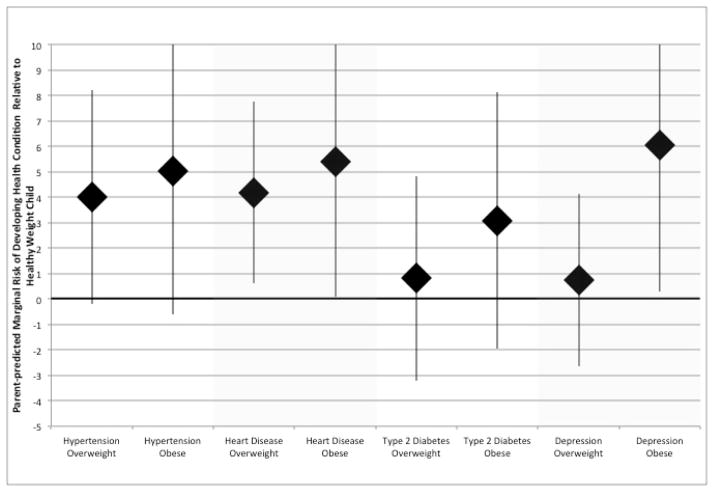
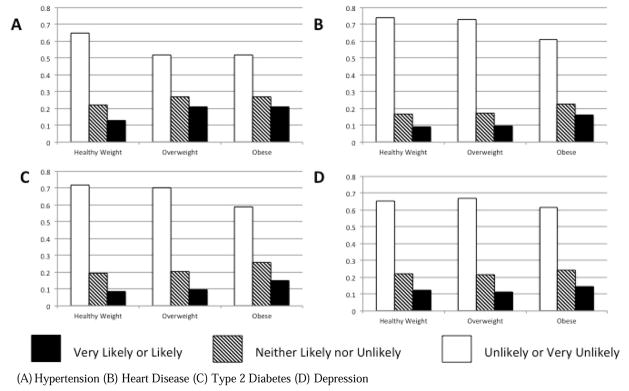
Results: The survey had an overall response rate of 39.2%. The mean (SD) unadjusted parent predicted health risks were 15.4% (17.7%), 11.2% (14.7%), 12.5% (16.2%), and 12.1% (16.1%) for hypertension, heart disease, depression, and diabetes, respectively. Despite underperceiving their child's current body mass index class, parents of children with obesity estimate their children to be at greater risk for obesity-related health conditions than parents of healthy-weight children by 5 to 6 percentage points. Having a family history of a chronic disease, higher quality of care, and older parent age were also significant predictors of estimating higher risk probabilities.
Conclusions: Despite evidence that parents of children who are overweight may not perceive these children as being overweight, parents unexpectedly estimate greater future risk of weight-related health conditions for these children. Focusing communication about weight on screening for and reducing the risk of weight-related diseases may prove useful in engaging parents and children in weight management.
Keywords: cardiovascular disease; childhood obesity; diabetes; mental health; risk assessment; risk communication; risk perception.
Copyright © 2016 Academic Pediatric Association. Published by Elsevier Inc. All rights reserved.
Figures

References
-
- Skinner AC, Skelton JA. Prevalence and Trends in Obesity and Severe Obesity Among Children in the United States, 1999–2012. JAMA Pediatr. 2014 - PubMed
-
- Whitaker RC, Wright JA, Pepe MS, Seidel KD, Dietz WH. Predicting obesity in young adulthood from childhood and parental obesity. N Engl J Med. 1997;337:869–873. - PubMed
-
- RWJF, NPR, Harvard School of Public Health. A Poll About Children and Weight: Crunch Time During the American Work and School Week-- 3 pm to Bed. 2013.
-
- Katz DL. Oblivobesity: looking over the overweight that parents keep overlooking. Child Obes. 2015;11:225–226. - PubMed
-
- Duncan DT, Hansen AR, Wang W, Yan F, Zhang J. Change in Misperception of Child’s Body Weight among Parents of American Preschool Children. Child Obes. 2015 - PubMed
Publication types
MeSH terms
Grants and funding
LinkOut - more resources
Full Text Sources
Other Literature Sources
Medical
