


Dual neurocircuitry dysfunctions in disruptive behavior disorders: emotional responding and response inhibition
- PMID: 26875722
- PMCID: PMC5638306
- DOI: 10.1017/S0033291716000118
Dual neurocircuitry dysfunctions in disruptive behavior disorders: emotional responding and response inhibition
Abstract
Background: To determine the functional integrity of the neural systems involved in emotional responding/regulation and response control/inhibition in youth (age 10-18 years) with disruptive behavioral disorders (DBDs: conduct disorder and/or oppositional defiant disorder) as a function of callous-unemotional (CU) traits.
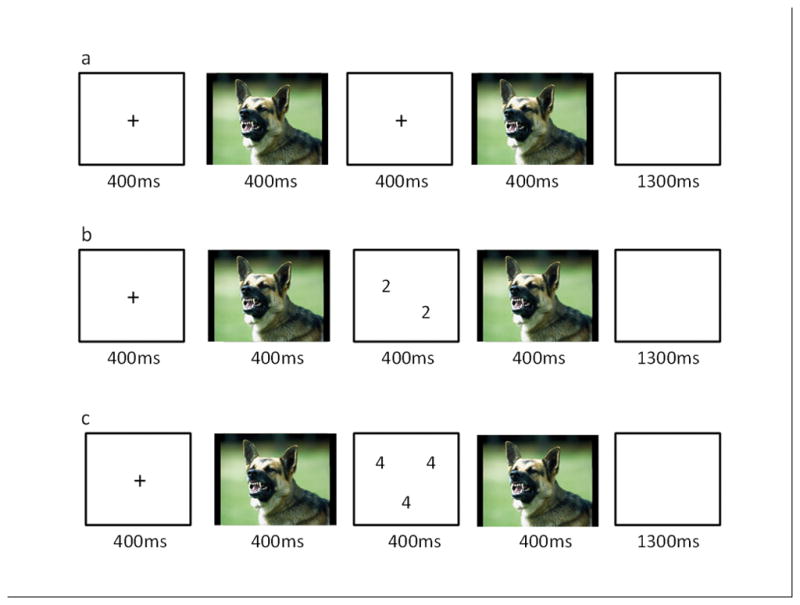
Method: Twenty-eight healthy youths and 35 youths with DBD [high CU (HCU), n = 18; low CU (LCU), n = 17] performed the fMRI Affective Stroop task. Participants viewed positive, neutral, and negative images under varying levels of cognitive load. A 3-way ANOVA (group×emotion by task) was conducted on the BOLD response data.
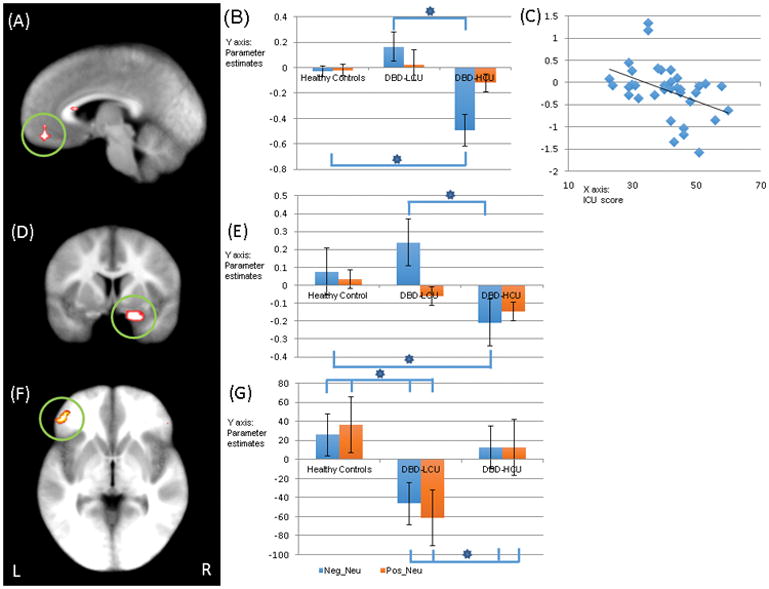
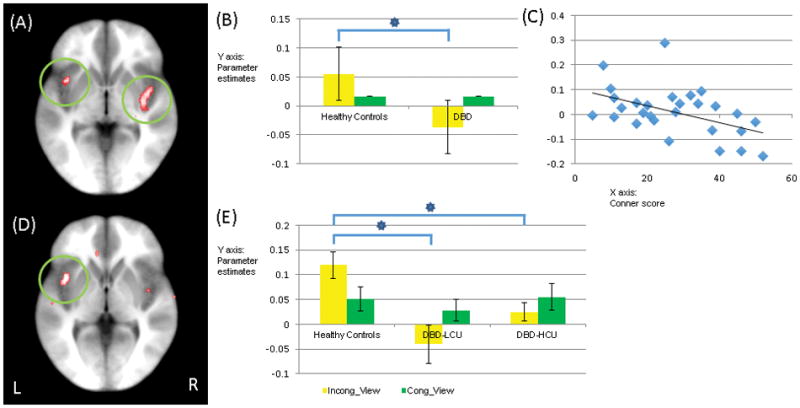
Results: Youth with DBD-HCU showed significantly less activation of ventromedial prefrontal cortex (vmPFC) and amygdala in response to negative stimuli, compared to healthy youth and youth with DBD-LCU. vmPFC responsiveness was inversely related to CU symptoms in DBD. Youth with DBD-LCU showed decreased functional connectivity between amygdala and regions including inferior frontal gyrus in response to emotional stimuli. Youth with DBD (LCU and HCU) additionally showed decreased insula responsiveness to high load (incongruent trials) compared to healthy youth. Insula responsiveness was inversely related to ADHD symptoms in DBD.
Conclusions: These data reveal two forms of pathophysiology in DBD. One associated with reduced amygdala and vmPFC responses to negative stimuli and related to increased CU traits. Another associated with reduced insula responses during high load task trials and related to ADHD symptoms. Appropriate treatment will need to be individualized according to the patient's specific pathophysiology.
Keywords: Amygdala; callous-unemotional trait; disruptive behavior disorder; emotional responding; response inhibition.
Figures
References
-
- American Psychiatric Association. Diagnostic and Statistical Manual. Vol. 5. American Psychiatric Association; Washington D.C: 2013.
-
- Baker RH, Clanton RL, Rogers JC, De Brito SA. Neuroimaging findings in disruptive behavior disorders. CNS Spectrums. 2015;20:369–81. - PubMed
-
- Blair KS, Vythilingam M, Crowe SL, McCaffrey DE, Ng P, Wu CC, Scaramozza M, Mondillo K, Pine DS, Charney DS, Blair RJ. Cognitive control of attention is differentially affected in trauma-exposed individuals with and without post-traumatic stress disorder. Psychological Medicine. 2013;43:85–95. - PMC - PubMed
Publication types
MeSH terms
Grants and funding
LinkOut - more resources
Full Text Sources
Other Literature Sources
Medical
