. 2016 Feb 12:8:16.
doi: 10.1186/s13148-016-0182-9. eCollection 2016.

Identification of the epigenetic reader CBX2 as a potential drug target in advanced prostate cancer

Affiliations

Identification of the epigenetic reader CBX2 as a potential drug target in advanced prostate cancer

Pier-Luc Clermont et al. Clin Epigenetics. .

Abstract

Background: While localized prostate cancer (PCa) can be effectively cured, metastatic disease inevitably progresses to a lethal state called castration-resistant prostate cancer (CRPC). Emerging evidence suggests that aberrant epigenetic repression by the polycomb group (PcG) complexes fuels PCa progression, providing novel therapeutic opportunities.

Results: In the search for potential epigenetic drivers of CRPC, we analyzed the molecular profile of PcG members in patient-derived xenografts and clinical samples. Overall, our results identify the PcG protein and methyl-lysine reader CBX2 as a potential therapeutic target in advanced PCa. We report that CBX2 was recurrently up-regulated in metastatic CRPC and that elevated CBX2 expression was correlated with poor clinical outcome in PCa cohorts. Furthermore, CBX2 depletion abrogated cell viability and induced caspase 3-mediated apoptosis in metastatic PCa cell lines. Mechanistically explaining this phenotype, microarray analysis in CBX2-depleted cells revealed that CBX2 controls the expression of many key regulators of cell proliferation and metastasis.

Conclusions: Taken together, this study provides the first evidence that CBX2 inhibition induces cancer cell death, positioning CBX2 as an attractive drug target in lethal CRPC.

Keywords: CBX2; Castration-resistant prostate cancer; Epigenetics; Metastatic prostate cancer; Polycomb.


Figures

Fig. 1
Fig. 1
CBX2 is overexpressed in metastatic PCa. a Establishment of the LTL313B/LTL313H PDX model of metastatic PCa; b Expression of core PcG family members in the LTL313H/LTL313B xenograft model; Results are based on a single microarray experiment; c Confirmation of CBX2 mRNA up-regulation in the LTL313H tumor line by qRT-PCR; d Confirmation of CBX2 protein up-regulation in the LTL313H tumor line by IHC (20x). Images are representative of multiple fields taken from 2 independent experiments; e Elevated CBX2 mRNA levels in metastatic PCa compared to non-metastatic samples in three independent patients
Fig. 2
Fig. 2
Hormonal regulation of CBX2. a Establishment of the LTL313B/LTL313BR patient-derived xenograft model of CRPC; b Assessment of CBX2 mRNA levels in the LTL313B/LTL313BR xenograft model by qRT-PCR; c IHC staining of CBX2 in the LTL313B and LTL313BR xenografts ×20. Images are representative of multiple fields taken from two independent experiments; d Levels of CBX2 mRNA in androgen-dependent (AD, n = 10) and androgen-independent (AI, n = 5) PDXs from the LTL; e Relative CBX2 expression in PCa cell lines compared to benign control (BPH1) assessed by qRT-PCR; f CBX2 mRNA levels in LNCaP cells cultured in charcoaled-stripped media in the presence or absence of DHT supplementation (10 nM)
Fig. 3
Fig. 3
CBX2 depletion induces proliferation arrest and apoptosis in advanced PCa cell lines. a, b Confirmation of CBX2 mRNA knockdown in LNCaP and C4-2 cells by qPCR; c, d Confirmation of CBX2 protein knockdown in LNCaP and C4-2 cells; e, f MTT analysis of cell viability following CBX2 silencing in LNCaP and C4-2 cells; g, h Assessment of caspase 3–7 activity in LNCaP and C4-2 cells following CBX2 depletion
Fig. 4
Fig. 4
Morphology of LNCaP and C4-2 cells following CBX2 depletion (96 h post-siRNA treatment). Images are representative of multiple fields taken from three independent experiments (×20 for large image and ×40 for small image)
Fig. 5
Fig. 5
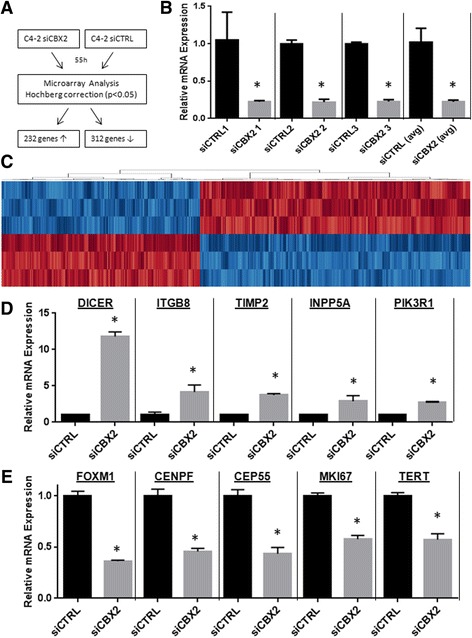
Gene expression profiling of CBX2-regulated genes. a Experimental design of microarray analysis; b Validation of CBX2 silencing in samples subjected to microarray analysis; c Unsupervised hierarchical clustering of genes differentially expressed following CBX2 knockdown; d Differential expression of up-regulated CRGs confirmed by qRT-PCR in CBX2-depleted C4-2 cells; e Differential expression of down-regulated CRGs confirmed by qRT-PCR in CBX2-depleted C4-2 cells
Fig. 6
Fig. 6
Clinical analysis of CBX2 and CBX2-regulated genes in the MSKCC prostate adenocarcinoma cohort. a Heatmap showing the expression of the 544 genes differentially expressed after knocking-down CBX2. Here, only the 140 patients with gene expression data are shown. The columns (patients) were sorted based on CBX2 expression (red: high expression, blue: low expression). Metastatic prostate cancer patients had significantly higher CBX2; b CBX2 expression correlated with the expression of the differently expressed genes; c CBX2 expression distribution across the 140 patients. Here, we used a CBX2 expression threshold of 2 to call CBX2 up-regulation since there was a natural gap around expression value of 2; d Patients with CBX2 expression up-regulation had significantly lower disease-free survival

References

    1. Siegel R, Ma J, Zou Z, Jemal A. Cancer statistics, 2014. CA Cancer J Clin. 2014;64:9–29. doi: 10.3322/caac.21208. - DOI - PubMed
    1. Horwich A, Hugosson J, de Reijke T, et al. Prostate cancer: ESMO consensus conference guidelines 2012. Ann Oncol. 2013;24:1141–62. doi: 10.1093/annonc/mds624. - DOI - PubMed
    1. Feldman BJ, Feldman D. The development of androgen-independent prostate cancer. Nat Rev Cancer. 2001;1:34–45. doi: 10.1038/35094009. - DOI - PubMed
    1. Tannock IF, de Wit R, Berry WR, et al. Docetaxel plus prednisone or mitoxantrone plus prednisone for advanced prostate cancer. N Engl J Med. 2004;351:1502–12. doi: 10.1056/NEJMoa040720. - DOI - PubMed
    1. Beer TM, Armstrong AJ, Rathkopf DE, et al. Enzalutamide in metastatic prostate cancer before chemotherapy. N Engl J Med. 2014;371:424–33. doi: 10.1056/NEJMoa1405095. - DOI - PMC - PubMed

Publication types

MeSH terms