Excess mortality among patients on dialysis: Comparison with the general population in Korea
- PMID: 26877956
- PMCID: PMC4714183
- DOI: 10.1016/j.krcp.2014.04.001
Excess mortality among patients on dialysis: Comparison with the general population in Korea
Abstract
Background: Although patients with end-stage renal disease (ESRD) experience excess mortality compared with the general population, the standardized mortality ratio (SMR) for Korean patients on dialysis has not yet been investigated. In this study, we evaluated the SMR among all Korean ESRD patients on maintenance dialysis in 2009 and 2010, and compared it according to age categories, sex, and dialysis modality.
Methods: We used data from all patients on maintenance dialysis between January 1, 2009 and December 31, 2010 in Korea using the database of the Korean Health Insurance Review and Assessment Service, and the SMR was determined by calculating of the ratio between the number of actual deaths and expected deaths.
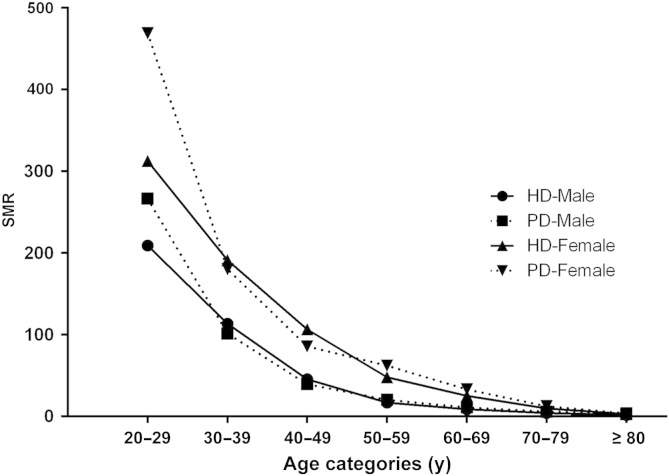
Results: A total of 45,568 patients in 2009 and 48,170 patients in 2010 were included in the analysis. The overall age- and sex-adjusted SMR was 10.3 [95% confidence interval (CI), 10.0-10.6] in 2009 and 10.9 (95% CI, 10.7-11.2) in 2010. The SMR for females was much higher than for males. The SMR gradually decreased with increasing age groups. The overall SMR for maintenance hemodialysis patients was lower than that of peritoneal dialysis patients.
Conclusion: The SMR among Korean ESRD patients is likely to be higher than in other countries. Further evaluation is needed to attempt to improve the outcomes.
Keywords: Dialysis; End-stage renal disease; Korea; Mortality.
Figures
References
-
- Graham T. Osmotic Force. Philo Trans R Soc Lond. 1854;144:177–228.
-
- Yoon KY, Ahn MH, Moon BO, Kim CK, Lee SM, Whang WH, Lee TH. Use of artificial kidney in renal failure. Korean J Med. 1967;10:83–91.
-
- Current Renal Replacement Therapy in Korea, 2011. Available at: http://www.ksn.or.kr/journal/2012/index.html [Date accessed: 17 July 2013]
-
- Statistics for Medical Action. Available at: http://www.hira.or.kr/rdd_disease.do?method=listInfoMdfee&pgmid=HIRAA020... [Date accessed: 17 July 2013]
LinkOut - more resources
Full Text Sources
Other Literature Sources