Accuracy of Bolton analysis measured in laser scanned digital models compared with plaster models (gold standard) and cone-beam computer tomography images
- PMID: 26877978
- PMCID: PMC4751296
- DOI: 10.4041/kjod.2016.46.1.13
Accuracy of Bolton analysis measured in laser scanned digital models compared with plaster models (gold standard) and cone-beam computer tomography images
Abstract
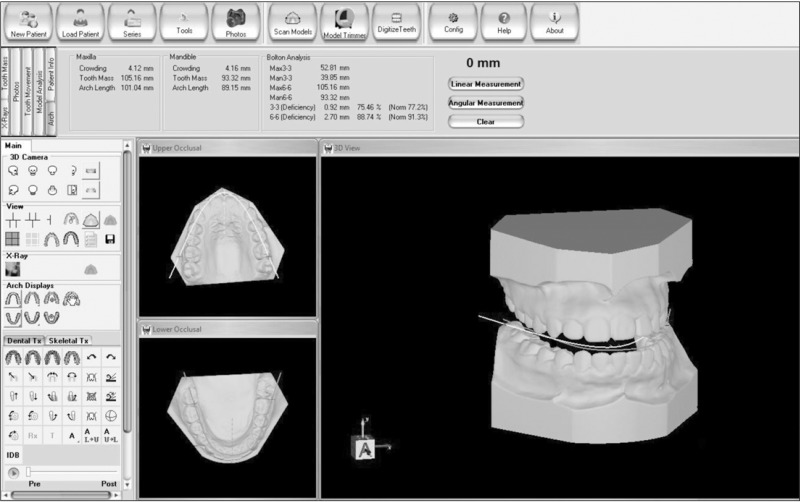
Objective: The aim of this study was to compare the accuracy of Bolton analysis obtained from digital models scanned with the Ortho Insight three-dimensional (3D) laser scanner system to those obtained from cone-beam computed tomography (CBCT) images and traditional plaster models.
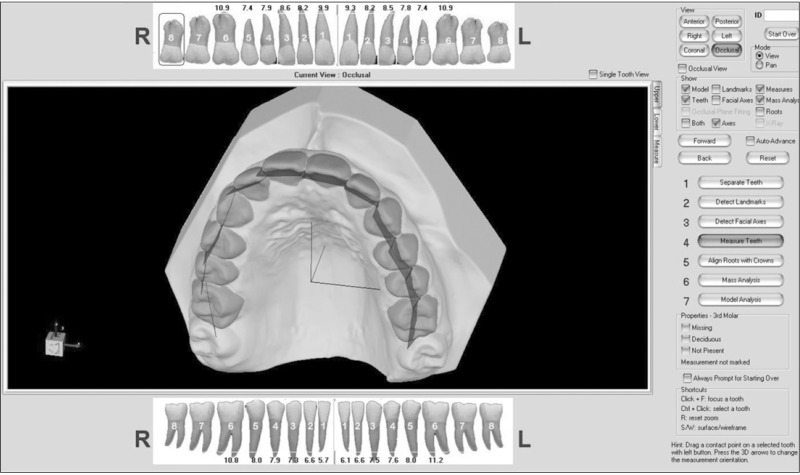
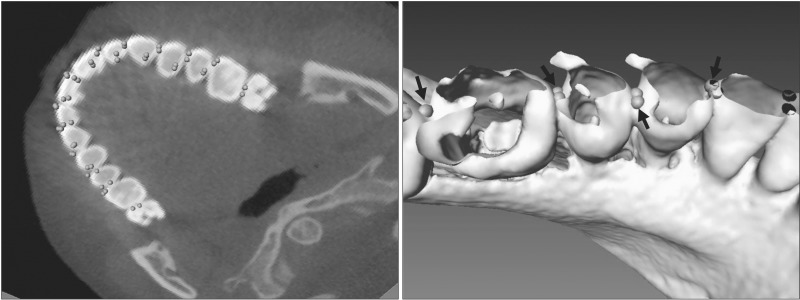
Methods: CBCT scans and plaster models were obtained from 50 patients. Plaster models were scanned using the Ortho Insight 3D laser scanner; Bolton ratios were calculated with its software. CBCT scans were imported and analyzed using AVIZO software. Plaster models were measured with a digital caliper. Data were analyzed with descriptive statistics and the intraclass correlation coefficient (ICC).
Results: Anterior and overall Bolton ratios obtained by the three different modalities exhibited excellent agreement (> 0.970). The mean differences between the scanned digital models and physical models and between the CBCT images and scanned digital models for overall Bolton ratios were 0.41 ± 0.305% and 0.45 ± 0.456%, respectively; for anterior Bolton ratios, 0.59 ± 0.520% and 1.01 ± 0.780%, respectively. ICC results showed that intraexaminer error reliability was generally excellent (> 0.858 for all three diagnostic modalities), with < 1.45% discrepancy in the Bolton analysis.
Conclusions: Laser scanned digital models are highly accurate compared to physical models and CBCT scans for assessing the spatial relationships of dental arches for orthodontic diagnosis.
Keywords: Dental cast analysis; Digital models; Three-dimensional scanner.
Conflict of interest statement
The authors report no commercial, proprietary, or financial interest in the products or companies described in this article.
Figures
References
-
- Wedrychowska-Szulc B, Janiszewska-Olszowska J, Stepień P. Overall and anterior Bolton ratio in Class I, II, and III orthodontic patients. Eur J Orthod. 2010;32:313–318. - PubMed
-
- Bolton WA. Disharmony in tooth size and its relation to the analysis and treatment of malocclusion. Angle Orthod. 1958;28:113–130.
-
- Bolton WA. The clinical use of a tooth size analysis. Am J Orthod Dentofacial Orthop. 1962;48:504–529.
-
- Othman SA, Harradine NW. Tooth-size discrepancy and Bolton's ratios: a literature review. J Orthod. 2006;33:45–51. - PubMed
-
- Sousa MV, Vasconcelos EC, Janson G, Garib D, Pinzan A. Accuracy and reproducibility of 3-dimensional digital model measurements. Am J Orthod Dentofacial Orthop. 2012;142:269–273. - PubMed
LinkOut - more resources
Full Text Sources
Other Literature Sources
Medical
Miscellaneous