Autophagy in 5-Fluorouracil Therapy in Gastrointestinal Cancer: Trends and Challenges
- PMID: 26879020
- PMCID: PMC4800847
- DOI: 10.4103/0366-6999.176069
Autophagy in 5-Fluorouracil Therapy in Gastrointestinal Cancer: Trends and Challenges
Abstract
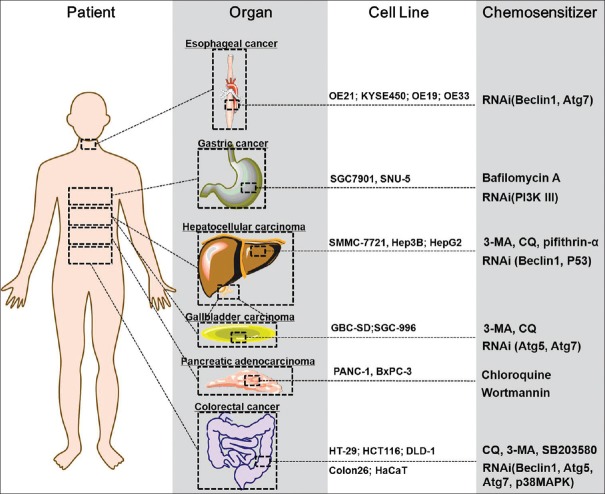
Objective: 5-Fluorouracil (5-FU)-based combination therapies are standard treatments for gastrointestinal cancer, where the modulation of autophagy is becoming increasingly important in offering effective treatment for patients in clinical practice. This review focuses on the role of autophagy in 5-FU-induced tumor suppression and cancer therapy in the digestive system.
Data sources: All articles published in English from 1996 to date those assess the synergistic effect of autophagy and 5-FU in gastrointestinal cancer therapy were identified through a systematic online search by use of PubMed. The search terms were "autophagy" and "5-FU" and ("colorectal cancer" or "hepatocellular carcinoma" or "pancreatic adenocarcinoma" or "esophageal cancer" or "gallbladder carcinoma" or "gastric cancer").
Study selection: Critical reviews on relevant aspects and original articles reporting in vitro and/or in vivo results regarding the efficiency of autophagy and 5-FU in gastrointestinal cancer therapy were reviewed, analyzed, and summarized. The exclusion criteria for the articles were as follows: (1) new materials (e.g., nanomaterial)-induced autophagy; (2) clinical and experimental studies on diagnostic and/or prognostic biomarkers in digestive system cancers; and (3) immunogenic cell death for anticancer chemotherapy.
Results: Most cell and animal experiments showed inhibition of autophagy by either pharmacological approaches or via genetic silencing of autophagy regulatory gene, resulting in a promotion of 5-FU-induced cancer cells death. Meanwhile, autophagy also plays a pro-death role and may mediate cell death in certain cancer cells where apoptosis is defective or difficult to induce. The dual role of autophagy complicates the use of autophagy inhibitor or inducer in cancer chemotherapy and generates inconsistency to an extent in clinic trials.
Conclusion: Autophagy might be a therapeutic target that sensitizes the 5-FU treatment in gastrointestinal cancer.
Figures
References
-
- Ringborg U, Platz A. Chemotherapy resistance mechanisms. Acta Oncol. 1996;35(Suppl 5):76–80. doi: 10.3109/02841869609083976. - PubMed
-
- Szakács G, Paterson JK, Ludwig JA, Booth-Genthe C, Gottesman MM. Targeting multidrug resistance in cancer. Nat Rev Drug Discov. 2006;5:219–34. doi: 10.1038/nrd1984. - PubMed
-
- Yousefi S, Simon HU. Autophagy in cancer and chemotherapy. Results Probl Cell Differ. 2009;49:183–90. doi: 10.1007/400_2008_25. - PubMed
-
- Notte A, Leclere L, Michiels C. Autophagy as a mediator of chemotherapy-induced cell death in cancer. Biochem Pharmacol. 2011;82:427–34. doi: 10.1016/j.bcp.2011.06.015. - PubMed
Publication types
MeSH terms
Substances
LinkOut - more resources
Full Text Sources
Other Literature Sources