


Mapping the neck disability index to SF-6D in patients with chronic neck pain
- PMID: 26879341
- PMCID: PMC4754827
- DOI: 10.1186/s12955-016-0422-x
Mapping the neck disability index to SF-6D in patients with chronic neck pain
Abstract
Background: This study sought to statistically map the neck disability index (NDI) to the six-dimension health state short form (SF-6D) to estimate algorithms for use in economic analyses in patients with chronic neck pain (CNP).
Methods: The relationships between NDI and SF-6D scores were estimated by using data from a cohort of patients with chronic neck pain (n = 272). By using ordinary least squares (OLS), generalized linear modeling (GLM), censored least absolute deviations (CLAD) and Tobit regression, scores from all 10 items of the NDI instruments were univariately tested against SF-6D values and retained in a multivariate regression model, if statistically significant. The predictive ability of the model was assessed by mean absolute error (MAE), root mean square error (RMSE) and normalized RMSE.
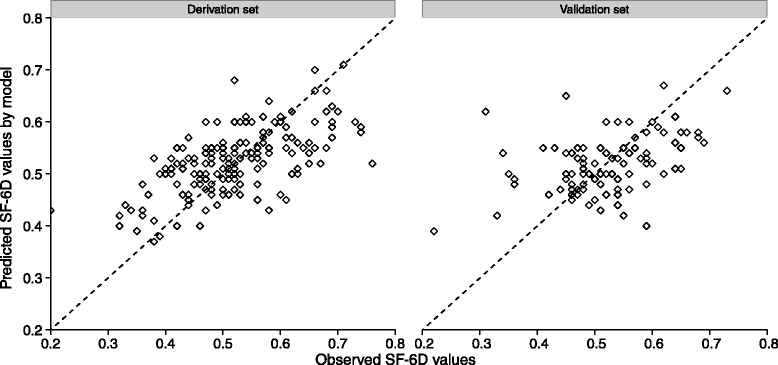
Results: The mean age of the 272 CNP patients was 39.9 ± 12.3 years; 57.8 % of the CNP patients were female. An OLS regression equation that included recreation item of NDI was optimal, with a MAE of 0.04and 0.04 and an RMSE of 0.06and 0.05in the derivation set and validation set, respectively. Predicted utilities accurately represented the observed ones.
Conclusions: We have provided algorithms for the estimation of health state utility values from the response of NDI. Future economic evaluations of the interventions for chronic neck pain could be informed by these algorithms.
Figures
Similar articles
-
Using the Multiple Sclerosis Impact Scale to estimate health state utility values: mapping from the MSIS-29, version 2, to the EQ-5D and the SF-6D.Value Health. 2012 Dec;15(8):1084-91. doi: 10.1016/j.jval.2012.07.007. Epub 2012 Nov 4. Value Health. 2012. PMID: 23244811 Clinical Trial.
-
Predicting SF-6D utility scores from the neck disability index and numeric rating scales for neck and arm pain.Spine (Phila Pa 1976). 2011 Mar 15;36(6):490-4. doi: 10.1097/BRS.0b013e3181d323f3. Spine (Phila Pa 1976). 2011. PMID: 20847713 Free PMC article.
-
Estimating EQ-5D values from the Neck Disability Index and numeric rating scales for neck and arm pain.J Neurosurg Spine. 2014 Sep;21(3):394-9. doi: 10.3171/2014.5.SPINE13570. Epub 2014 Jun 6. J Neurosurg Spine. 2014. PMID: 24905392
-
The development of a model for translation of the Neck Disability Index to utility scores for cost-utility analysis in cervical disorders.Spine J. 2012 Jan;12(1):55-62. doi: 10.1016/j.spinee.2011.12.002. Epub 2011 Dec 29. Spine J. 2012. PMID: 22209244 Clinical Trial.
-
Mapping the FACT-G cancer-specific quality of life instrument to the EQ-5D and SF-6D.Health Qual Life Outcomes. 2013 Dec 1;11:203. doi: 10.1186/1477-7525-11-203. Health Qual Life Outcomes. 2013. PMID: 24289488 Free PMC article. Clinical Trial.
Cited by
-
Tapentadol extended release for the management of chronic neck pain.J Pain Res. 2017 Mar 2;10:495-505. doi: 10.2147/JPR.S129056. eCollection 2017. J Pain Res. 2017. PMID: 28280384 Free PMC article.
-
Calculating ex-ante Utilities From the Neck Disability Index Score: Quantifying the Value of Care For Cervical Spine Pathology.Global Spine J. 2024 Mar;14(2):526-534. doi: 10.1177/21925682221114284. Epub 2022 Aug 7. Global Spine J. 2024. PMID: 35938309 Free PMC article.
-
Mapping the Chinese Version of the EORTC QLQ-BR53 Onto the EQ-5D-5L and SF-6D Utility Scores.Patient. 2020 Oct;13(5):537-555. doi: 10.1007/s40271-020-00422-x. Patient. 2020. PMID: 32382953
-
Cost-utility of revisions for cervical deformity correction warrants minimization of reoperations.J Spine Surg. 2018 Dec;4(4):702-711. doi: 10.21037/jss.2018.10.02. J Spine Surg. 2018. PMID: 30714001 Free PMC article.
References
Publication types
MeSH terms
LinkOut - more resources
Full Text Sources
Other Literature Sources
Medical
