


Impact of Awareness and Patterns of Nonhospitalized Atrial Fibrillation on the Risk of Mortality: The Reasons for Geographic And Racial Differences in Stroke (REGARDS) Study
- PMID: 26880475
- PMCID: PMC4769105
- DOI: 10.1002/clc.22501
Impact of Awareness and Patterns of Nonhospitalized Atrial Fibrillation on the Risk of Mortality: The Reasons for Geographic And Racial Differences in Stroke (REGARDS) Study
Abstract
Background: Although mortality associated with atrial fibrillation (AF) has been reported to decrease over prior decades, the mortality risk of asymptomatic, nonhospitalized AF has not been examined.
Hypothesis: Asymptomatic, nonhospitalized AF is associated with an increased risk of death.
Methods: This analysis included 25,976 participants (mean age, 65 ± 9.4 years; 55% female; 38% black) from the Reasons for Geographic And Racial Differences (REGARDS) study. Atrial fibrillation was detected on the baseline electrocardiogram (ECG AF) or by self-reported history. Atrial fibrillation unawareness was defined as present if ECG evidence of the arrhythmia was detected but no self-reported history was reported. All-cause mortality was confirmed during follow-up through March 31, 2014.
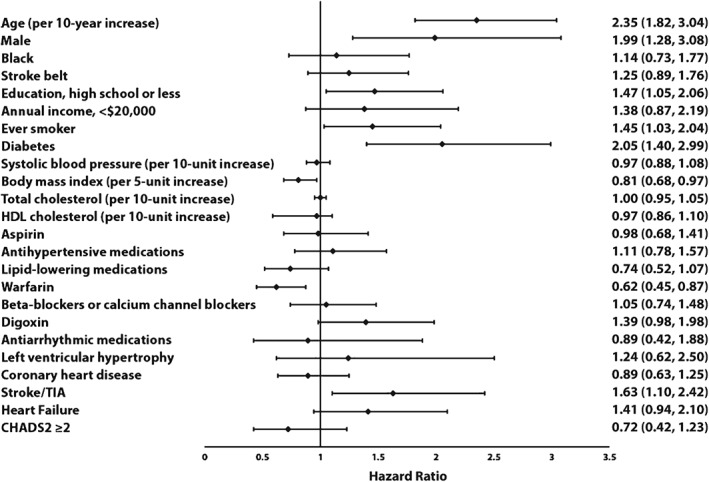
Results: A total of 2208 (8.5%) participants had AF at baseline (ECG: n = 371/17%; self-reported: n = 1837/83%). Over a median follow-up of 7.6 years, 3481 deaths occurred. In a multivariable Cox regression model, AF was associated with a 32% increased risk of mortality (95% confidence interval [CI]: 1.19-1.46). Risk of death was higher among those with ECG AF (hazard ratio: 1.71, 95% CI: 1.42-2.07) compared with self-reported cases (hazard ratio: 1.15, 95% CI: 1.03-1.29). Those who were unaware of their AF diagnosis had a 94% increased risk of death (95% CI: 1.50-2.52) compared with AF participants who were aware of their diagnosis.
Conclusions: Asymptomatic, nonhospitalized AF is associated with an increased risk of mortality in the general population. Mortality is higher in those with ECG-confirmed cases and among those who are unaware of their diagnosis.
© 2016 Wiley Periodicals, Inc.
Figures


References
-
- Go AS, Hylek EM, Phillips KA, et al. Prevalence of diagnosed atrial fibrillation in adults: national implications for rhythm management and stroke prevention: the AnTicoagulation and Risk Factors in Atrial Fibrillation (ATRIA) Study. JAMA. 2001;285:2370–2375. - PubMed
-
- Benjamin EJ, Levy D, Vaziri SM, et al. Independent risk factors for atrial fibrillation in a population‐based cohort: the Framingham Heart Study. JAMA. 1994;271:840–844. - PubMed
-
- Heeringa J, Kors JA, Hofman A, et al. Cigarette smoking and risk of atrial fibrillation: the Rotterdam Study. Am Heart J. 2008;156:1163–1169. - PubMed
-
- Wolf PA, Abbott RD, Kannel WB. Atrial fibrillation as an independent risk factor for stroke: the Framingham Study. Stroke. 1991;22:983–988. - PubMed
-
- Gottdiener JS, Arnold AM, Aurigemma GP, et al. Predictors of congestive heart failure in the elderly: the Cardiovascular Health Study. J Am Coll Cardiol. 2000;35:1628–1637. - PubMed
Publication types
MeSH terms
Grants and funding
LinkOut - more resources
Full Text Sources
Other Literature Sources
Medical
