Review
. 2016:2016:6705927.
doi: 10.1155/2016/6705927. Epub 2016 Jan 6.

The Importance of Ubiquitination and Deubiquitination in Cellular Reprogramming

Affiliations
Review

The Importance of Ubiquitination and Deubiquitination in Cellular Reprogramming

Bharathi Suresh et al. Stem Cells Int. 2016.

Abstract

Ubiquitination of core stem cell transcription factors can directly affect stem cell maintenance and differentiation. Ubiquitination and deubiquitination must occur in a timely and well-coordinated manner to regulate the protein turnover of several stemness related proteins, resulting in optimal embryonic stem cell maintenance and differentiation. There are two switches: an E3 ubiquitin ligase enzyme that tags ubiquitin molecules to the target proteins for proteolysis and a second enzyme, the deubiquitinating enzyme (DUBs), that performs the opposite action, thereby preventing proteolysis. In order to maintain stemness and to allow for efficient differentiation, both ubiquitination and deubiquitination molecular switches must operate properly in a balanced manner. In this review, we have summarized the importance of the ubiquitination of core stem cell transcription factors, such as Oct3/4, c-Myc, Sox2, Klf4, Nanog, and LIN28, during cellular reprogramming. Furthermore, we emphasize the role of DUBs in regulating core stem cell transcriptional factors and their function in stem cell maintenance and differentiation. We also discuss the possibility of using DUBs, along with core transcription factors, to efficiently generate induced pluripotent stem cells. Our review provides a relatively new understanding regarding the importance of ubiquitination/deubiquitination of stem cell transcription factors for efficient cellular reprogramming.


Figures
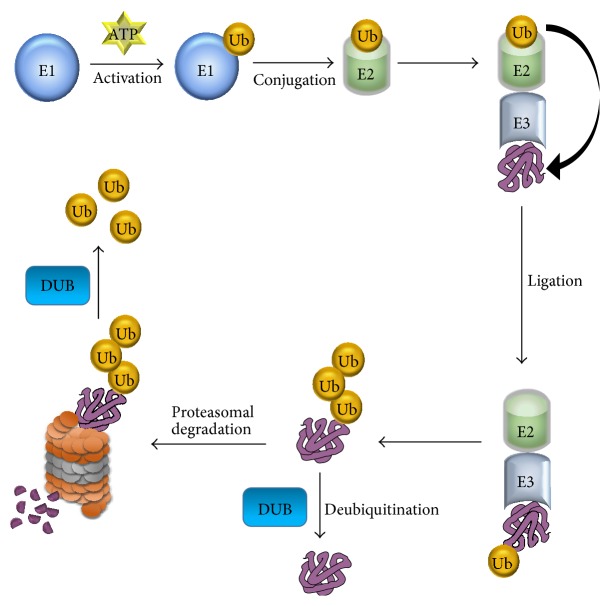
Figure 1
Figure 1
The ubiquitin proteasome system. The process of ubiquitination is catalyzed by an organized milieu of E1, E2, and E3 enzymes, which promote the ligation of a ubiquitin molecule to the lysine residues in the protein substrates. Lysine-48-linked polyubiquitination chain attached proteins are targeted to the 26S proteasome for protein degradation. DUB enzymes are involved in reversing ubiquitin conjugation and in the recycling of ubiquitin molecules through the ubiquitin proteasome pathway.
Figure 2
Figure 2
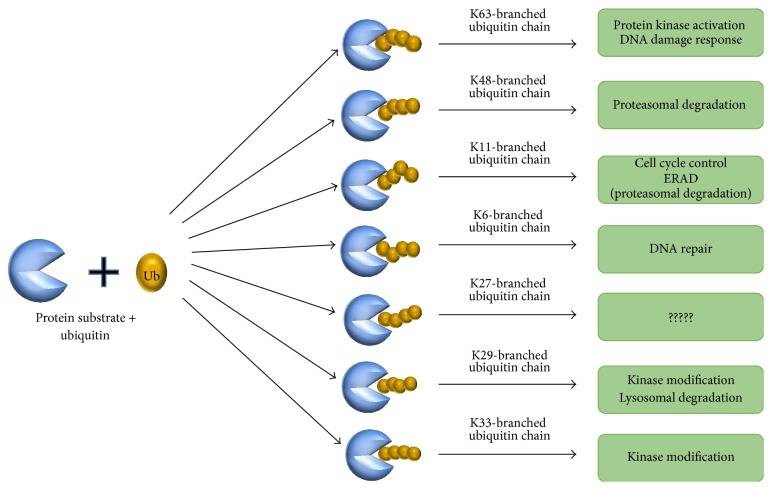
Ubiquitin modifications and their cellular functions. The attachment of ubiquitin molecules to one or more lysine residues results in polyubiquitination. Several types of polyubiquitin chains linked via lysine residues on the protein substrate are implicated in diverse cellular functions.
Figure 3
Figure 3
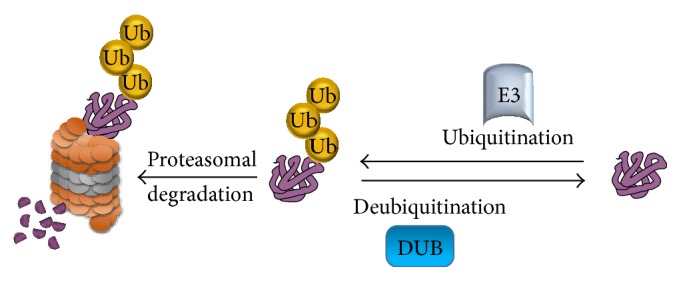
The ubiquitination and deubiquitination processes. A ubiquitin E3 ligase enzyme catalyzes the transfer of ubiquitin to lysine residue on the targeted protein and channels the protein to the 26S proteasome for protein degradation. Another class of enzyme, called deubiquitinating enzymes, that is able to reverse ubiquitin conjugation from protein substrates, thereby preventing proteolysis.
Figure 4
Figure 4
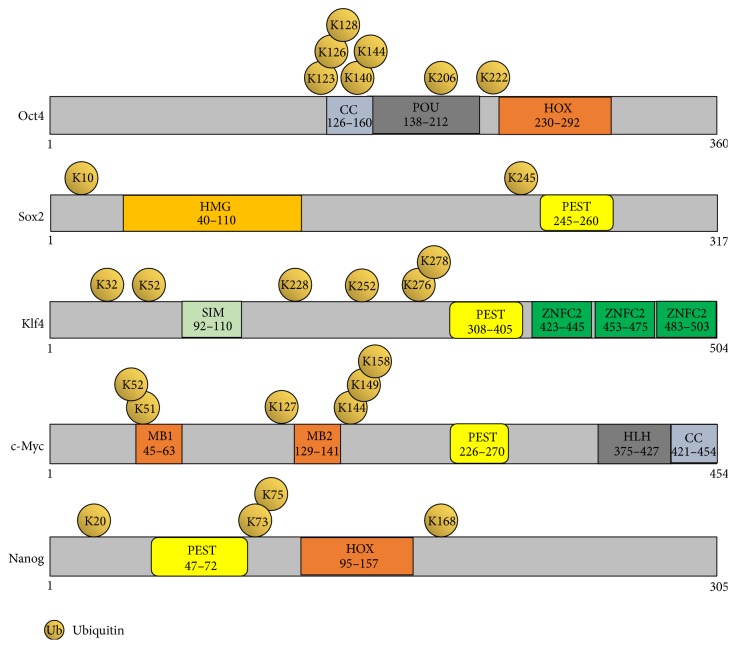
Schematic representation of the human Oct3/4, Sox2, Klf4, c-Myc, and Nanog proteins. Shown are the locations of both predicted and reported lysine sites for ubiquitination (lysine sites are predicted using the bioinformatics tool http://www.ubpred.org/).
Figure 5
Figure 5
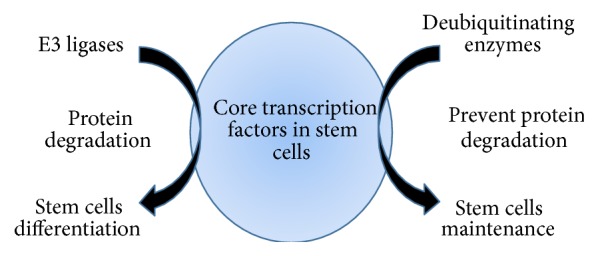
Schematic representation of the roles of E3 ligases and deubiquitinating enzymes in regulating stem cell differentiation and stem cell maintenance. Ubiquitination of core stem cell transcription factors by E3 ligases mediates stem cell differentiation. Deubiquitination of the core stem cell transcription factors by DUBs mediates stem cell maintenance.

References

    1. Thomson J. A., Itskovitz-Eldor J., Shapiro S. S., et al. Embryonic stem cell lines derived from human blastocysts. Science. 1998;282(5391):1145–1147. doi: 10.1126/science.282.5391.1145. - DOI - PubMed
    1. Cowan C. A., Klimanskaya I., McMahon J., et al. Derivation of embryonic stem-cell lines from human blastocysts. The New England Journal of Medicine. 2004;350(13):1353–1356. doi: 10.1056/nejmsr040330. - DOI - PubMed
    1. Lensch M. W., Daley G. Q. Origins of mammalian hematopoiesis: in vivo paradigms and in vitro models. Current Topics in Developmental Biology. 2004;60:127–196. doi: 10.1016/s0070-2153(04)60005-6. - DOI - PubMed
    1. Takahashi K., Yamanaka S. Induction of pluripotent stem cells from mouse embryonic and adult fibroblast cultures by defined factors. Cell. 2006;126(4):663–676. doi: 10.1016/j.cell.2006.07.024. - DOI - PubMed
    1. Yu J., Vodyanik M. A., Smuga-Otto K., et al. Induced pluripotent stem cell lines derived from human somatic cells. Science. 2007;318(5858):1917–1920. doi: 10.1126/science.1151526. - DOI - PubMed

LinkOut - more resources