


Evidence-Based mHealth Chronic Disease Mobile App Intervention Design: Development of a Framework
- PMID: 26883135
- PMCID: PMC4773596
- DOI: 10.2196/resprot.4838
Evidence-Based mHealth Chronic Disease Mobile App Intervention Design: Development of a Framework
Abstract
Background: Mobile technology offers new capabilities that can help to drive important aspects of chronic disease management at both an individual and population level, including the ability to deliver real-time interventions that can be connected to a health care team. A framework that supports both development and evaluation is needed to understand the aspects of mHealth that work for specific diseases, populations, and in the achievement of specific outcomes in real-world settings. This framework should incorporate design structure and process, which are important to translate clinical and behavioral evidence, user interface, experience design and technical capabilities into scalable, replicable, and evidence-based mobile health (mHealth) solutions to drive outcomes.
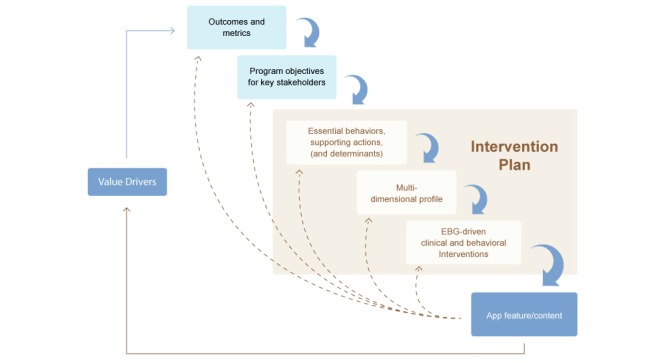
Objective: The purpose of this paper is to discuss the identification and development of an app intervention design framework, and its subsequent refinement through development of various types of mHealth apps for chronic disease.
Methods: The process of developing the framework was conducted between June 2012 and June 2014. Informed by clinical guidelines, standards of care, clinical practice recommendations, evidence-based research, best practices, and translated by subject matter experts, a framework for mobile app design was developed and the refinement of the framework across seven chronic disease states and three different product types is described.
Results: The result was the development of the Chronic Disease mHealth App Intervention Design Framework. This framework allowed for the integration of clinical and behavioral evidence for intervention and feature design. The application to different diseases and implementation models guided the design of mHealth solutions for varying levels of chronic disease management.
Conclusions: The framework and its design elements enable replicable product development for mHealth apps and may provide a foundation for the digital health industry to systematically expand mobile health interventions and validate their effectiveness across multiple implementation settings and chronic diseases.
Keywords: behavioral intervention; chronic disease; diabetes; intervention design; mHealth; mHealth framework; mHealth implementation; mobile app design; mobile applications; telemedicine.
Conflict of interest statement
Conflicts of Interest: CCW and MP are employed by, have stock options in, and were supported during time spent writing this article by WellDoc. RCAK was employed by WellDoc when the work described in the publication was being implemented, and has stock options in WellDoc.
References
-
- Akter S, Ray P. mHealth - an ultimate platform to serve the unserved. Yearb Med Inform. 2010:94–100.me10010094 - PubMed
-
- Free C, Phillips G, Galli L, Watson L, Felix L, Edwards P, Patel V, Haines A. The effectiveness of mobile-health technology-based health behaviour change or disease management interventions for health care consumers: A systematic review. PLoS Med. 2013;10(1):e1001362. doi: 10.1371/journal.pmed.1001362. http://dx.plos.org/10.1371/journal.pmed.1001362 PMEDICINE-D-12-00520 - DOI - DOI - PMC - PubMed
-
- Free C, Phillips G, Watson L, Galli L, Felix L, Edwards P, Patel V, Haines A. The effectiveness of mobile-health technologies to improve health care service delivery processes: A systematic review and meta-analysis. PLoS Med. 2013 Jan;10(1):e1001363. doi: 10.1371/journal.pmed.1001363. http://dx.plos.org/10.1371/journal.pmed.1001363 PMEDICINE-D-12-00641 - DOI - DOI - PMC - PubMed
-
- Kumar S, Nilsen WJ, Abernethy A, Atienza A, Patrick K, Pavel M, Riley WT, Shar A, Spring B, Spruijt-Metz D, Hedeker D, Honavar V, Kravitz R, Lefebvre RC, Mohr DC, Murphy SA, Quinn C, Shusterman V, Swendeman D. Mobile health technology evaluation: The mHealth evidence workshop. Am J Prev Med. 2013 Aug;45(2):228–236. doi: 10.1016/j.amepre.2013.03.017. http://europepmc.org/abstract/MED/23867031 S0749-3797(13)00277-8 - DOI - PMC - PubMed
LinkOut - more resources
Full Text Sources
Other Literature Sources
