


Impact of conflict on medical education: a cross-sectional survey of students and institutions in Iraq
- PMID: 26883241
- PMCID: PMC4762136
- DOI: 10.1136/bmjopen-2015-010460
Impact of conflict on medical education: a cross-sectional survey of students and institutions in Iraq
Abstract
Objective: This study surveyed all Iraqi medical schools and a cross-section of Iraqi medical students regarding their institutional and student experiences of medical education amidst ongoing conflict. The objective was to better understand the current resources and challenges facing medical schools, and the impacts of conflict on the training landscape and student experience, to provide evidence for further research and policy development.
Setting: Deans of all Iraqi medical schools registered in the World Directory of Medical Schools were invited to participate in a survey electronically. Medical students from three Iraqi medical schools were invited to participate in a survey electronically.
Outcomes: Primary: Student enrolment and graduation statistics; human resources of medical schools; dean perspectives on impact of conflict. Secondary: Medical student perspectives on quality of teaching, welfare and future career intentions.
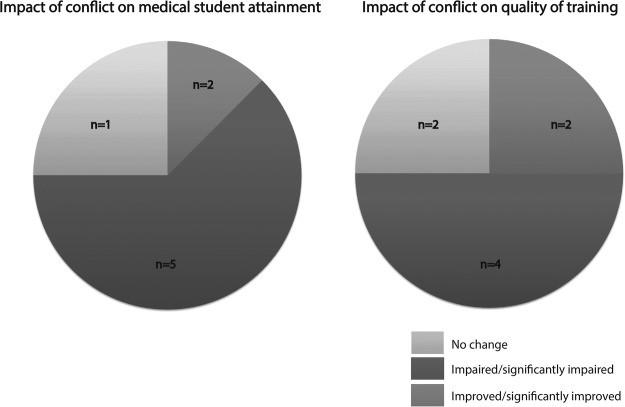
Findings: Of 24 medical schools listed in the World Directory of Medical Schools, 15 replied to an initial email sent to confirm their contact details, and 8 medical schools responded to our survey, giving a response rate from contactable medical schools of 53% and overall of 33%. Five (63%) medical schools reported medical student educational attainment being impaired or significantly impaired; 4 (50%) felt the quality of training medical schools could offer had been impaired or significantly impaired due to conflict. A total of 197 medical students responded, 62% of whom felt their safety had been threatened due to violent insecurity. The majority (56%) of medical students intended to leave Iraq after graduating.
Conclusions: Medical schools are facing challenges in staff recruitment and adequate resource provision; the majority believe quality of training has suffered as a result. Medical students are experiencing added psychological stress and lower quality of teaching; the majority intend to leave Iraq after graduation.
Keywords: Conflict; Medical education; Training; War; healthcare.
Published by the BMJ Publishing Group Limited. For permission to use (where not already granted under a licence) please go to http://www.bmj.com/company/products-services/rights-and-licensing/
Figures


References
-
- World Bank. Fragility, conflict and violence overview. 2015. http://www.worldbank.org/en/topic/fragilityconflictviolence/overview.
-
- Jackson A. The Cost of War Afghan Experiences of Conflict, 1978–2009. OXFAM, London; 2009.
-
- UNESCO. The hidden crisis: Armed conflict and education. UNESCO, Paris; 2011.
-
- Krause K, Muggah R, Gilgen E. The Global Burden of Armed Violence. Geneva Declaration, Geneva; 2011.
MeSH terms
LinkOut - more resources
Full Text Sources
Other Literature Sources
