ONC201: Stressing tumors to death
- PMID: 26884598
- PMCID: PMC7422919
- DOI: 10.1126/scisignal.aad7955
ONC201: Stressing tumors to death
Abstract
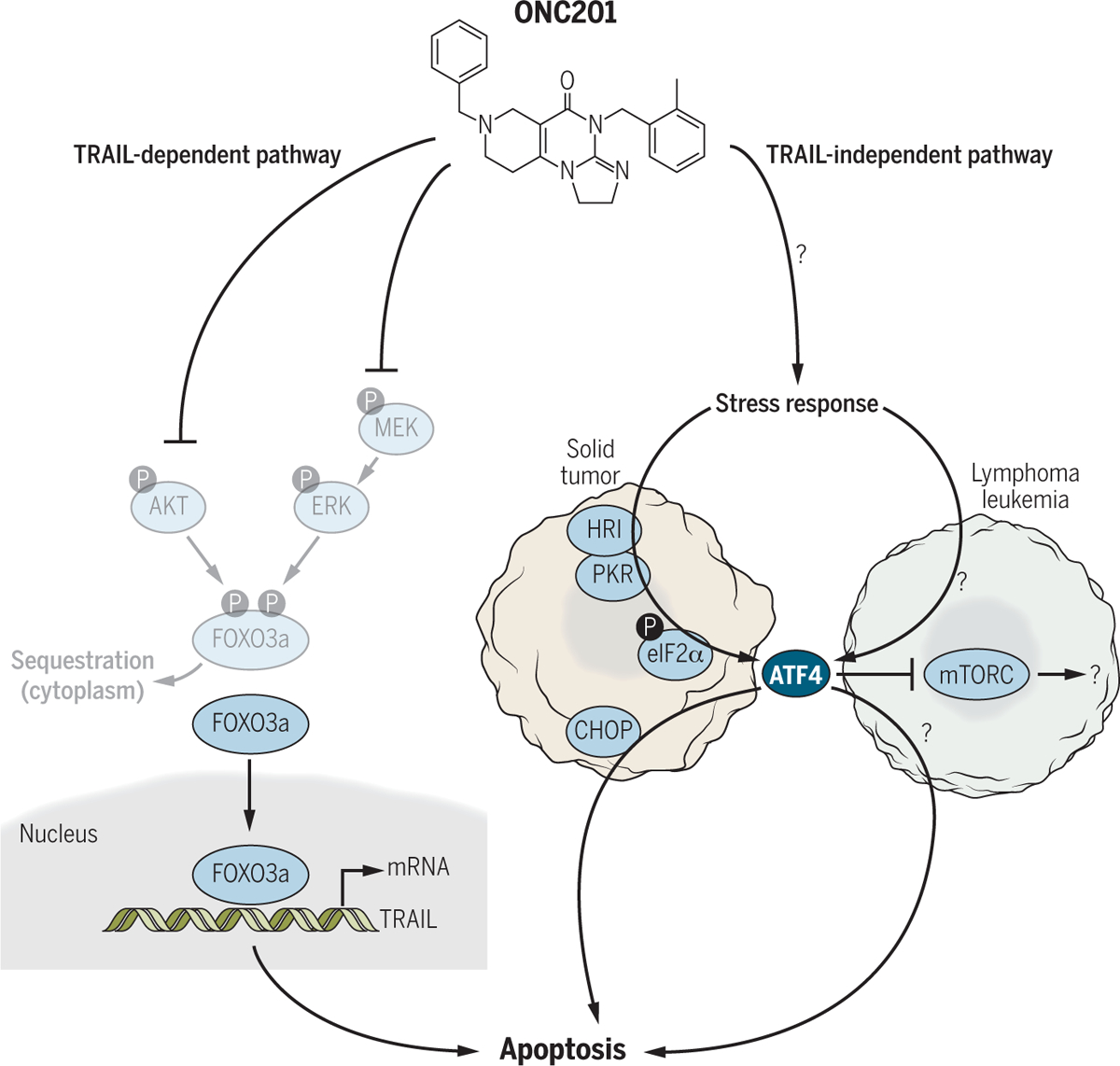
The small molecule ONC201 was identified in a screen for compounds that would induce expression of the gene encoding tumor necrosis factor-related apoptosis-inducing ligand (TRAIL) in tumors and thus cause an autocrine- or paracrine-induced death in tumor cells. Two Research Articles in this issue of Science Signaling by Ishizawa et al. and Kline et al. describe how ONC201 can also trigger cytotoxicity by inducing a stress response. The mechanisms of the stress response induced differ between hematological malignancies and solid tumors, highlighting the complexity of ONC201-induced toxicity and raising intriguing issues of tissue-specific pathways activated by the drug.
Copyright © 2016, American Association for the Advancement of Science.
Conflict of interest statement
Figures
Comment on
-
ATF4 induction through an atypical integrated stress response to ONC201 triggers p53-independent apoptosis in hematological malignancies.Sci Signal. 2016 Feb 16;9(415):ra17. doi: 10.1126/scisignal.aac4380. Sci Signal. 2016. PMID: 26884599 Free PMC article.
-
ONC201 kills solid tumor cells by triggering an integrated stress response dependent on ATF4 activation by specific eIF2α kinases.Sci Signal. 2016 Feb 16;9(415):ra18. doi: 10.1126/scisignal.aac4374. Sci Signal. 2016. PMID: 26884600 Free PMC article.
References
-
- Johnstone RW, Frew AJ, Smyth MJ, The TRAIL apoptotic pathway in cancer onset, progression and therapy. Nat. Rev. Cancer 8, 782–798 (2008). - PubMed
-
- Ashkenazi A, Salvesen G, Regulated cell death: Signaling and mechanisms. Annu. Rev. Cell Dev. Biol 30, 337–356 (2014). - PubMed
-
- den Hollander MW, Gietema JA, de Jong S,Walenkamp AM, Reyners AK, Oldenhuis CN,de Vries EG, Translating TRAIL-receptor targeting agents to the clinic. Cancer Lett. 332, 194–201 (2013). - PubMed
Publication types
MeSH terms
Substances
Grants and funding
LinkOut - more resources
Full Text Sources
Other Literature Sources
Medical