


Decade-Long Trends (2001-2011) in the Incidence and Hospital Death Rates Associated with the In-Hospital Development of Cardiogenic Shock after Acute Myocardial Infarction
- PMID: 26884615
- PMCID: PMC4794369
- DOI: 10.1161/CIRCOUTCOMES.115.002359
Decade-Long Trends (2001-2011) in the Incidence and Hospital Death Rates Associated with the In-Hospital Development of Cardiogenic Shock after Acute Myocardial Infarction
Abstract
Background: Limited information is available about relatively contemporary trends in the incidence and hospital case-fatality rates of cardiogenic shock in patients hospitalized with acute myocardial infarction. The purpose of this population-based study was to describe decade long trends (2001-2011) in the incidence and hospital case-fatality rates for patients who developed cardiogenic shock during hospitalization for an acute myocardial infarction.
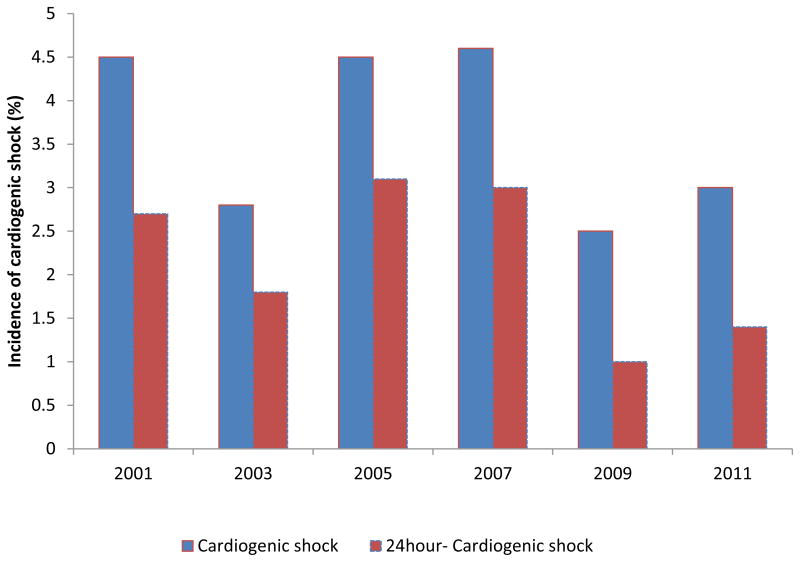
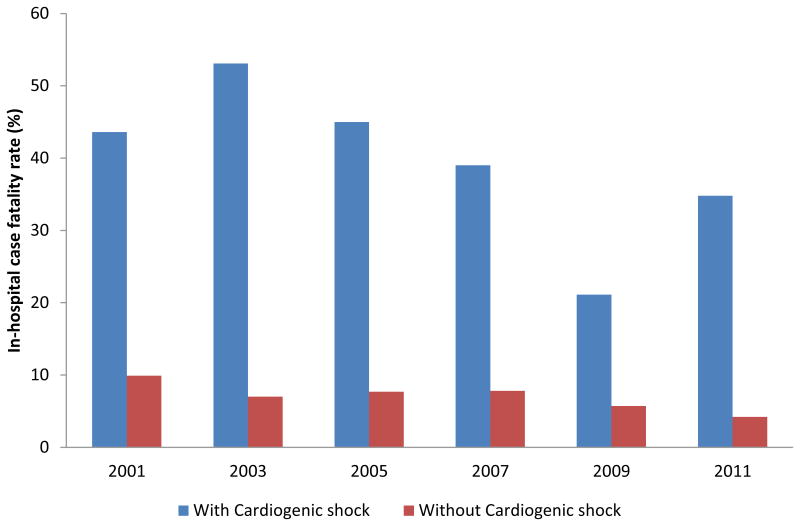
Methods and results: The study population consisted of 5686 residents of central Massachusetts hospitalized with acute myocardial infarction at all 11 medical centers in the Worcester, MA, metropolitan area during 6 biennial periods between 2001 and 2011, who did not have cardiogenic shock at the time of hospital presentation. On average, 3.7% of these patients developed cardiogenic shock during their acute hospitalization with nonsignificant and inconsistent trends noted over time in both crude (3.7% in 2001/2003; 4.5% in 2005/2007; 2.7% in 2009/2011; P=0.19) and multivariable adjusted analyses. The overall in-hospital case-fatality rate for patients who developed cardiogenic shock was 41.4%. The crude and multivariable adjusted odds of dying after cardiogenic shock declined during the most recent study years (47.1% dying in 2001/2003, 42.0% dying in 2005/2007, and 28.6% dying in 2009/2011). Increases in the use of evidence-based cardiac medications, and interventional procedures paralleled the increasing hospital survival trends.
Conclusions: We found suggestions of a decline in the death, but not incidence, rates of cardiogenic shock over time. These encouraging trends in hospital survival are likely because of advances in the early recognition and aggressive management of patients who develop cardiogenic shock.
Keywords: epidemiology; hospitalization; myocardial infarction; secondary prevention; shock, cardiogenic.
© 2016 American Heart Association, Inc.
Figures
References
-
- Goldberg RJ, Gore JM, Alpert JS, Osganian V, de Groot J, Bade J, Chen Z, Frid D, Dalen JE. Cardiogenic shock after acute myocardial infarction. Incidence and mortality from a community-wide perspective, 1975 to 1988. N Engl J Med. 1991;325:1117–22. - PubMed
-
- Goldberg RJ, Samad NA, Yarzebski J, Gurwitz J, Bigelow C, Gore JM. Temporal trends in cardiogenic shock complicating acute myocardial infarction. N Engl J Med. 1999;340:1162–8. - PubMed
-
- Goldberg RJ, Spencer FA, Gore JM, Lessard D, Yarzebski J. Thirty-year trends (1975 to 2005) in the magnitude of, management of, and hospital death rates associated with cardiogenic shock in patients with acute myocardial infarction: a population-based perspective. Circulation. 2009;119:1211–9. - PMC - PubMed
-
- Reynolds HR, Hochman JS. Cardiogenic shock: current concepts and improving outcomes. Circulation. 2008;117:686–97. - PubMed
-
- Hochman JS, Sleeper LA, Webb JG, Sanborn TA, White HD, Talley JD, Buller CE, Jacobs AK, Slater JN, Col J, McKinlay SM, LeJemtel TH. Early revascularization in acute myocardial infarction complicated by cardiogenic shock. SHOCK Investigators. Should We Emergently Revascularize Occluded Coronaries for Cardiogenic Shock. N Engl J Med. 1999;341:625–34. - PubMed
Publication types
MeSH terms
Grants and funding
LinkOut - more resources
Full Text Sources
Other Literature Sources
Medical
