


Body size in early life and risk of lymphoid malignancies and histological subtypes in adulthood
- PMID: 26888490
- PMCID: PMC4855635
- DOI: 10.1002/ijc.30044
Body size in early life and risk of lymphoid malignancies and histological subtypes in adulthood
Abstract
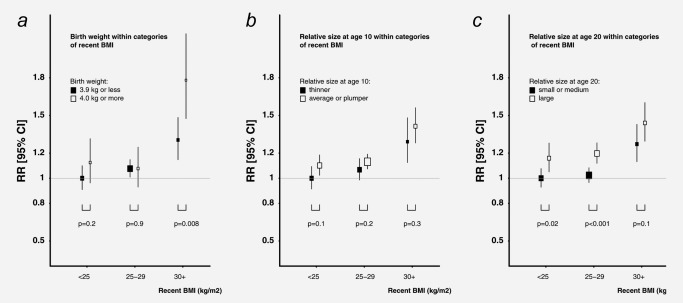
Risk of adult lymphoid malignancy is associated with recent adiposity. Some have reported apparent associations with adiposity in childhood or early adulthood, but whether these associations are independent of recent adiposity is unknown. Birth weight, body size at age 10 years, clothes size at age 20 years, and recent body mass index (BMI) were recorded in 745,273 UK women, mean age 60.1 (SD 4.9) at baseline, without prior cancer. They were followed for 11 years, during which time 5,765 lymphoid malignancies occurred. Using Cox regression, a higher risk of lymphoid malignancy was strongly associated with higher recent BMI (RR=1.33, 95%CI 1.17-1.51, for BMI 35+ vs <22.5 kg/m(2)), and this association remained essentially unchanged after adjustment for birth weight and body size at 10. Higher lymphoid malignancy risk was also associated with large size at birth, at age 10, and at age 20 years, but after adjustment for recent BMI, the significance of the associations with large size at birth and at age 10 years was sufficiently reduced that residual confounding by adult BMI could not be excluded; a weak association with large size at 20 years remained (adjusted RR =1.17, 95%CI 1.10-1.24 for large size at age 20 vs. medium or small size). We found no strong evidence of histological specificity in any of these associations. In conclusion, our findings suggest a possible role of adiposity throughout adulthood in the risk of lymphoid malignancy, but the independent contribution of body size at birth and during childhood appears to be small.
Keywords: body mass index; childhood obesity; lymphoid malignancies; lymphoma; myeloma; obesity.
© 2016 The Authors International Journal of Cancer published by John Wiley & Sons Ltd on behalf of UICC.
Figures
References
-
- Larsson SC, Wolk A. Body mass index and risk of non‐Hodgkin's and Hodgkin's lymphoma: a meta‐analysis of prospective studies. Eur J Cancer 2011;47:2422–30. - PubMed
-
- Cerhan JR, Janney CA, Vachon CM, et al. Anthropometric characteristics, physical activity, and risk of non‐Hodgkin's lymphoma subtypes and B‐cell chronic lymphocytic leukemia: a prospective study. Am J Epidemiol 2002;156:527–35. - PubMed
-
- Maskarinec G, Erber E, Gill J, et al. Overweight and obesity at different times in life as risk factors for non‐Hodgkin's lymphoma: the Multiethnic Cohort. Cancer Epidemiol Biomarkers Prev 2008;17:196–203. - PubMed
Publication types
MeSH terms
Grants and funding
LinkOut - more resources
Full Text Sources
Other Literature Sources
Medical
