


Increasing Clinical Severity during a Dengue Virus Type 3 Cuban Epidemic: Deep Sequencing of Evolving Viral Populations
- PMID: 26889031
- PMCID: PMC4836355
- DOI: 10.1128/JVI.02647-15
Increasing Clinical Severity during a Dengue Virus Type 3 Cuban Epidemic: Deep Sequencing of Evolving Viral Populations
Abstract
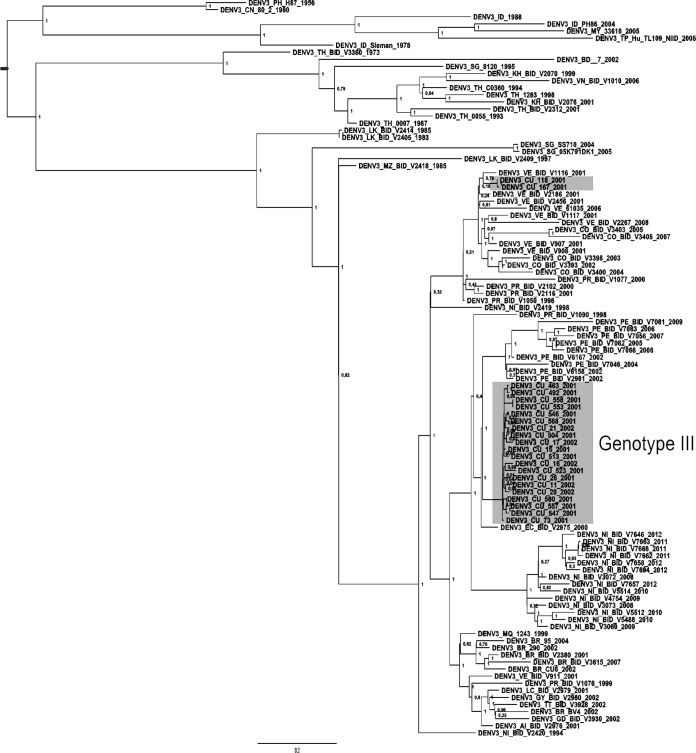
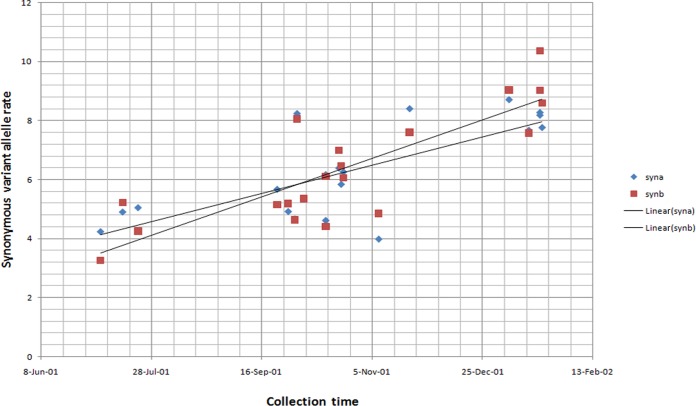
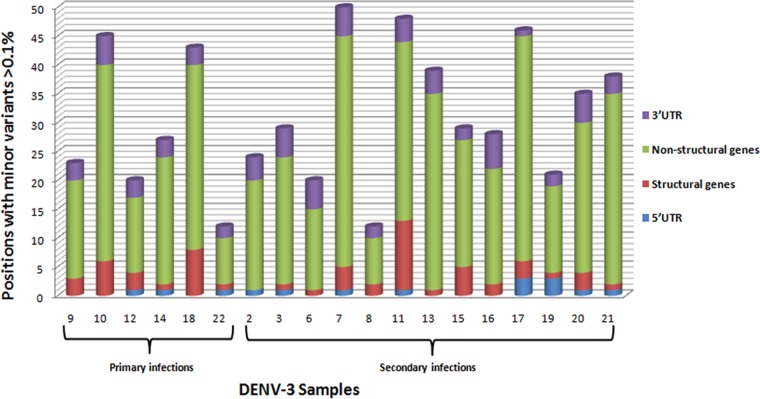
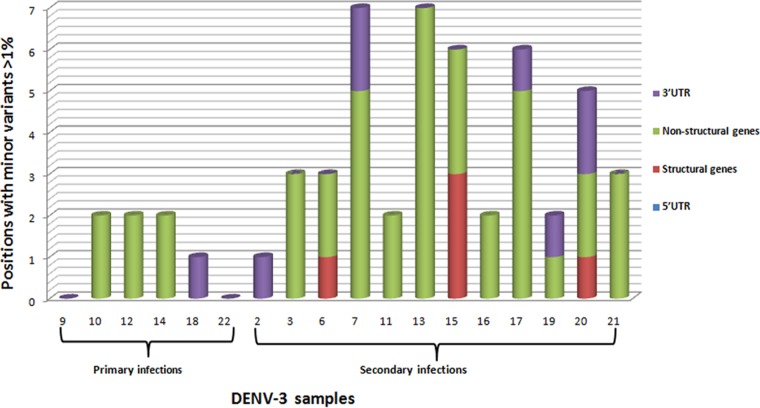
During the dengue virus type 3 (DENV-3) epidemic that occurred in Havana in 2001 to 2002, severe disease was associated with the infection sequence DENV-1 followed by DENV-3 (DENV-1/DENV-3), while the sequence DENV-2/DENV-3 was associated with mild/asymptomatic infections. To determine the role of the virus in the increasing severity demonstrated during the epidemic, serum samples collected at different time points were studied. A total of 22 full-length sequences were obtained using a deep-sequencing approach. Bayesian phylogenetic analysis of consensus sequences revealed that two DENV-3 lineages were circulating in Havana at that time, both grouped within genotype III. The predominant lineage is closely related to Peruvian and Ecuadorian strains, while the minor lineage is related to Venezuelan strains. According to consensus sequences, relatively few nonsynonymous mutations were observed; only one was fixed during the epidemic at position 4380 in the NS2B gene. Intrahost genetic analysis indicated that a significant minor population was selected and became predominant toward the end of the epidemic. In conclusion, greater variability was detected during the epidemic's progression in terms of significant minority variants, particularly in the nonstructural genes. An increasing trend of genetic diversity toward the end of the epidemic was observed only for synonymous variant allele rates, with higher variability in secondary cases. Remarkably, significant intrahost genetic variation was demonstrated within the same patient during the course of secondary infection with DENV-1/DENV-3, including changes in the structural proteins premembrane (PrM) and envelope (E). Therefore, the dynamic of evolving viral populations in the context of heterotypic antibodies could be related to the increasing clinical severity observed during the epidemic.
Importance: Based on the evidence that DENV fitness is context dependent, our research has focused on the study of viral factors associated with intraepidemic increasing severity in a unique epidemiological setting. Here, we investigated the intrahost genetic diversity in acute human samples collected at different time points during the DENV-3 epidemic that occurred in Cuba in 2001 to 2002 using a deep-sequencing approach. We concluded that greater variability in significant minor populations occurred as the epidemic progressed, particularly in the nonstructural genes, with higher variability observed in secondary infection cases. Remarkably, for the first time significant intrahost genetic variation was demonstrated within the same patient during the course of secondary infection with DENV-1/DENV-3, including changes in structural proteins. These findings indicate that high-resolution approaches are needed to unravel molecular mechanisms involved in dengue pathogenesis.
Copyright © 2016 Rodriguez-Roche et al.
Figures
References
-
- Bhatt S, Gething PW, Brady OJ, Messina JP, Farlow AW, Moyes CL, Drake JM, Brownstein JS, Hoen AG, Sankoh O, Myers MF, George DB, Jaenisch T, Wint GR, Simmons CP, Scott TW, Farrar JJ, Hay SI. 2013. The global distribution and burden of dengue. Nature 496:504–507. doi: 10.1038/nature12060. - DOI - PMC - PubMed
-
- WHO/TDR. 2009. Dengue guidelines for diagnosis, treatment, prevention and control—new edition. World Health Organization Press, Geneva, Switzerland. - PubMed
-
- WHO. 1997. Dengue hemorrhagic fever: diagnosis, treatment, prevention and control, 2nd ed World Health Organization Press, Geneva, Switzerland.
Publication types
MeSH terms
Substances
LinkOut - more resources
Full Text Sources
Other Literature Sources
Medical
Molecular Biology Databases
