. 2016 Mar;22(3):491-502.
doi: 10.3201/eid2203.151788.

Factors Associated with Loss to Follow-up during Treatment for Multidrug-Resistant Tuberculosis, the Philippines, 2012-2014

Factors Associated with Loss to Follow-up during Treatment for Multidrug-Resistant Tuberculosis, the Philippines, 2012-2014

Thelma E Tupasi et al. Emerg Infect Dis. 2016 Mar.

Abstract

To identify factors associated with loss to follow-up during treatment for multidrug-resistant (MDR) tuberculosis (TB) in the Philippines, we conducted a case-control study of adult patients who began receiving treatment for rifampin-resistant TB during July 1-December 31, 2012. Among 91 case-patients (those lost to follow-up) and 182 control-patients (those who adhered to treatment), independent factors associated with loss to follow-up included patients' higher self-rating of the severity of vomiting as an adverse drug reaction and alcohol abuse. Protective factors included receiving any type of assistance from the TB program, better TB knowledge, and higher levels of trust in and support from physicians and nurses. These results provide insights for designing interventions aimed at reducing patient loss to follow-up during treatment for MDR TB.

Keywords: MDR TB; TB; follow-up; multidrug-resistant tuberculosis; patient compliance; risk factors; side effects; the Philippines; treatment; tuberculosis and other mycobacteria.


Figures
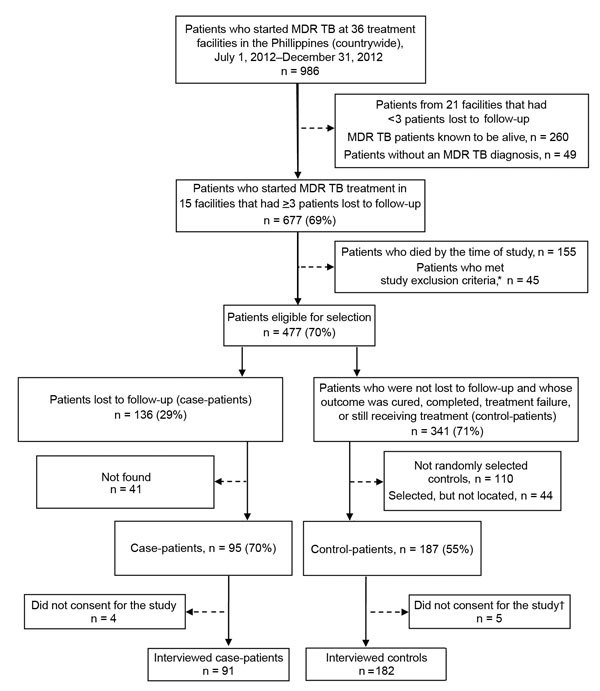
Figure 1
Figure 1
Selection of participants for study of loss to follow-up during treatment for multidrug resistant tuberculosis (MDR TB) in the Philippines, 2012–2014. *Study exclusion criteria were incarceration, age <18 years, enrollment in pharmaceutical clinical trials, and major psychiatric disorder or physical incapacitation. †Control-patients who did not give consent for the study were replaced by other randomly selected eligible patients.
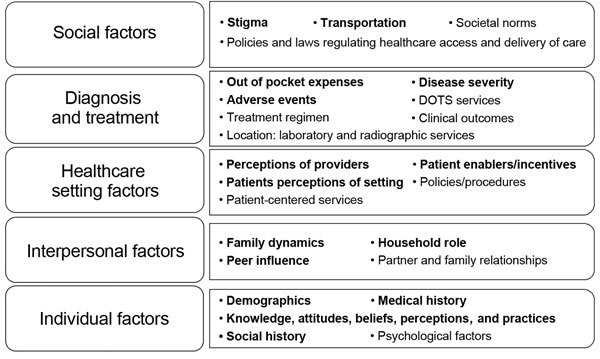
Figure 2
Figure 2
Social ecologic model used to identify factors influencing loss to follow-up during treatment for multidrug resistant tuberculosis in the Philippines, 2012–2014. Boldface indicates data collected through patient interviews and medical record abstractions. DOTS, directly observed therapy.

References

    1. World Health Organization. Countdown to 2015: global tuberculosis report 2013 supplement [cited 2015 Jul 24]. http://apps.who.int/iris/bitstream/10665/91542/1/WHO_HTM_TB_2013.13_eng.pdf
    1. Ahuja SD, Ashkin D, Avendano M, Banerjee R, Bauer M, Bayona JN, et al. Multidrug resistant pulmonary tuberculosis treatment regimens and patient outcomes: an individual patient data meta-analysis of 9,153 patients. PLoS Med. 2012;9:e1001300. 10.1371/journal.pmed.1001300 - DOI - PMC - PubMed
    1. Fitzpatrick C, Floyd K. A systematic review of the cost and cost effectiveness of treatment for multidrug-resistant tuberculosis. Pharmacoeconomics. 2012;30:63–80. 10.2165/11595340-000000000-00000 - DOI - PubMed
    1. Orenstein EW, Basu S, Shah NS, Andrews JR, Friedland GH, Moll AP, et al. Treatment outcomes among patients with multidrug-resistant tuberculosis: systematic review and meta-analysis. Lancet Infect Dis. 2009;9:153–61. 10.1016/S1473-3099(09)70041-6 - DOI - PubMed
    1. Ramachandran G, Swaminathan S. Safety and tolerability profile of second-line anti-tuberculosis medications. Drug Saf. 2015;38:253–69. 10.1007/s40264-015-0267-y - DOI - PubMed

Publication types

Substances

LinkOut - more resources