


Prevalence of psoriasis phenotypes among men and women in the USA
- PMID: 26890045
- PMCID: PMC4915990
- DOI: 10.1111/ced.12805
Prevalence of psoriasis phenotypes among men and women in the USA
Abstract
Background: We present the largest set of US prevalence data for psoriasis to date, obtained from three prospective cohort studies describing validated clinical phenotypes of psoriasis, including novel data about the prevalence of inverse (intertriginous) psoriasis in these groups. Nonplaque psoriasis phenotypes have been largely unmeasured in observational and interventional studies, and this has led to an under-recognition of this aspect of psoriatic disease.
Aim: To describe the prevalence of nonplaque psoriasis phenotypes in a large prospective cohort.
Methods: We included 3179 women and 646 men in the analysis. Participants in the Nurses Health Study (NHS) and Health Professionals Follow-up Study (HPFS) with physician-diagnosed psoriasis completed a validated, self-administered questionnaire to assess plaque and nonplaque subsets of psoriasis.
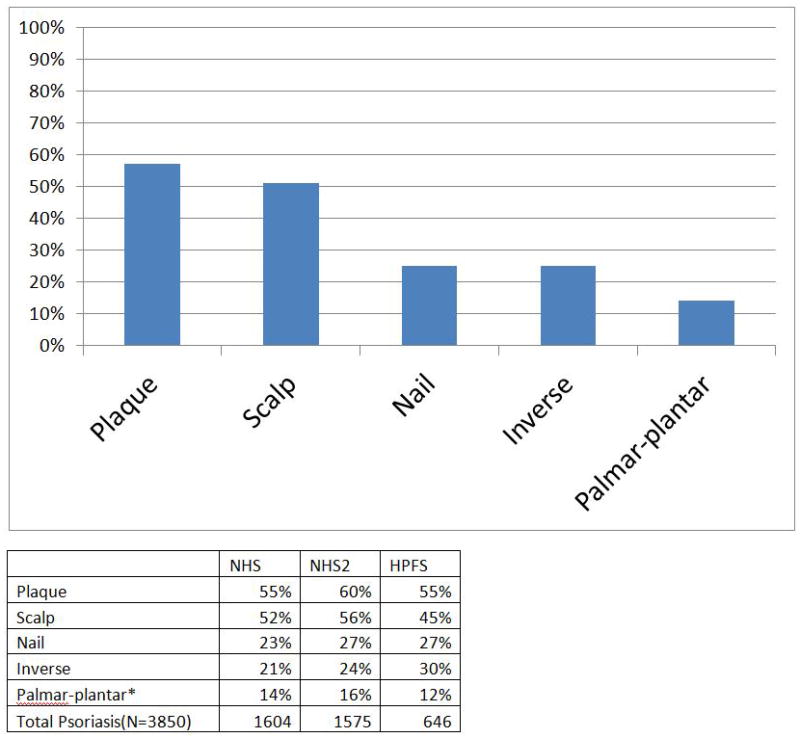
Results: Psoriasis phenotypes were as follows: plaque 55%, scalp 52%, palmar-plantar 14%, nail 23% and inverse 21% in the NHS (n = 1604); plaque 60%, scalp 56%, palmar-plantar 16%, nail 27% and inverse 24% in the second NHS study (NHS II) (n = 1575); and plaque 55%, scalp 45%, palmar-plantar 12%, nail 27% and inverse 30% in the HPFS (n = 646). Scalp, nail, palmar-plantar and inverse disease represent highly prevalent phenotypes of psoriasis in the USA.
Conclusion: Scalp, nail, palmar-plantar and inverse disease represent highly prevalent phenotypes of psoriasis.
© 2016 British Association of Dermatologists.
Conflict of interest statement
Conflict of interest: JFM is a consultant for Biogen IDEC, Amgen, Abbvie and Eli Lilly, has received a grant from Biogen IDEC, and has licensed a questionnaire to Abbvie. AAQ has licensed a questionnaire to Merck, Pfizer and Abbvie, has received a grant from Amgen, and has acted as a consultant for Jansen, Novartis and Abbott. None of the other authors has any conflict of interest to report.
Figures
References
-
- Augustin M, Reich K, Blome C, et al. Nail psoriasis in Germany: epidemiology and burden of disease. Br J Dermatol. 2010;163:580–5. - PubMed
-
- de Jong EM, Seegers BA, Gulinck MK, et al. Psoriasis of the nails associated with disability in a large number of patients: results of a recent interview with 1,728 patients. Dermatology. 1996;193:300–3. - PubMed
-
- Dominguez PL, Assarpour A, Kuo H, et al. Development and pilot-testing of a psoriasis screening tool. Br J Dermatol. 2009;161:778–84. - PubMed
-
- Doss N. Psoriasis: different clinical phenotypes. International journal of dermatology. 2014;53:e142–143. - PubMed
MeSH terms
Grants and funding
LinkOut - more resources
Full Text Sources
Other Literature Sources
Medical
