Inequalities in Hospitalized Unintentional Injury Between Aboriginal and Non-Aboriginal Children in New South Wales, Australia
- PMID: 26890169
- PMCID: PMC4985120
- DOI: 10.2105/AJPH.2015.303022
Inequalities in Hospitalized Unintentional Injury Between Aboriginal and Non-Aboriginal Children in New South Wales, Australia
Abstract
Objectives: To quantify inequalities in rates of unintentional injury-related hospitalizations between Australian Aboriginal and non-Aboriginal children.
Methods: We used linked hospital and mortality data to construct a retrospective whole-of-population birth cohort including 1,124,717 children born in the state of New South Wales, Australia, between July 1, 2000 and December 31, 2012. We adjusted hazard ratios (HRs) of first injury hospitalization for geographic clustering and individual- and area-level factors.
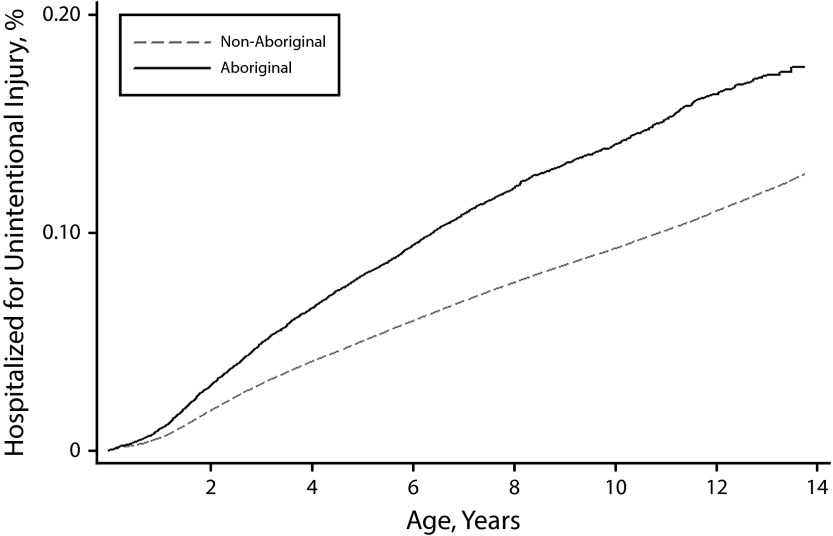
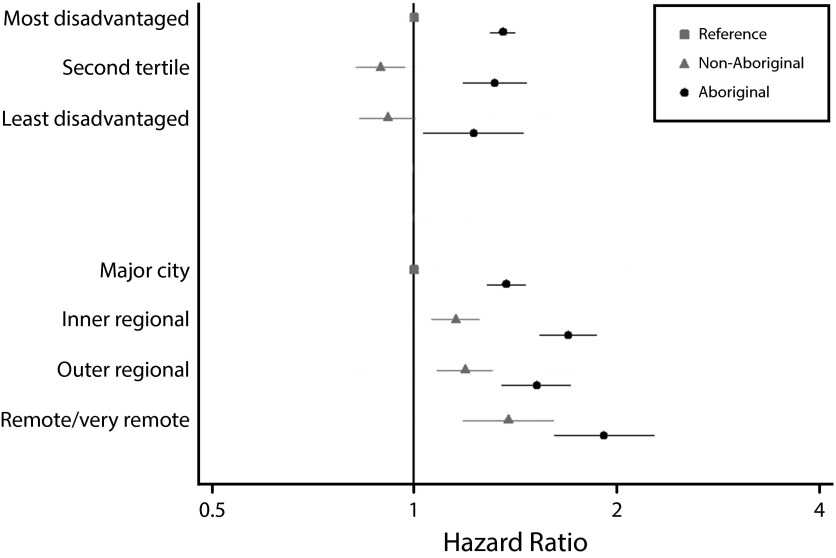
Results: Aboriginal children were 1.6 times more likely than were non-Aboriginal children to be hospitalized for an unintentional injury. The largest inequalities were for poisoning (HR = 2.7; 95% CI = 2.4, 3.0) and injuries stemming from exposure to fire, flames, heat, and hot substances (HR = 2.4; 95% CI = 2.1, 2.7). Adjustment reduced the inequality for all unintentional injury overall (HR = 1.4; 95% CI = 1.3, 1.4) and within leading injury mechanisms.
Conclusions: Australian Aboriginal children suffer a disproportionately high burden of unintentional injury.
Figures
References
-
- Australian Institute of Health and Welfare. The Health and Welfare of Australia’s Aboriginal and Torres Strait Islander People, an Overview. Canberra, Australia: 2011.
-
- Gracey M, King M. Indigenous health part 1: determinants and disease patterns. Lancet. 2009;374(9683):65–75. - PubMed
-
- Australian Bureau of Statistics. Experimental Life Tables for Aboriginal and Torres Strait Islander Australians, 2005–2007. Canberra, Australia: 2009.
-
- Australian Indigenous HealthInfoNet. Overview of Australian Indigenous Health Status, 2013. Perth, Australia: 2014.
-
- Australian Institute of Health and Welfare. A Picture of Australia’s Children 2012. Canberra, Australia: 2012.
Publication types
MeSH terms
LinkOut - more resources
Full Text Sources
Other Literature Sources
Medical