Review
. 2016 Mar;17(3):160-72.
doi: 10.1038/nrn.2015.29.

Extracellular vesicles round off communication in the nervous system

Affiliations
Review

Extracellular vesicles round off communication in the nervous system

Vivian Budnik et al. Nat Rev Neurosci. 2016 Mar.

Abstract

Functional neural competence and integrity require interactive exchanges among sensory and motor neurons, interneurons and glial cells. Recent studies have attributed some of the tasks needed for these exchanges to extracellular vesicles (such as exosomes and microvesicles), which are most prominently involved in shuttling reciprocal signals between myelinating glia and neurons, thus promoting neuronal survival, the immune response mediated by microglia, and synapse assembly and plasticity. Such vesicles have also been identified as important factors in the spread of neurodegenerative disorders and brain cancer. These extracellular vesicle functions add a previously unrecognized level of complexity to transcellular interactions within the nervous system.


Figures
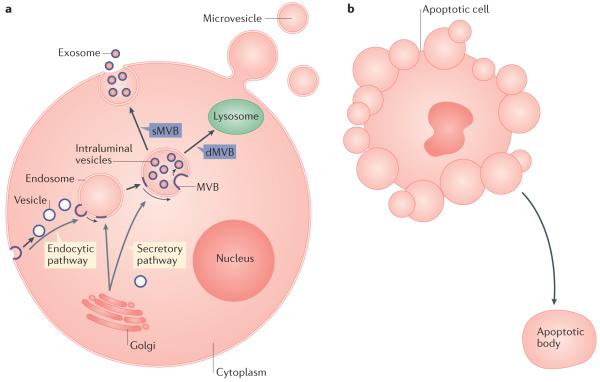
Figure 1
Figure 1. Extracellular vesicle formation and release
a ∣ Multivesicular bodies (MVBs), the cellular source of exosomes, can form via the endocytic or the secretory pathway. In this process, vesicles that originate by endocytosis at the plasma membrane or that are generated by the Golgi complex fuse with the limiting membrane of an endosomal compartment and bud inwardly into the lumen of the endosome (the movement of membrane constituents from the plasma membrane or Golgi complex to the exosome membranes is depicted by a blue line boundary). Although degradative MVBs (dMVBs) subsequently fuse with the lysosome, leading to MVB content degradation, secretory MVBs (sMVBs) fuse with the plasma membrane, releasing exosomes into the extracellular space. In contrast to exosomes, microvesicles form by the outward budding of the plasma membrane, which releases microvesicles after the bud pinches off from the cell surface. b ∣ A cell undergoing apoptosis sheds apoptotic bodies, which bud off from the plasma membrane.
Figure 2
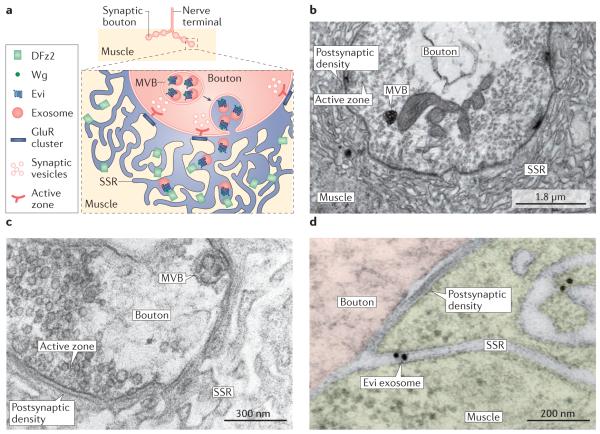
Figure 2. Release of Evi-containing exosomes at the Drosophila melanogaster neuromuscular junction
a ∣ At the Drosophila melanogaster neuromuscular junction, exosomes are released by motor neuron terminals (synaptic boutons) and are received by muscles. In the synaptic boutons (see inset box), multivesicular bodies (MVBs) fuse with the plasma membrane at extrasynaptic sites, away from active zones, and release exosomes containing Evi and Wingless (Wg). Exosomes travel through extracellular canals formed by the subsynaptic reticulum (SSR), a folded structure that is formed at the junctional region of the muscle cell, and eventually interact with DFrizzled-2 (DFz2) receptors, localized deep in the SSR. b ∣ Cross-section of a synaptic bouton showing an MVB at the ultrastructural level. An active zone and its apposed postsynaptic density, as well as the folded muscle SSR, are indicated. c ∣ Electron micrograph of a synaptic bouton showing an MVB docked at the presynaptic bouton membrane, away from sites of neurotransmitter release. d ∣ High-magnification view of a presynaptic bouton region and the postsynaptic SSR in an animal that expressed Evi-GFP (green fluorescent protein) exclusively in neurons, immunolabelled with gold granules. Note the presence of a gold-labelled Evi exosome that is outside the bouton and within an SSR canal. A nearby postsynaptic density is also shown. Part b is modified with permission from REF. 49, Elsevier. Parts c and d are modified with permission from REF. 48, © 2016 The American Society for Biochemistry and Molecular Biology.

References

    1. Colombo M, Raposo G, Thery C. Biogenesis, secretion, and intercellular interactions of exosomes and other extracellular vesicles. Annu. Rev. Cell Dev. Biol. 2014;30:255–289. An important review of the current understanding of EV biogenesis and secretion, including protocols for EV isolation and current challenges for the field.

    1. Crescitelli R, et al. Distinct RNA profiles in subpopulations of extracellular vesicles: apoptotic bodies, microvesicles and exosomes. J. Extracell. Vesicles. 2013 http://dx.doi.org/10.3402/jev.v2i0.20677. - DOI - PMC - PubMed
    1. Hurley JH. ESCRTs are everywhere. EMBO J. 2015;34:2398–2407. - PMC - PubMed
    1. Babst M. MVB vesicle formation: ESCRT-dependent, ESCRT-independent and everything in between. Curr. Opin. Cell Biol. 2011;23:452–457. An excellent discussion on the role of the ESCRT versus lipids in forming MVB ILVs.

    1. Lorent JH, Levental I. Structural determinants of protein partitioning into ordered membrane domains and lipid rafts. Chem. Phys. Lipids. 2015;192:23–32. - PubMed

Publication types