. 2016 Feb 19:11:31.
doi: 10.1186/s13019-016-0406-2.

Surgical treatment of primary cardiac valve tumor: early and late results in eight patients

Affiliations

Surgical treatment of primary cardiac valve tumor: early and late results in eight patients

Yong Wang et al. J Cardiothorac Surg. .

Abstract

Background: To report early and late outcomes of patients with the primary cardiac valve tumor undergoing surgical treatment over a 30-year period in our cardiovascular center.

Methods: From January 1980 to December 2014, a total of 211 patients with primary cardiac tumors accepted surgical treatments, of which only 8 (3.8 %) were primary cardiac valve tumor patients in our surgical center of cardiovascular.

Results: The diagnosis was identified by echocardiography preoperatively and pathological analysis postoperatively. All patients underwent intracardiac procedures with extracorporeal circulation. Intracardiac procedures included resection of tumor on leaflet in 2 patients (25 %), resection of tumor and native valvuloplasty in 2 patients (25 %), resection of neoplasm and replacement of native valve with prosthetic valve in 4 patients (50 %). One man was performed a resection of tumor on aortic noncoronary leaflet and a coronary artery bypass graft. Eight cases of primary valve tumor occurred in all of four cardiac valves. The majority of valvular tumor was myxoma in 3 cases (37.5 %), followed by the papillary fibroelastomas in 2 cases (25 %). There were one rhabdomyoma (12.5 %), one lipoma (12.5 %) and one mild malignant sarcoma (12.5 %). The mitral valve was the most commonly original valve (62.5 %). There was pulmonic (12.5 %), aortic (12.5 %) and tricuspid (12.5 %) valve tumor each one patient. There was no death and recrudescence in the series. Follow-up of all patients ranged from 1 to 16 years (mean 7.06 ± 4.24 years). There was no recrudesce and cardiac valve dysfunction.

Conclusion: The incidence of primary valve tumor was very low. More understanding of the rare disease and widespread use of echocardiography would greatly improve the diagnosis of primary valve tumor in the early stage. Echocardiography could detect millimeters in diameter neoplasms on cardiac valve. The diagnoses were based on imaging findings and the classical triad symptoms associated with the hemodynamic abnormalities, the organ embolism and the systemic symptoms directly from tumors. The intraoperative frozen sections and postoperative pathology analysis provided accurate diagnosis and supported the treatment strategies. Early diagnosis and intervention were keys to reserve the normal original valve function. Prompt surgical resection is necessary to prevent potential critical events.


Figures
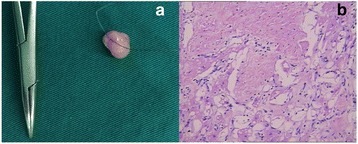
Fig. 1
Fig. 1
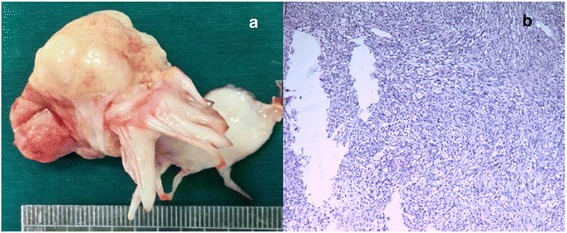
(Case 4, Mitral valve rhabdomyoma) a: A light-red elliptical neoplasm with smooth surface, shaved completely from the mitral anterior leaflet, 1 × 0.8 × 0.4 cm3. b: Histologically, the tumor was highly cellular and composed of somewhat pleomorphic, polygonal muscle cells admixed with spindle-shaped cells. There was “spider web” appearance in some tumor cells which has been known as the classic microscopic finding for rhabdomyoma. The tumor showed widely myxoid degeneration. (Hematoxylin and eosin)
Fig. 2
Fig. 2
(Case 5, Malignant mitral valve tumor) a: A Yellow neoplasm looked like cauliflower with granular surface, destructively growth from the posterior leaflet of MV, 4.8 × 4.0 × 2.5 cm3. b Histology of mesenchymal sarcoma. Tumor cells of different sizes and shapes have pleomorphic nuclei and much secretion of fluid matrix. Karyokinesis is visible
Fig. 3
Fig. 3
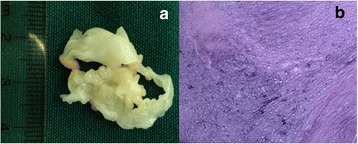
(Case 7, Mitral valve multiple myxoma) a: There are more than 10 pieces of neoplasm on leaflets of mitral valve. White neoplasms looked like granular surface. b Histologic aspect of the tumor, with the Characteristic Acid-Mucopolysaccharide Matrix and Embedded Polygonal Cells. (Hematoxylin and eosin)
Fig. 4
Fig. 4
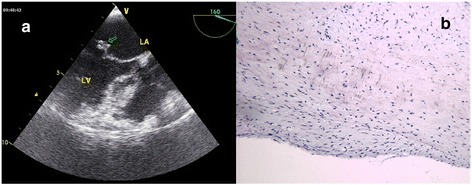
(Case 6, Mitral valve papillary fibroelastoma) a: The echocardiogram shows a 1.2 × 1.0 cm2 mass attached to the anterior leaflet of mitral valve. The arrow indicates the neoplasm on the atrial side of mitral valve. b The low power photomicrograph showing fibroustissue hyaline degeneration papillary hyperplasia and mucinous degeneration. (Hematoxylin and eosin)
Fig. 5
Fig. 5
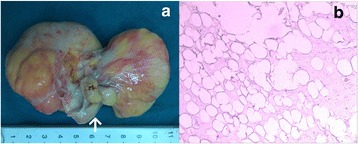
(Case 8, Giant pulmonary valve lipoma.) a: A giant smooth surface neoplasm growed from the pulmonary valve, 10 × 5.5 × 4.5 cm3. The arrow indicates the original pulmonary valve. b Histologic aspect of the tumor. The tumor consists of well-circumscribed lobulated adipose tissue and uniform mature fat cells. (Hematoxylin and eosin)

References

    1. Edwards FH, Hale D, Cohen A, Thompson L, Pezzella AT, Virmani R. Primary cardiac valve tumors. Ann Thorac Surg. 1991;52:1127–31. doi: 10.1016/0003-4975(91)91293-5. - DOI - PubMed
    1. Sun JP, Asher CR, Yang XS, Cheng GG, Scalia GM, Massed AG, et al. Clinical and Echocardiographic Characteristics of Papillary Fibroelastomas: A Retrospective and Prospective Study in 162 Patients. Circulation. 2001;103:2687–93. doi: 10.1161/01.CIR.103.22.2687. - DOI - PubMed
    1. Gowda RM, Khan IA, Nair CK, Mehta NJ, Vasavada BC, Sacchi TJ, et al. Cardiac papillary fibroelastoma: A comprehensive analysis of 725 cases. Am Heart J. 2003;146:404–10. doi: 10.1016/S0002-8703(03)00249-7. - DOI - PubMed
    1. Huang Z, Sun L, Ming D, Ruan Y, Wang H. Primary Cardiac Valve Tumors: Early and Late Results of Surgical Treatment in 10 Patients. Ann Thorac Surg. 2003;76:1609–13. doi: 10.1016/S0003-4975(03)00961-5. - DOI - PubMed
    1. Bruce CJ. Cardiac tumors: diagnosis and management. Heart. 2011;97:151–60. doi: 10.1136/hrt.2009.186320. - DOI - PubMed

MeSH terms