. 2016 Jun;38(6):919-29.
doi: 10.1007/s10529-016-2064-9. Epub 2016 Feb 18.

Improved delivery of Cas9 protein/gRNA complexes using lipofectamine CRISPRMAX

Affiliations

Improved delivery of Cas9 protein/gRNA complexes using lipofectamine CRISPRMAX

Xin Yu et al. Biotechnol Lett. 2016 Jun.

Abstract

Objectives: To identify the best lipid nanoparticles for delivery of purified Cas9 protein and gRNA complexes (Cas9 RNPs) into mammalian cells and to establish the optimal conditions for transfection.

Results: Using a systematic approach, we screened 60 transfection reagents using six commonly-used mammalian cell lines and identified a novel transfection reagent (named Lipofectamine CRISPRMAX). Based on statistical analysis, the genome modification efficiencies in Lipofectamine CRISPRMAX-transfected cell lines were 40 or 15 % higher than those in Lipofectamine 3000 or RNAiMAX-transfected cell lines, respectively. Upon optimization of transfection conditions, we observed 85, 75 or 55 % genome editing efficiencies in HEK293FT cells, mouse ES cells, or human iPSCs, respectively. Furthermore, we were able to co-deliver donor DNA with Cas9 RNPs into a disrupted EmGFP stable cell line, resulting in the generation of up to 17 % EmGFP-positive cells.

Conclusion: Lipofectamine CRISPRMAX was characterized as the best lipid nanoparticles for the delivery of Cas9 RNPs into a variety of mammalian cell lines, including mouse ES cells and iPSCs.

Keywords: CRISPR; CRISPRMAX; Cas9 protein; Cell engineering; Genome editing; Homologous recombination.


Figures
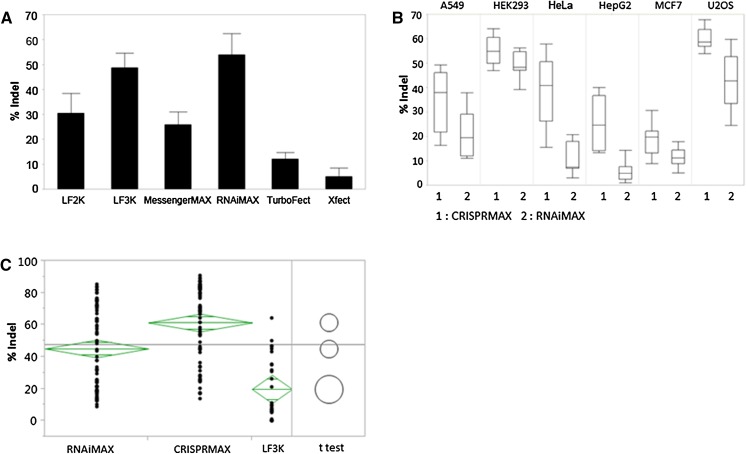
Fig. 1
Fig. 1
Identification of Lipofectamine CRISPRMAX. a One day prior to transfection, HEK293 and HCT116 were seeded on a 24 well plate at 105 cells per well. On the day of transfection, 500 ng Cas9 protein and 120 ng HPRT1 gRNA were transfected with either Lipofectamine 2000 (LF2K), Lipofectamine 3000 (LF3K), Lipofectamine MessengerMAX, Lipofectamine RNAiMAX, TurboFect or Xfect transfection reagent according to manufacturer’s protocol. At 48 h post-transfection, cells were harvested to perform genomic cleavage assays. The % of Indel was quantified using AlphaView software. The data was analyzed using JMP statistical software. The bar graph represented the mean and standard deviation of three independent experiments of two cell lines. b, c A549, HEK293, HepG2, HeLa, MCF-7 and U2OS were seeded on 96-well plates at approx. 20,000 cells per well and then transfected with 40 ng Cas9 protein and 8.5 ng HPRT gRNA using either Lipofectamine CRISPRMAX, Lipofectamine RNAiMAX or Lipofectamine 3000. After 48 h post-transfection, the cells were lysed and subjected to a genomic cleavage assay. The results were processed using JMP11 software. b was the Box Plot of Indel frequencies comparing Lipofectamine CRISPRMAX to Lipofectamine RNAiMAX in six different cell lines. c was one-way ANOVA analysis of % Indel by type of lipid with blocking of cell type. Each dot represented one experimental data point. The diamond represented the 95 % confidence interval for the mean of each group. The circles were visual representations of group mean comparisons using Student’s t-tests. The p value was less than 0.05
Fig. 2
Fig. 2
Activities of Cas9 RNP complexes and Cas9 RNP/Lipofectamine CRISPRMAX complexes. One day prior to transfection, cells were seeded on a 96 well plates. A master mixes of Cas9 RNP complexes and Lipofectamine CRISPRMAX were prepared in Opti-MEM media based upon 40 ng Cas9 protein, 8.5 ng gRNA, and 0.3 µl Lipofectamine CRISPRMAX per well. The incubation times of Cas9 RNP (a), Lipofectamine CRISPRMAX (b), and Cas9 RNP/Lipofectamine CRISPRMAX complexes (c) served as dependent variables. At the indicated time point, aliquots of Cas9 RNP complexes in Opti-MEM were added to aliquots of Lipofectamine CRISPRMAX solution and incubated for indicated time prior to addition to A549, HEK293, and HeLa cells, respectively. Upon 48 h post-transfection, the genome cleavage efficiencies were determined
Fig. 3
Fig. 3
Factors regulating transfection efficiencies. a A549, HEK293, HepG2, HeLa, MCF-7 and U2OS were seeded on 96-well plates at two cell densities and then transfected with either 40 ng Cas9 protein and 8.5 ng gRNA (1×), 80 ng Cas9 protein and 17 ng gRNA (2×) or 120 ng Cas9 protein and 25.5 ng gRNA (3×) using either 0.2 or 0.4 µl Lipofectamine CRISPRMAX. The editing efficiency was determined at 48 h post-transfection. The Indel percentage was determined using the AlphaView software and the resulting data was processed using JMP11 software. Analysis of variance (ANOVA) analysis of % Indel by dose of Cas9 RNP (a), cell density (b), and amount of transfection reagent (c) were carried out across six different cell lines. Each dot represented one data point, whereas the diamond represented the 95 % confidence interval. The circles were visual views of group mean comparisons using Student’s t-tests. The p value was less than 0.05
Fig. 4
Fig. 4
Cell toxicity using Lipofectamine CRISPRMAX. a Prior to transfection and at 48 h post-transfection, the morphologies of A549, HeLa, HEK293, and human epidermal keratinocytes (HEKa) were examined by an IncuCyte instrument, Essen BioScience Inc. (Ann Arbor, MI, USA). b Cell viabilities were measured by Trypan Blue staining before 0 and after 48 h post-transfection. c The genome modification efficiencies were determined at 48 h post-transfection
Fig. 5
Fig. 5
Co-delivery of Cas9 RNP and donor DNA. Various amount of a 97 bp single-stranded DNA oligonucleotide (ssDNA) or a 400 bp double-stranded DNA fragment (dsDNA) was co-delivered with Cas9 RNPs into a disrupted EmGFP stable cell line in 24-well culture plates. After 48 h post-transfection, the percentages of GFP positive cells were quantified using flow cytometric analysis. Delivery of Cas9 RNP or Cas9 plus donor DNA (Cas9/D) served as controls. The experiments were performed in triplicate

References

    1. Chu VT, Weber T, Wefers B, Wurst W, Sander S, Rajewsky K, Kühn R. Increasing the efficiency of homology-directed repair for CRISPR-Cas9-induced precise gene editing in mammalian cells. Nat Biotechnol. 2015;33:543–548. doi: 10.1038/nbt.3198. - DOI - PubMed
    1. Copolovici DM, Langel K, Eriste E, Langel Ü. Cell-penetrating peptides: design, synthesis, and applications. ACS Nano. 2014;8:1972–1994. doi: 10.1021/nn4057269. - DOI - PubMed
    1. D’Astolfo DS, Pagliero RJ, Pras A, Karthaus WR, Clevers H, Prasad V, Lebbink RJ, Rehmann H, Geijsen N. Efficient intracellular delivery of native proteins. Cell. 2015;161:674–690. doi: 10.1016/j.cell.2015.03.028. - DOI - PubMed
    1. Erazo-Oliveras A, Najjar K, Dayani L, Wang TY, Johnson GA, Pellois JP. Protein delivery into live cells by incubation with an endosomolytic agent. Nat Methods. 2014;11:861–867. doi: 10.1038/nmeth.2998. - DOI - PMC - PubMed
    1. Jo J, Hong S, Choi WY, Lee DR. Cell-penetrating peptide (CPP)-conjugated proteins is an efficient tool for manipulation of human mesenchymal stromal cells. Sci Rep. 2014;4:4378. - PMC - PubMed
