


Is the closest facility the one actually used? An assessment of travel time estimation based on mammography facilities
- PMID: 26892310
- PMCID: PMC4757990
- DOI: 10.1186/s12942-016-0039-7
Is the closest facility the one actually used? An assessment of travel time estimation based on mammography facilities
Abstract
Background: Characterizing geographic access depends on a broad range of methods available to researchers and the healthcare context to which the method is applied. Globally, travel time is one frequently used measure of geographic access with known limitations associated with data availability. Specifically, due to lack of available utilization data, many travel time studies assume that patients use the closest facility. To examine this assumption, an example using mammography screening data, which is considered a geographically abundant health care service in the United States, is explored. This work makes an important methodological contribution to measuring access--which is a critical component of health care planning and equity almost everywhere.
Method: We analyzed one mammogram from each of 646,553 women participating in the US based Breast Cancer Surveillance Consortium for years 2005-2012. We geocoded each record to street level address data in order to calculate travel time to the closest and to the actually used mammography facility. Travel time between the closest and the actual facility used was explored by woman-level and facility characteristics.
Results: Only 35% of women in the study population used their closest facility, but nearly three-quarters of women not using their closest facility used a facility within 5 min of the closest facility. Individuals that by-passed the closest facility tended to live in an urban core, within higher income neighborhoods, or in areas where the average travel times to work was longer. Those living in small towns or isolated rural areas had longer closer and actual median drive times.
Conclusion: Since the majority of US women accessed a facility within a few minutes of their closest facility this suggests that distance to the closest facility may serve as an adequate proxy for utilization studies of geographically abundant services like mammography in areas where the transportation networks are well established.
Figures
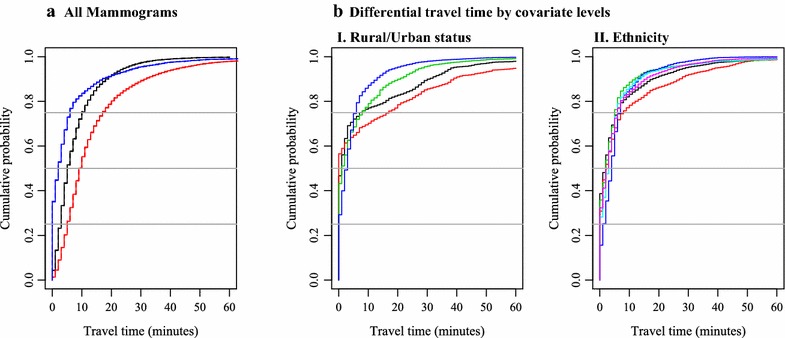
 Closest.
  Actual.
  Differential. bI
Large rural town. Small town/isolated rural.
Differential. bI
Large rural town. Small town/isolated rural.  Sub-urban. Urban core. bII
White, non-Hispanic. Black, non-Hispanic. Hispanic. Asian.
Sub-urban. Urban core. bII
White, non-Hispanic. Black, non-Hispanic. Hispanic. Asian.  Native American.
  Other
OtherReferences
Publication types
MeSH terms
Grants and funding
LinkOut - more resources
Full Text Sources
Other Literature Sources
Medical
