. 2016 Feb 18:15:100.
doi: 10.1186/s12936-016-1143-7.

Incremental impact upon malaria transmission of supplementing pyrethroid-impregnated long-lasting insecticidal nets with indoor residual spraying using pyrethroids or the organophosphate, pirimiphos methyl

Affiliations

Incremental impact upon malaria transmission of supplementing pyrethroid-impregnated long-lasting insecticidal nets with indoor residual spraying using pyrethroids or the organophosphate, pirimiphos methyl

Busiku Hamainza et al. Malar J. .

Abstract

Background: Long-lasting, insecticidal nets (LLINs) and indoor residual spraying (IRS) are the most widely accepted and applied malaria vector control methods. However, evidence that incremental impact is achieved when they are combined remains limited and inconsistent.

Methods: Fourteen population clusters of approximately 1000 residents each in Zambia's Luangwa and Nyimba districts, which had high pre-existing usage rates (81.7 %) of pyrethroid-impregnated LLINs were quasi-randomly assigned to receive IRS with either of two pyrethroids, namely deltamethrin [Wetable granules (WG)] and lambdacyhalothrin [capsule suspension (CS)], with an emulsifiable concentrate (EC) or CS formulation of the organophosphate pirimiphos methyl (PM), or with no supplementary vector control measure. Diagnostic positivity of patients tested for malaria by community health workers in these clusters was surveyed longitudinally over pre- and post-treatment periods spanning 29 months, over which the treatments were allocated and re-allocated in advance of three sequential rainy seasons.

Results: Supplementation of LLINs with PM CS offered the greatest initial level of protection against malaria in the first 3 months of application (incremental protective efficacy (IPE) [95 % confidence interval (CI)] = 0.63 [CI 0.57, 0.69], P < 0.001), followed by lambdacyhalothrin (IPE [95 % CI] = 0.31 [0.10, 0.47], P = 0.006) and PM EC (IPE, 0.23 [CI 0.15, 0.31], P < 0.001) and then by deltamethrin (IPE [95 % CI] = 0.19 [-0.01, 0.35], P = 0.064). Neither pyrethroid formulation provided protection beyond 3 months after spraying, but the protection provided by both PM formulations persisted undiminished for longer periods: 6 months for CS and 12 months for EC. The CS formulation of PM provided greater protection than the combined pyrethroid IRS formulations throughout its effective life IPE [95 % CI] = 0.79 [0.75, 0.83] over 6 months. The EC formulation of PM provided incremental protection for the first 3 months (IPE [95 % CI] = 0.23 [0.15, 0.31]) that was approximately equivalent to the two pyrethroid formulations (lambdacyhalothrin, IPE [95 % CI] = 0.31 [0.10, 0.47] and deltamethrin, IPE [95 % CI] = 0.19 [-0.01, 0.35]) but the additional protection provided by the former, apparently lasted an entire year.

Conclusion: Where universal coverage targets for LLIN utilization has been achieved, supplementing LLINs with IRS using pyrethroids may reduce malaria transmission below levels achieved by LLIN use alone, even in settings where pyrethroid resistance occurs in the vector population. However, far greater reduction of transmission can be achieved under such conditions by supplementing LLINs with IRS using non-pyrethroid insecticide classes, such as organophosphates, so this is a viable approach to mitigating and managing pyrethroid resistance.


Figures
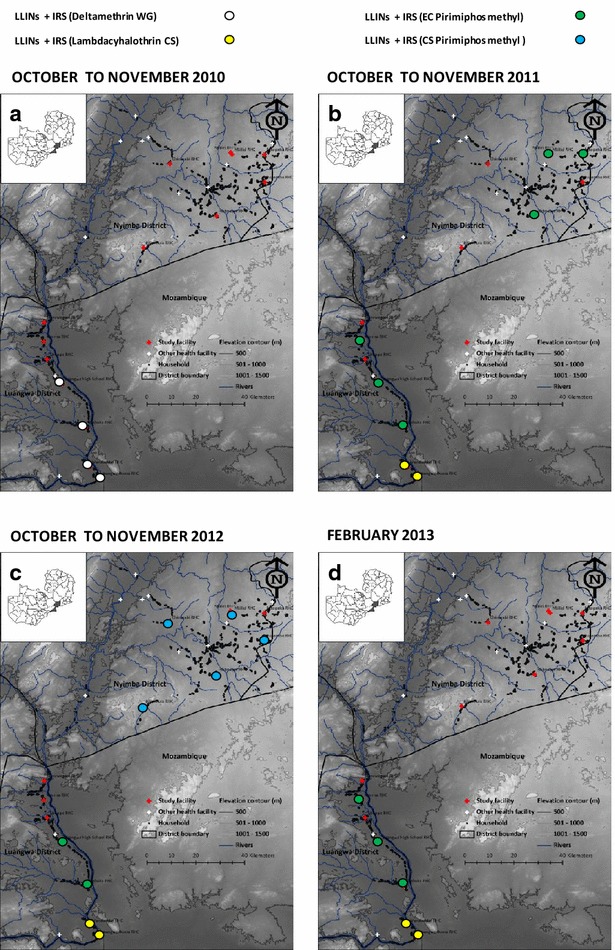
Fig. 1
Fig. 1
Map indicating location of health facilities and associated catchment populations enrolled in the study, with allocation of IRS treatments per cluster and year [a LLINs + IRS (deltamethrin WG); b LLINs + IRS (EC pirimiphos methyl or lambdacyhalothrin CS); c LLINs + IRS (EC pirimiphos methyl or CS pirimiphos methyl or lambdacyhalothrin CS); and d LLINs + IRS (EC pirimiphos methyl or lambdacyhalothrin CS)]
Fig. 2
Fig. 2
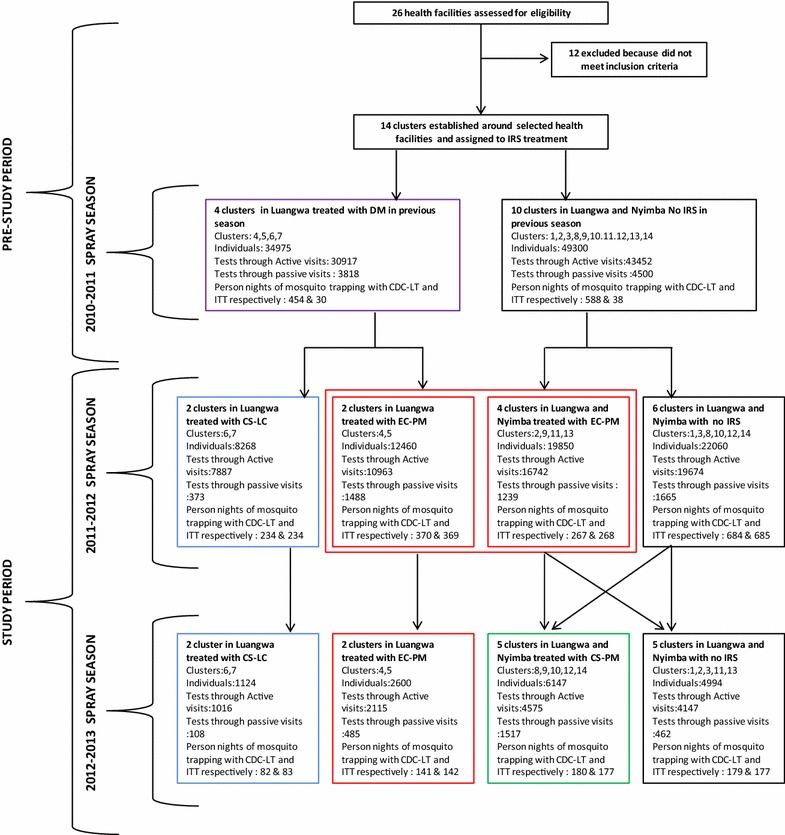
Study profile indicating treatments provided to each cluster with associated timelines, population surveyed and persons nights of mosquito trapping
Fig. 3
Fig. 3
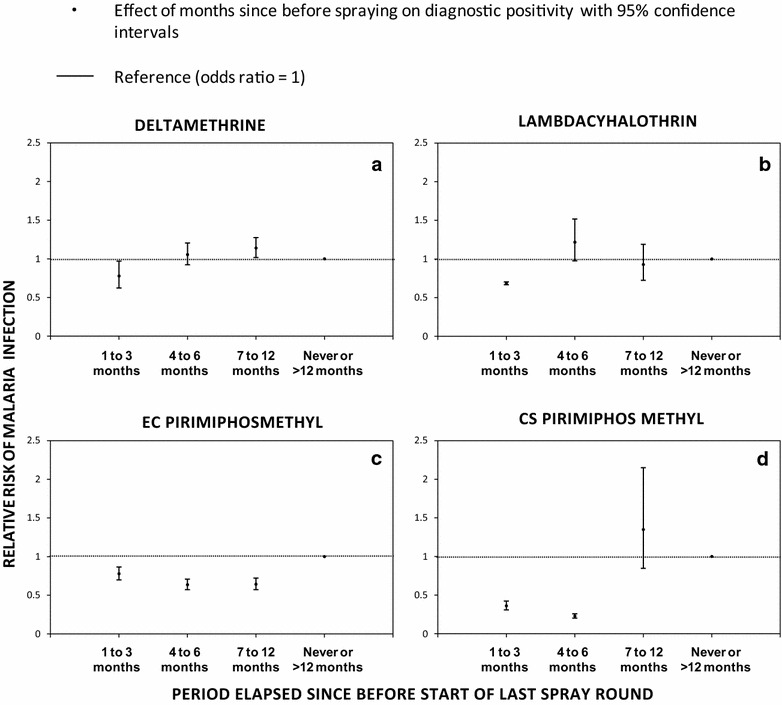
The incremental protective efficacy of each of the four IRS treatments on diagnostic positivity for Plasmodium falciparum malaria infection over several time periods since the last spray round began, relative to clusters that has either never been sprayed or had last been sprayed >12 months ago (reference group), estimated exactly as described in Table 1 (a deltamethrin, b lambdacyhalothrin, c EC pirimiphos methyl and d CS pirimiphos methyl)
Fig. 4
Fig. 4
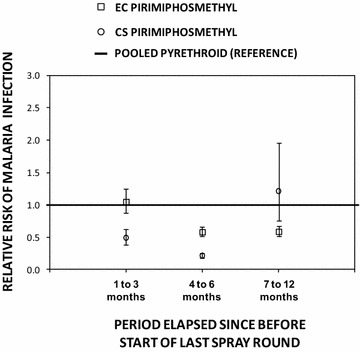
The incremental protective efficacy of pirimiphos methyl EC and CS IRS treatments on diagnostic positivity for Plasmodium falciparum malaria infection over several time periods since the last spray round began, relative to clusters that have been sprayed with either deltamethrin and/or lambdacyhalothrin (reference group), estimated exactly as described in Table 2, except that three separate models were fitted for the three different time periods since the last spray round began, and the combined pyrethroid formulations were treated as the reference group
Fig. 5
Fig. 5
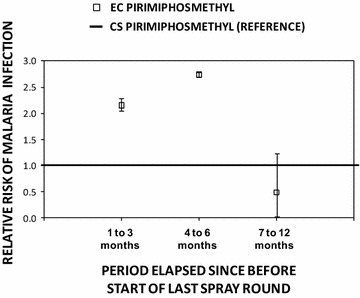
The incremental protective efficacy of pirimiphos methyl EC IRS treatment on diagnostic positivity for Plasmodium falciparum malaria infection over several time periods since the last spray round began, relative to clusters that have been sprayed with pirimiphos methyl EC (reference group), estimated exactly as described in Table 2, except that three separate models were fitted for the three different time periods since the last spray round began and the EC formulation of pirimiphos methyl was treated as the reference group
Fig. 6
Fig. 6
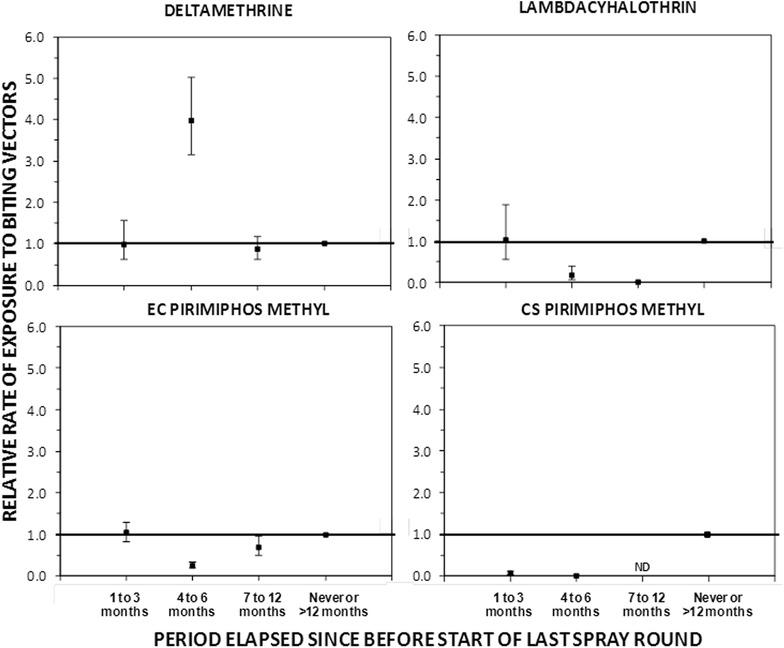
The incremental protective efficacy of each of the four IRS treatments against Anopheles funestus bites over several time periods since the last spray round began, relative to clusters that has either never been sprayed or had last been sprayed >12 months ago (reference group), estimated exactly as described in Table 3 (ND Not done)
Fig. 7
Fig. 7
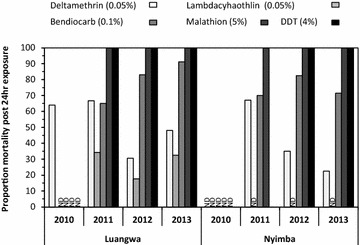
Insecticide resistance profile of Anopheles funestus in the study site from 2010 to 2013
Fig. 8
Fig. 8
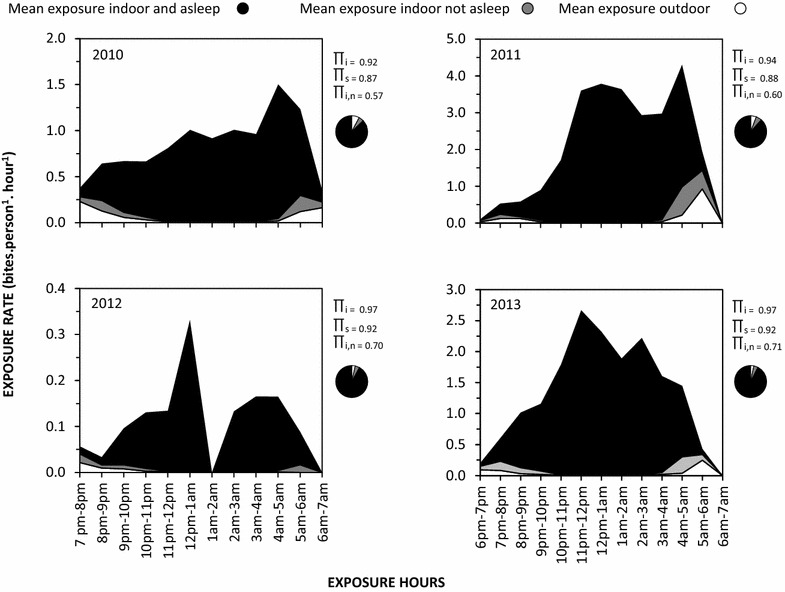
Mean exposure of humans to Anopheles funestus bites when they are indoors or outdoors where πi is the average proportion of human exposure to bites of the Anopheles funestus which occurs indoors in the absence of any protective measure, πs is the average proportion of human exposure to bites of the Anopheles funestus population which occurs indoors when individuals are asleep in the absence of any protective measure, and πi,n is the average proportion of residual human exposure for users of net which occurs indoors, calculated exactly as previously described [39]

References

    1. WHO. World Malaria Report2012. Geneva: World Health Organization. 2013.
    1. Killeen GF, Smith TA, Ferguson HM, Mshinda H, Abdulla S, Lengeler C, et al. Preventing childhood malaria in Africa by protecting adults from mosquitoes with insecticide-treated nets. PLoS Med. 2007;4:e229. doi: 10.1371/journal.pmed.0040229. - DOI - PMC - PubMed
    1. Koella JC, Sorensen FL, Anderson RA. The malaria parasite, Plasmodium falciparum, increases the frequency of multiple feeding of its mosquito vector, Anopheles gambiae. Proc Biol Sci. 1998;265:763–768. doi: 10.1098/rspb.1998.0358. - DOI - PMC - PubMed
    1. Lines JD, Myamba J, Curtis CF. Experimental hut trials of permethrin-impregnated mosquito nets and eave curtains against malaria vectors in Tanzania. Med Vet Entomol. 1987;1:37–51. doi: 10.1111/j.1365-2915.1987.tb00321.x. - DOI - PubMed
    1. Smith A, Webley DJ. A verandah-trap hut for studying the house-frequenting habits of mosquitoes and for assessing insecticides III. The effect of DDT on behaviour and mortality. Bull Entomol Res. 1968;59:33–46. doi: 10.1017/S000748530000300X. - DOI - PubMed

Publication types