


Developmental and Post-Eruptive Defects in Molar Enamel of Free-Ranging Eastern Grey Kangaroos (Macropus giganteus) Exposed to High Environmental Levels of Fluoride
- PMID: 26895178
- PMCID: PMC4760926
- DOI: 10.1371/journal.pone.0147427
Developmental and Post-Eruptive Defects in Molar Enamel of Free-Ranging Eastern Grey Kangaroos (Macropus giganteus) Exposed to High Environmental Levels of Fluoride
Abstract
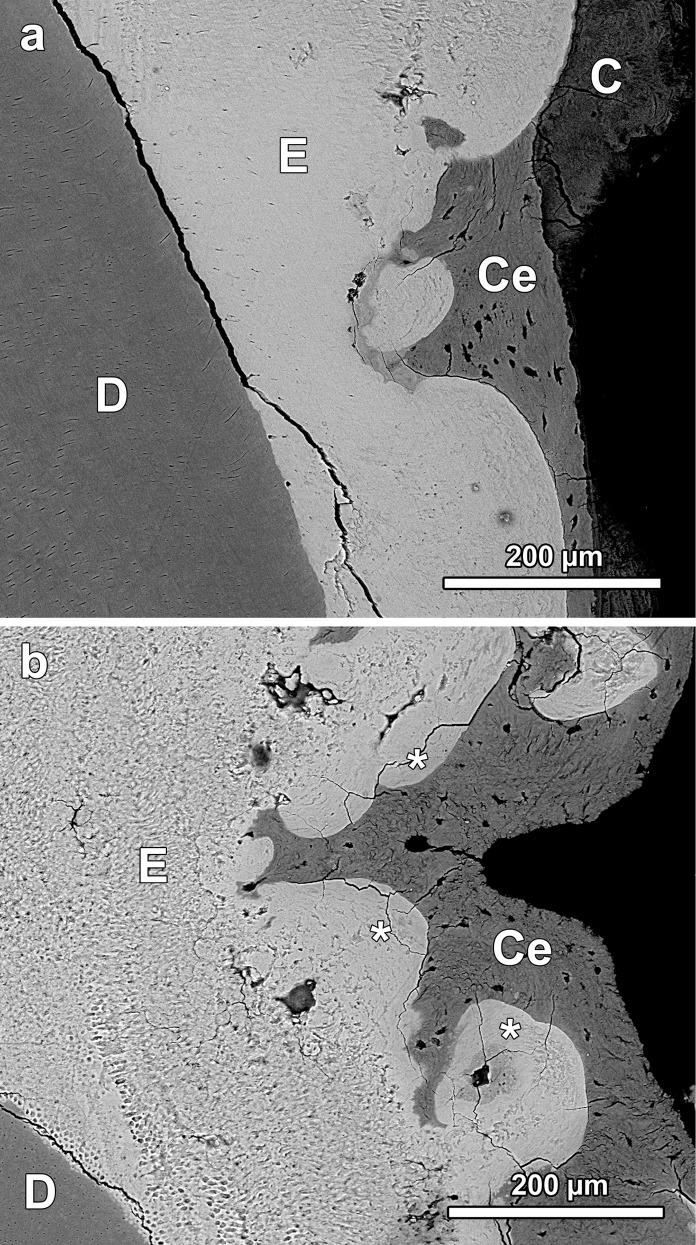
Dental fluorosis has recently been diagnosed in wild marsupials inhabiting a high-fluoride area in Victoria, Australia. Information on the histopathology of fluorotic marsupial enamel has thus far not been available. This study analyzed the developmental and post-eruptive defects in fluorotic molar enamel of eastern grey kangaroos (Macropus giganteus) from the same high-fluoride area using light microscopy and backscattered electron imaging in the scanning electron microscope. The fluorotic enamel exhibited a brownish to blackish discolouration due to post-eruptive infiltration of stains from the oral cavity and was less resistant to wear than normally mineralized enamel of kangaroos from low-fluoride areas. Developmental defects of enamel included enamel hypoplasia and a pronounced hypomineralization of the outer (sub-surface) enamel underneath a thin rim of well-mineralized surface enamel. While the hypoplastic defects denote a disturbance of ameloblast function during the secretory stage of amelogenesis, the hypomineralization is attributed to an impairment of enamel maturation. In addition to hypoplastic defects, the fluorotic molars also exhibited numerous post-eruptive enamel defects due to the flaking-off of portions of the outer, hypomineralized enamel layer during mastication. The macroscopic and histopathological lesions in fluorotic enamel of M. giganteus match those previously described for placental mammals. It is therefore concluded that there exist no principal differences in the pathogenic mechanisms of dental fluorosis between marsupial and placental mammals. The regular occurrence of hypomineralized, opaque outer enamel in the teeth of M. giganteus and other macropodids must be considered in the differential diagnosis of dental fluorosis in these species.
Conflict of interest statement
Figures



References
-
- Boyde A. Enamel In: Oksche A, Vollrath L (eds.) Handbook of microscopic anatomy vol V/6: Teeth. Berlin: Springer; 1989. pp 309–473.
-
- LeGeros RZ, Sakae T, Bautista C, Retino M, LeGeros JP. Magnesium and carbonate in enamel and synthetic apatites. Adv Dent Res. 1996; 10:225–231. - PubMed
-
- Hillson S. Teeth. Second edition Cambridge: Cambridge University Press; 2005.
-
- Pasteris JD, Wopenka B, Valsami-Jones E. Bone and tooth mineralization: why apatite? Elements. 2008; 4:97–104.
-
- Warshawsky H. The teeth In: Weiss L (ed.) Cell and Tissue Biology. Baltimore: Urban and Schwarzenberg; 1988. pp. 595–640.
Publication types
MeSH terms
Substances
LinkOut - more resources
Full Text Sources
Other Literature Sources
