


Prenatal Exposure to Perfluorocarboxylic Acids (PFCAs) and Fetal and Postnatal Growth in the Taiwan Maternal and Infant Cohort Study
- PMID: 26895313
- PMCID: PMC5089898
- DOI: 10.1289/ehp.1509998
Prenatal Exposure to Perfluorocarboxylic Acids (PFCAs) and Fetal and Postnatal Growth in the Taiwan Maternal and Infant Cohort Study
Abstract
Background: Perfluorocarboxylic acids (PFCAs) are environmentally and biologically persistent synthetic chemicals. PFCAs include perfluorooctanoic acid (PFOA; C8) and long-chain PFCAs (C9-C20). Studies examining long-chain PFCAs and fetal and postnatal growth are limited.
Objectives: We investigated the associations of prenatal exposure to long-chain PFCAs with fetal and postnatal growth.
Methods: For 223 Taiwanese mothers and their term infants, we measured PFOA and four long-chain PFCAs (ng/mL) in third-trimester maternal serum; infant weight (kg), length and head circumference (cm) at birth; and childhood weight and height at approximately 2, 5, 8, and 11 years of age. For each sex, we used multivariable linear regression to examine associations between ln-transformed prenatal PFCAs and continuous infant measures, and logistic regression to examine small for gestational age (SGA). Linear mixed models were applied to prenatal PFCAs and childhood weight and height z-scores.
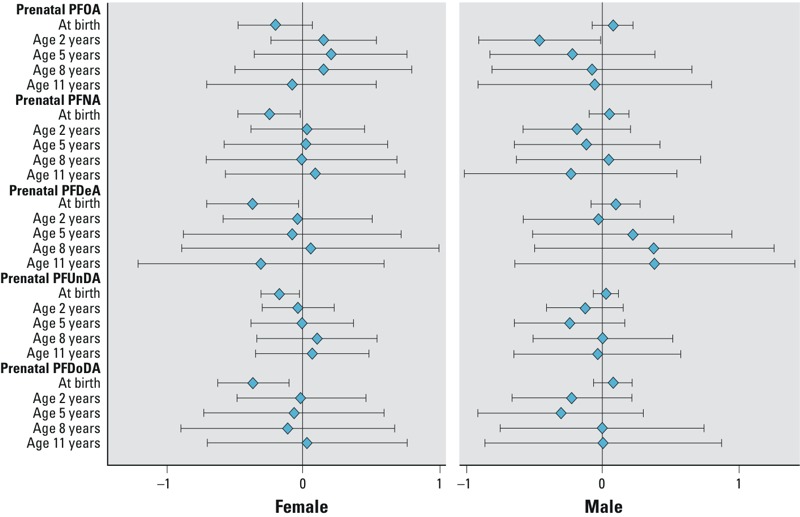
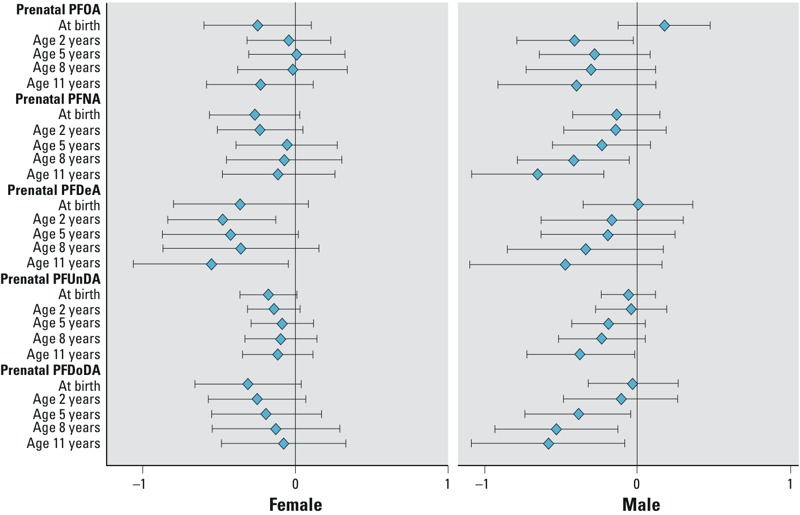
Results: In girls, prenatal perfluorononanoic acid (PFNA), perfluorodecanoic acid (PFDeA), perfluoroundecanoic acid (PFUnDA), and perfluorododecanoic acid (PFDoDA) concentrations were inversely associated with birth weight [e.g., βbirth weight (kg) = -0.06, 95% CI: -0.11, -0.01 per 1 ln-unit PFUnDA increase]; prenatal PFDeA and PFUnDA were associated with elevated odds of SGA; and PFDeA, PFUnDA, and PFDoDA were associated with lower average childhood height z-score. In boys, prenatal PFNA, and PFDoDA were associated with reductions in height at certain ages in childhood, but not with size at birth.
Conclusions: Prenatal exposure to long-chain PFCAs may interfere with fetal and childhood growth in girls, and childhood growth in boys. Citation: Wang Y, Adgent M, Su PH, Chen HY, Chen PC, Hsiung CA, Wang SL. 2016. Prenatal exposure to perfluorocarboxylic acids (PFCAs) and fetal and postnatal growth in the Taiwan Maternal and Infant Cohort Study. Environ Health Perspect 124:1794-1800; http://dx.doi.org/10.1289/ehp.1509998.
Conflict of interest statement
The authors declare they have no actual or potential competing financial interests.
Figures
References
-
- Axmon A, Axelsson J, Jakobsson K, Lindh CH, Jönsson BA. Time trends between 1987 and 2007 for perfluoroalkyl acids in plasma from Swedish women. Chemosphere. 2014;102:61–67. - PubMed
-
- Chen W, Chang MH. New growth charts for Taiwanese children and adolescents based on World Health Organization standards and health-related physical fitness. Pediatr Neonatol. 2010;51:69–79. - PubMed
-
- Clifton VL. Review: sex and the human placenta: mediating differential strategies of fetal growth and survival. Placenta. 2010;33(suppl):S33–S39. - PubMed
MeSH terms
Substances
LinkOut - more resources
Full Text Sources
Other Literature Sources
Medical
Research Materials
Miscellaneous