


Racial and Ethnic Disparities in Early Childhood Obesity: Growth Trajectories in Body Mass Index
- PMID: 26896112
- PMCID: PMC4761404
- DOI: 10.1007/s40615-015-0122-y
Racial and Ethnic Disparities in Early Childhood Obesity: Growth Trajectories in Body Mass Index
Abstract
Objective: The aims of this study are to describe growth trajectories in the body mass index (BMI) among the major racial and ethnic groups of US children and to identify predictors of children's BMI trajectories.
Methods: The Early Childhood Longitudinal Study-Birth Cohort (ECLS-B) was used to identify predictors of BMI growth trajectories, including child characteristics, maternal attributes, home practices related to diet and social behaviors, and family sociodemographic factors. Growth models, spanning 48 to 72 months of age, were estimated with hierarchical linear modeling via STATA/Xtmixed methods.
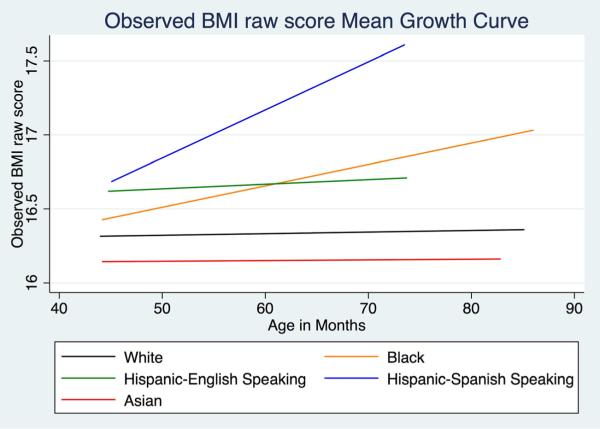
Results: Approximately one-third of 4-year-old females and males were overweight and/or obese. African-American and Latino children displayed higher predicted mean BMI scores and differing mean BMI trajectories, compared with White children, adjusting for time-independent and time-dependent predictors. Several factors were significantly associated with lower mean BMI trajectories, including very low birth weight, higher maternal education level, residing in a two-parent household, and breastfeeding during infancy. Greater consumption of soda and fast food was associated with higher mean BMI growth. Soda consumption was a particularly strong predictor of mean BMI growth trajectory for young Black children. Neither the child's inactivity linked to television viewing nor fruit nor vegetable consumption was predictive of BMI growth for any racial/ethnic group.
Conclusion: Significant racial and ethnic differences are discernible in BMI trajectories among young children. Raising parents' and health practitioners' awareness of how fast food and sweetened-beverage consumption contributes to early obesity and growth in BMI-especially for Blacks and Latinos-could improve the health status of young children.
Keywords: BMI; Early childhood; Ethnic disparities; Fast-food; Obesity; Soda consumption.
Figures
References
-
- Ogden CL, Carroll MD, Flegal KM. High body mass index for age among US children and adolescents, 2003-2006. JAMA. 2008;299(20):2401–5. - PubMed
-
- Anderson SE, Whitaker RC. Prevalence of obesity among US pre-school children in different racial and ethnic groups. Arch Pediatr Adolesc Med. 2009;163(4):344–8. - PubMed
-
- Singh GK, et al. Racial/ethnic, socioeconomic, and behavioral determinants of childhood and adolescent obesity in the United States: analyzing independent and joint associations. Ann Epidemiol. 2008;18(9):682–95. - PubMed
Publication types
MeSH terms
Grants and funding
LinkOut - more resources
Full Text Sources
Other Literature Sources
Medical