. 2016 Apr;202(4):1365-75.
doi: 10.1534/genetics.115.184218. Epub 2016 Feb 19.

Conserved and Diverged Functions of the Calcineurin-Activated Prz1 Transcription Factor in Fission Yeast

Affiliations

Conserved and Diverged Functions of the Calcineurin-Activated Prz1 Transcription Factor in Fission Yeast

Kate Chatfield-Reed et al. Genetics. 2016 Apr.

Abstract

Gene regulation in response to intracellular calcium is mediated by the calcineurin-activated transcription factor Prz1 in the fission yeast Schizosaccharomyces pombe Genome-wide studies of the Crz1 and CrzA fungal orthologs have uncovered numerous target genes involved in conserved and species-specific cellular processes. In contrast, very few target genes of Prz1 have been published. This article identifies an extensive list of genes using transcriptome and ChIP-chip analyses under inducing conditions of Prz1, including CaCl2 and tunicamycin treatment, as well as a ∆pmr1 genetic background. We identified 165 upregulated putative target genes of Prz1 in which the majority contained a calcium-dependent response element in their promoters, similar to that of the Saccharomyces cerevisiae ortholog Crz1 These genes were functionally enriched for Crz1-conserved processes such as cell-wall biosynthesis. Overexpression of prz1(+)increased resistance to the cell-wall degradation enzyme zymolyase, likely from upregulation of theO-mannosyltransferase encoding gene omh1(+) Loss of omh1(+)abrogates this phenotype. We uncovered a novel inhibitory role in flocculation for Prz1. Loss of prz1(+)resulted in constitutive flocculation and upregulation of genes encoding the flocculins Gsf2 and Pfl3, as well as the transcription factor Cbf12. The constitutive flocculation of the ∆prz1 strain was abrogated by the loss of gsf2(+) or cbf12(+) This study reveals that Prz1 functions as a positive and negative transcriptional regulator of genes involved in cell-wall biosynthesis and flocculation, respectively. Moreover, comparison of target genes between Crz1/CrzA and Prz1 indicate some conservation in DNA-binding specificity, but also substantial rewiring of the calcineurin-mediated transcriptional regulatory network.

Keywords: calcium; cell wall; fission yeast; flocculation; transcription factor.


Figures

Figure 1
Figure 1
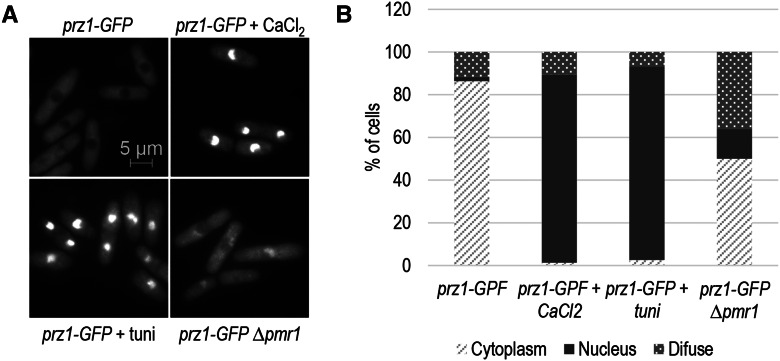
Intracellular localization of endogenously controlled Prz1-GFP. (A) Wild-type cells expressing endogenously controlled Prz1-GFP were exponentially grown in YES medium (top left) and treated with 0.15 M CaCl2 (top right) or 2.5 µg/ml tunicamycin (bottom left) for 0.5 and 1.5 hr, respectively. The intracellular localization of endogenously controlled Prz1-GFP in ∆pmr1 cells grown in rich medium (bottom right). (B) Bar graph showing the percentage of cells in each category of Prz1-GFP localization from A. The data are from three replicates of ∼100 cells each.
Figure 2
Figure 2
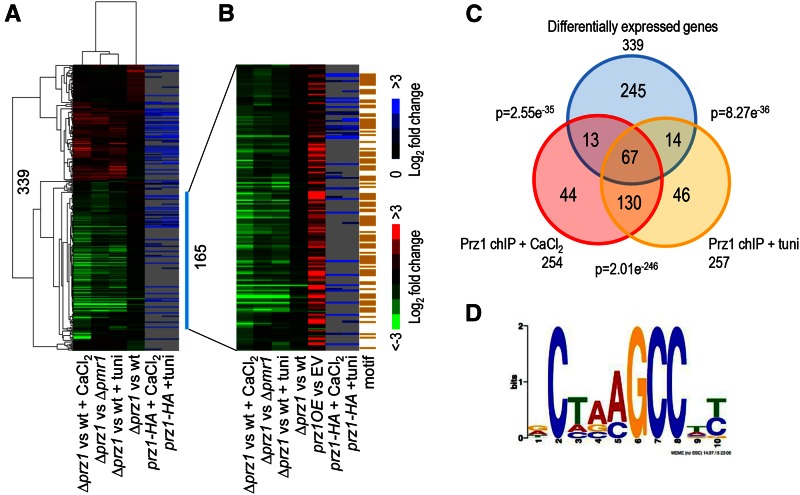
Identification of Prz1 target genes by transcriptome and ChIP-chip profiling. (A) The heat map shows two-dimensional hierarchical clustering of 339 genes that were differentially expressed by at least twofold in at least one of the microarray experiments. The first four columns of the heat map compare transcriptomes of the following conditions: the ∆prz1 strain and wild type, the ∆prz1 strain and wild type supplemented with 0.15 M CaCl2 for 0.5 hr, the ∆prz1 strain and wild type supplemented with 2.5 µg/ml tunicamycin for 1.5 hr, and the ∆prz1 strain compared to the ∆pmr1 strain. All of the above experiments were performed in rich medium. In the heat map, genes upregulated and downregulated in the ∆prz1 strain relative to the control are indicated in red and green, respectively. The two rightmost columns in the heat map show ChIP-chip analysis of a prz1-HA strain treated with 0.15 M CaCl2 or 2.5 µg/ml tunicamycin for 0.5 and 1.5 hr, respectively. (B) The heat map shows the expression profiles of 165 putative target genes that are positively regulated by Prz1. The first four columns of the heat map match the expression data from A while the fifth column shows the expression profiles of the same target genes upregulated in a prz1+ overexpression strain compared to the empty vector (EV) control. The next two columns in the heat map show ChIP-chip analysis of a prz1-HA strain treated with 0.15 M CaCl2 or 2.5 µg/ml tunicamycin for 0.5 and 1.5 hr, respectively. The rightmost column of the heat map shows the 91 genes containing the CDRE motif within their promoter in orange. The color bars indicate relative expression and ChIP enrichment ratios between experimental and control strains. All microarray expression and ChIP-chip experiments were performed in replicate with dye reversal. (C) The Venn diagram shows the overlap between the 339 differentially expressed genes in the transcriptome experiments and the genes identified from the ChIP-chip analysis with Prz1 promoter occupancy in the presence of CaCl2 or tunicamycin. The significance of the overlap is indicated as P-values that were determined using a hypergeometric distribution. (D) A DNA motif generated by MEME from promoter analysis of the 165 putative target genes of Prz1. This motif is similar to the CDRE motif (5′-AGCCTC-3′) previously discovered in Deng et al. (2006).
Figure 3
Figure 3
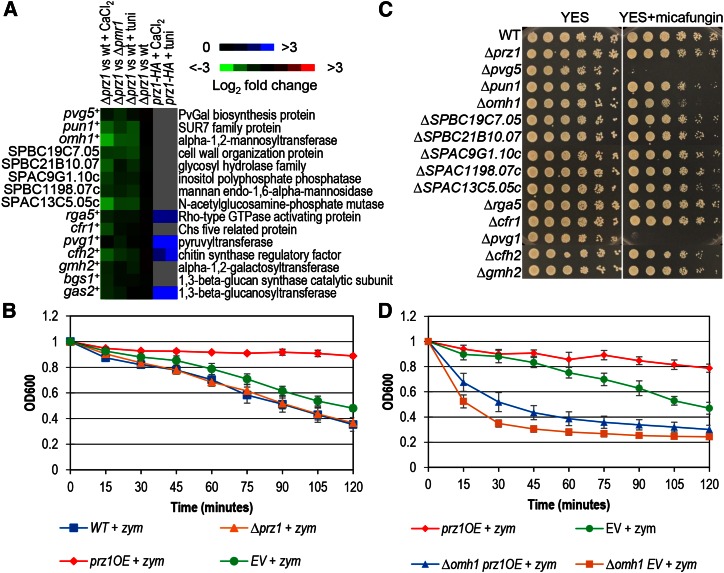
Characterization of putative target genes of Prz1 implicated in cell-wall-related processes. (A) The heat map shows relative expression and Prz1 promoter occupancy for 15 putative target genes annotated to function in cell-wall organization or biogenesis. The color bars indicate relative expression and ChIP enrichment ratios between experimental and control strains. All microarray expression and ChIP-chip experiments were performed in replicate with dye reversal. (B) Cell-wall degradation assays. Wild-type and ∆prz1 strains were grown in liquid YES medium, while nmt1-driven prz1+ or empty vector (EV) were grown in liquid EMM minus thiamine for 18–24 hr. The samples were adjusted to matching cell densities and transferred to test tubes in the presence of 25 U/ml Zymolyase 100T. The samples were shaken at 37°, and OD600 readings were taken every 15 min to assess the degree of cell-wall degradation. Overexpression of prz1+ caused resistance to the cell-wall-degrading enzyme zymolyase (P = 1.0e−4) while Δprz1 cells did not show significant sensitivity to zymolyase compared to wild type. (C) Spot dilution for micafungin sensitivity of deletion strains of the putative Prz1 target genes involved in cell-wall-related processes. Exponentially growing wild-type and deletion strains were pinned on solid YES medium containing 0.5 µg/ml micafungin and incubated at 30° for 3 days. (D) Cell-wall degradation assays. The Δomh1 strain was more sensitive to zymolyase treatment than wild type (P = 1.6e−2). The zymolyase-resistant phenotype from overexpression of prz1+ was abrogated by loss of omh1+ (P = 5.0e−4). The zymolyase experiments were repeated in triplicate, and error bars represent the standard error. The P-values were determined with ANOVA followed by a two-tailed t-test after 2 hr of zymolyase treatment.
Figure 4
Figure 4
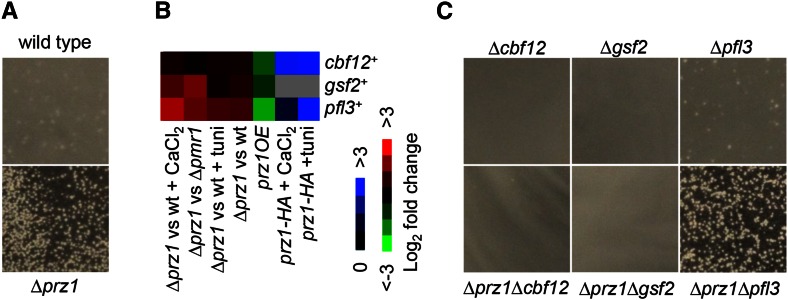
Constitutive flocculation of the ∆prz1 strain. (A) Wild type and the ∆prz1 strain were grown at an initial cell density of ∼107 cells/ml in liquid YES medium for 24 hr at 30° and assayed for flocculation. (B) Negative regulation of flocculation genes by Prz1. The heat map shows relative expression and Prz1 promoter occupancy for the flocculation genes cbf12+, gsf2+, and pfl3+. The color bars indicate relative expression and ChIP enrichment ratios between experimental and control strains. All microarray expression and ChIP-chip experiments were performed in replicate with dye reversal. (C) The ∆prz1 flocculation phenotype was abolished by loss of cbf12+ or gsf2+. Cells were assayed for flocculation as described for A.

References

    1. Andreishcheva E. N., Kunkel J. P., Gemmill T. R., Trimble R. B., 2004. Five genes involved in biosynthesis of the pyruvylated Galβ1,3-epitope in Schizosaccharomyces pombe N-linked glycans. J. Biol. Chem. 279: 35644–35655. - PubMed
    1. Araki Y., Wu H., Kitagaki H., Akao T., Takagi H., et al. , 2009. Ethanol stress stimulates the Ca2+-mediated calcineurin/Crz1 pathway in Saccharomyces cerevisiae. J. Biosci. Bioeng. 107: 1–6. - PubMed
    1. Bailey T. L., Elkan C., 1994. Fitting a mixture model by expectation maximization to discover motifs in biopolymers. Proc. Sec. Int. Conf. Intell. Syst. Mol. Biol. 2: 28–36. - PubMed
    1. Bodvard K., Jörhov A., Blomberg A., Molin M., Käll M., 2013. The yeast transcription factor Crz1 is activated by light in a Ca2+/calcineurin-dependent and PKA-independent manner. PLoS One 8: e53404. - PMC - PubMed
    1. Boyle E. I., Weng S., Gollub J., Jin H., Botstein D., et al. , 2004. GO:TermFinder-open source software for accessing Gene Ontology information and finding significantly enriched Gene Ontology terms associated with a list of genes. Bioinformatics 20: 3710–3715. - PMC - PubMed

Publication types

MeSH terms